University of Pittsburgh, Pittsburgh, PA.
San Diego State University, San Diego, CA.
Depress Anxiety. 2017 Dec;34(12):1106-1115. doi: 10.1002/da.22634. Epub 2017 Apr 28.
The past decade of research has seen considerable interest in computer-based approaches designed to directly target cognitive mechanisms of anxiety, such as attention bias modification (ABM).
By pooling patient-level datasets from randomized controlled trials of ABM that utilized a dot-probe training procedure, we assessed the impact of training "dose" on relevant outcomes among a pooled sample of 693 socially anxious adults.
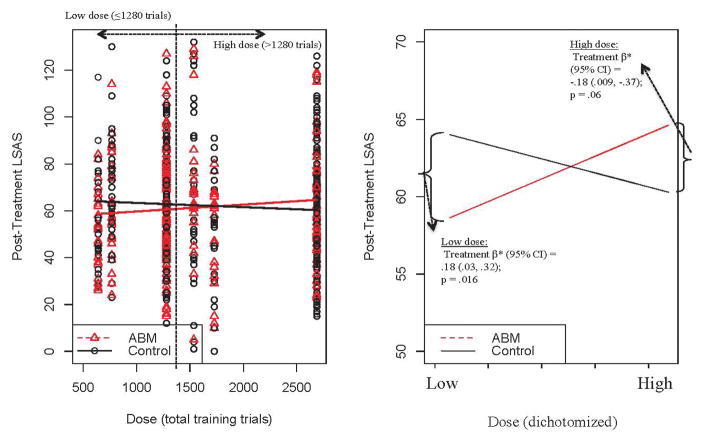
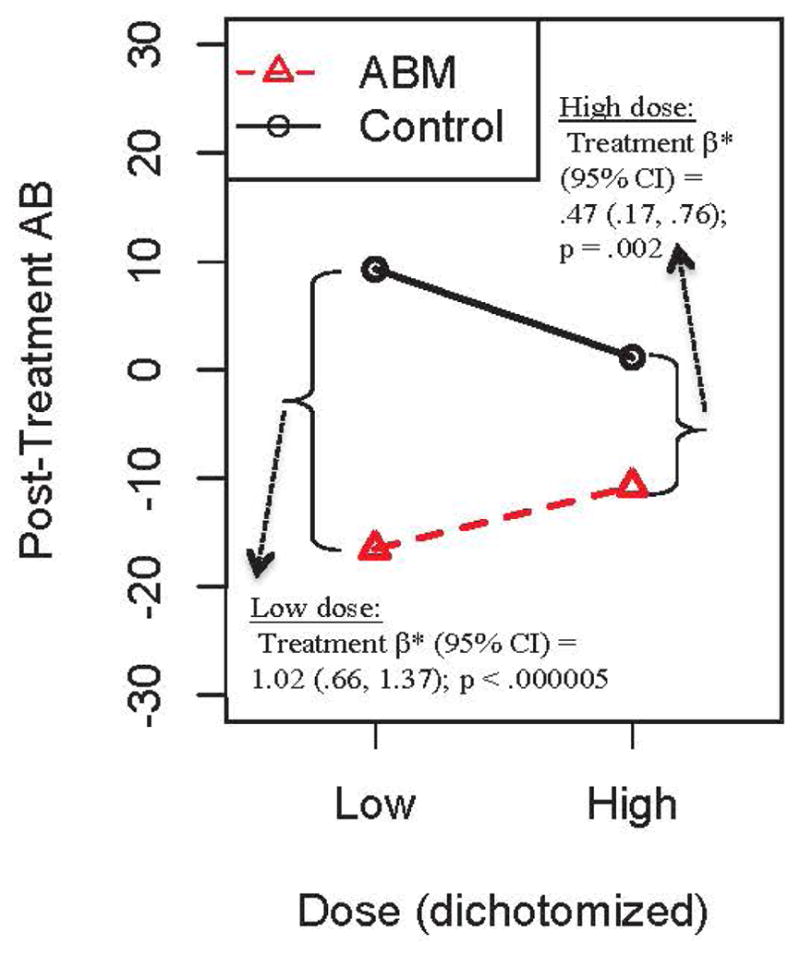
A paradoxical effect of the number of training trials administered was observed for both posttraining social anxiety symptoms and behavioral attentional bias (AB) toward threat (the target mechanism of ABM). Studies administering a large (>1,280) number of training trials showed no benefit of ABM over control conditions, while those administering fewer training trials showed significant benefit for ABM in reducing social anxiety (P = .02). These moderating effects of dose were not better explained by other examined variables and previously identified moderators, including patient age, training setting (laboratory vs. home), or type of anxiety assessment (clinician vs. self-report).
Findings inform the optimal dosing for future dot-probe style ABM applications in both research and clinical settings, and suggest several novel avenues for further research.
过去十年的研究对旨在直接针对焦虑认知机制(如注意偏向修正)的基于计算机的方法产生了浓厚兴趣。
通过汇集使用点探测训练程序的注意偏向修正(ABM)随机对照试验的患者水平数据集,我们评估了在 693 名社交焦虑成年人的合并样本中,“剂量”对相关结果的影响。
在训练后社交焦虑症状和对威胁的行为注意偏向(ABM 的目标机制)方面,观察到训练试验次数的增加出现了一种矛盾的效果。给予大量(>1280)训练试验的研究显示 ABM 对照条件没有益处,而给予较少训练试验的研究显示 ABM 在减少社交焦虑方面有显著益处(P =.02)。这些剂量的调节效应不能通过其他检查变量和先前确定的调节剂更好地解释,包括患者年龄、训练环境(实验室与家庭)或焦虑评估类型(临床医生与自我报告)。
这些发现为未来的研究和临床环境中基于点探测的 ABM 应用提供了最佳剂量,同时也为进一步的研究提供了一些新的途径。