Dingwell Jonathan B, Salinas Mandy M, Cusumano Joseph P
Department of Kinesiology & Health Education, University of Texas, Austin, TX 78712, United States.
Department of Kinesiology & Health Education, University of Texas, Austin, TX 78712, United States.
Gait Posture. 2017 Jun;55:131-137. doi: 10.1016/j.gaitpost.2017.03.018. Epub 2017 Mar 31.
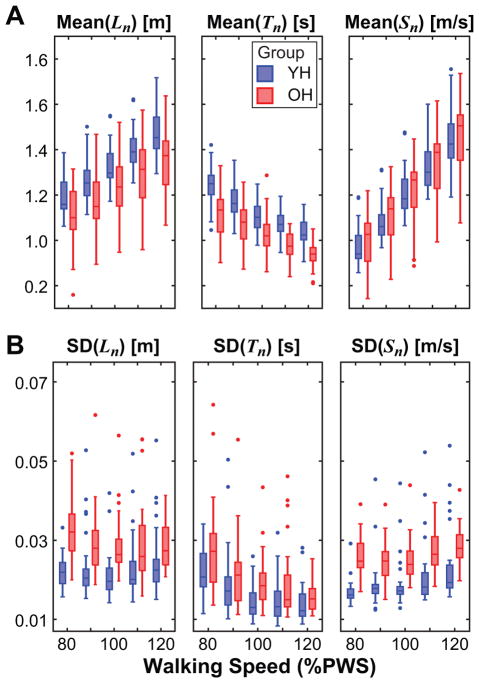
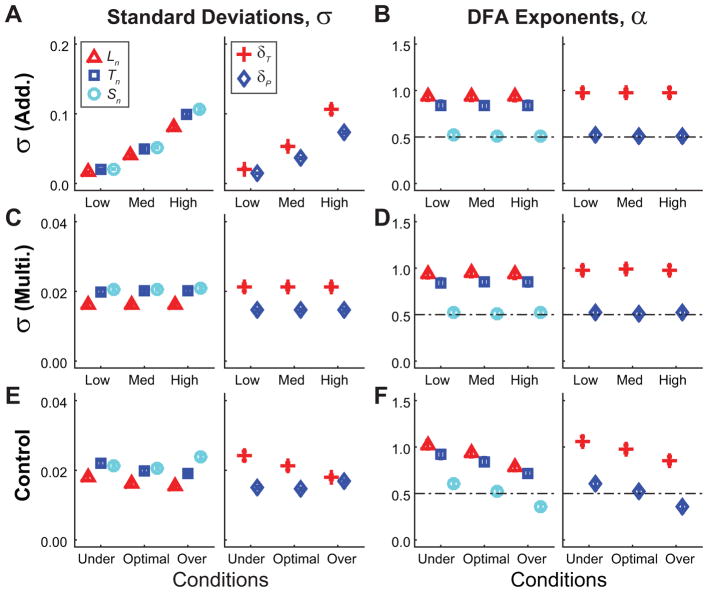
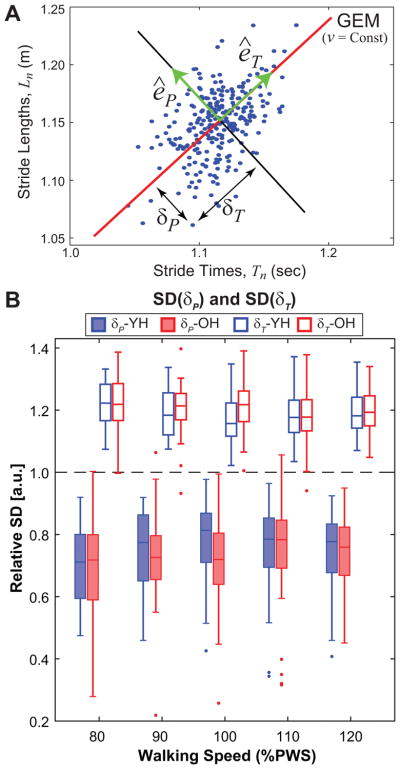
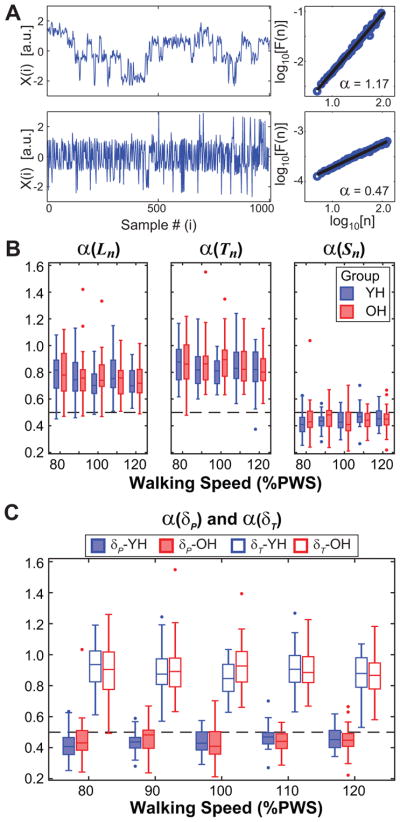
Older adults exhibit increased gait variability that is associated with fall history and predicts future falls. It is not known to what extent this increased variability results from increased physiological noise versus a decreased ability to regulate walking movements. To "walk", a person must move a finite distance in finite time, making stride length (L) and time (T) the fundamental stride variables to define forward walking. Multiple age-related physiological changes increase neuromotor noise, increasing gait variability. If older adults also alter how they regulate their stride variables, this could further exacerbate that variability. We previously developed a Goal Equivalent Manifold (GEM) computational framework specifically to separate these causes of variability. Here, we apply this framework to identify how both young and high-functioning healthy older adults regulate stepping from each stride to the next. Healthy older adults exhibited increased gait variability, independent of walking speed. However, despite this, these healthy older adults also concurrently exhibited no differences (all p>0.50) from young adults either in how their stride variability was distributed relative to the GEM or in how they regulated, from stride to stride, either their basic stepping variables or deviations relative to the GEM. Using a validated computational model, we found these experimental findings were consistent with increased gait variability arising solely from increased neuromotor noise, and not from changes in stride-to-stride control. Thus, age-related increased gait variability likely precedes impaired stepping control. This suggests these changes may in turn precede increased fall risk.
老年人表现出步态变异性增加,这与跌倒史相关,并可预测未来的跌倒情况。目前尚不清楚这种增加的变异性在多大程度上是由生理噪声增加还是步行运动调节能力下降所致。为了“行走”,一个人必须在有限的时间内移动有限的距离,使得步长(L)和时间(T)成为定义向前行走的基本步幅变量。多种与年龄相关的生理变化会增加神经运动噪声,从而增加步态变异性。如果老年人还改变了他们调节步幅变量的方式,这可能会进一步加剧这种变异性。我们之前专门开发了一种目标等效流形(GEM)计算框架,以区分这些变异性的原因。在这里,我们应用这个框架来确定年轻和功能良好的健康老年人如何调节从每一步到下一步的迈步。健康的老年人表现出步态变异性增加,与步行速度无关。然而,尽管如此,这些健康的老年人在步幅变异性相对于GEM的分布方式上,或者在他们逐步行调节基本迈步变量或相对于GEM的偏差方面,与年轻人相比也没有差异(所有p>0.50)。使用经过验证的计算模型,我们发现这些实验结果与仅由神经运动噪声增加而非步间控制变化引起的步态变异性增加是一致的。因此,与年龄相关的步态变异性增加可能先于迈步控制受损。这表明这些变化可能反过来先于跌倒风险增加。