Qi Honggang, Fu Xinyang, Li Yeping, Pang Xiang, Chen Sansan, Zhu Xiaojun, Li Fei, Tan Wanlong
Department of Urology, Nanfang Hospital, Southern Medical University, Guangzhou, Guangdong 510515, P.R. China.
Department of Urology, Ningbo Urology and Nephrology Hospital, Ningbo, Zhejiang 315100, P.R. China.
Oncol Lett. 2017 Apr;13(4):2577-2582. doi: 10.3892/ol.2017.5765. Epub 2017 Feb 22.
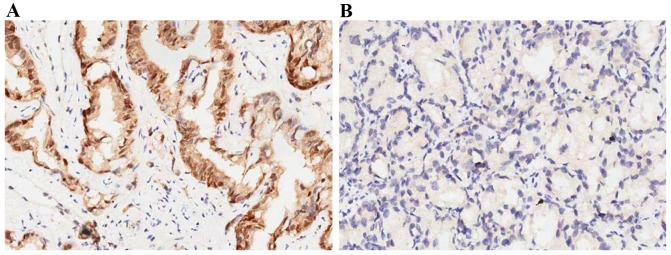
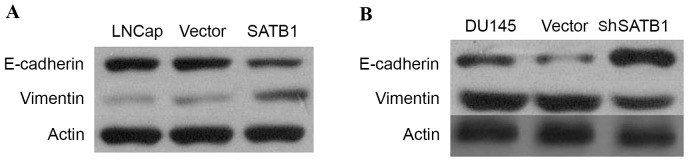
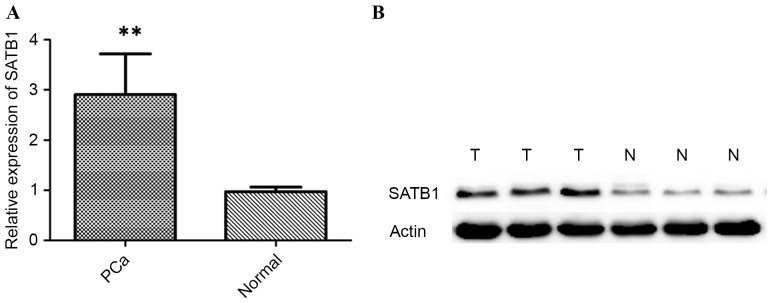
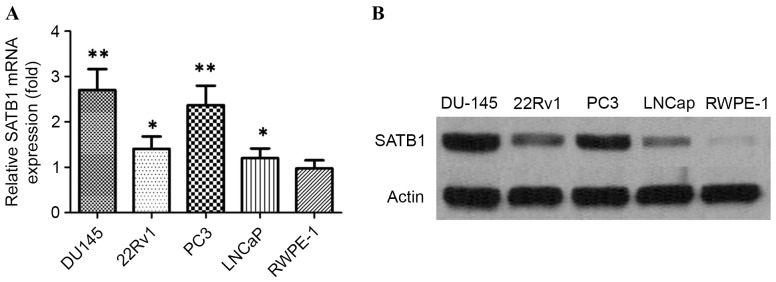
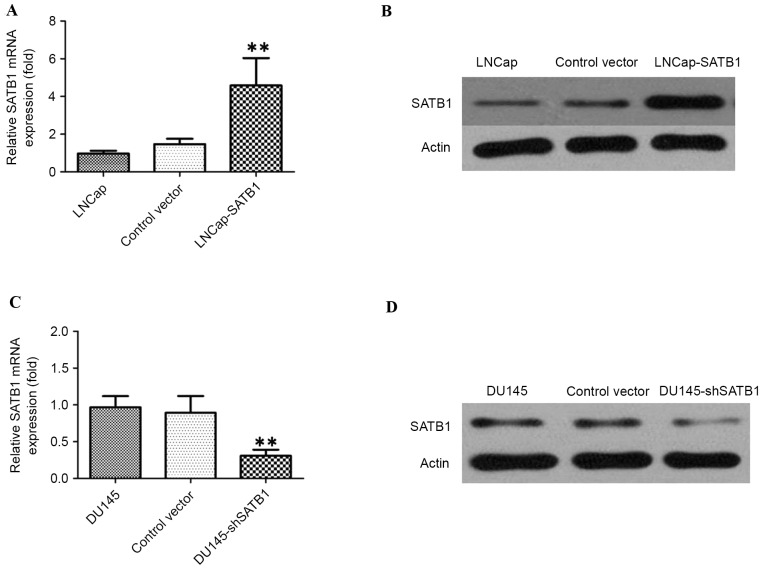
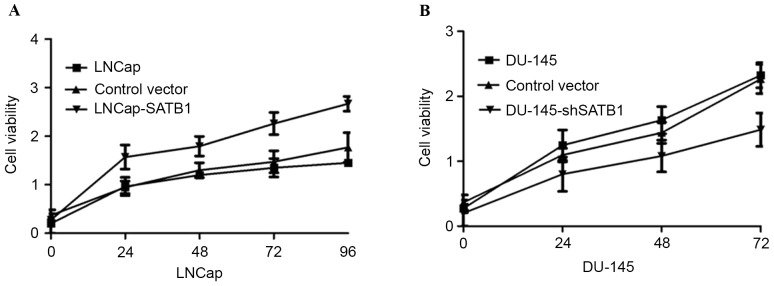
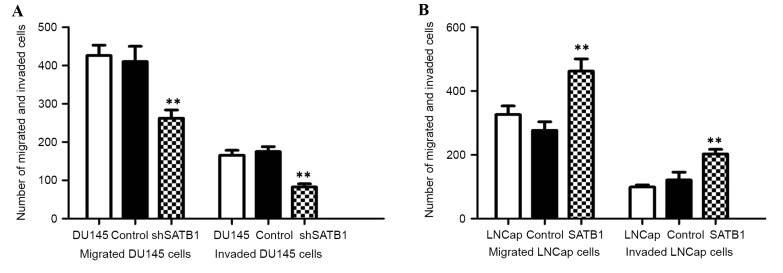
Special AT-rich sequence-binding protein-1 (SATB1) is associated with cancer progression and poor clinical outcome. The present study aims to evaluate whether SATB1 affects the biological behaviors of prostate cancer (PCa), and furthermore, to elucidate whether this effect works through the epithelial-mesenchymal transition (EMT) pathway. Firstly, the expression of SATB1 was investigated in a series of PCa tissues as well as in a panel of PCa cell lines. Cell proliferation, migration and invasion were evaluated in SATB1 knockdown and overexpressed PCa cell lines by MTT and Transwell assays. The results showed that the expression of SATB1 was markedly upregulated in PCa tissues and all PCa cell lines (P<0.001). Ectopic expression of SATB1 promoted PCa cell proliferation and migration. Knockdown of SATB1 repressed the ability of cell proliferation and migration of PCa cells. In addition, inhibition of SATB1 could reverse the EMT processes through upregulation of E-cadherin and downregulation of vimentin. The present study provided evidence that SATB1 may act as a potential therapeutic target in PCa patients.
富含AT序列结合蛋白1(SATB1)与癌症进展及不良临床预后相关。本研究旨在评估SATB1是否影响前列腺癌(PCa)的生物学行为,此外,阐明这种影响是否通过上皮-间质转化(EMT)途径起作用。首先,在一系列PCa组织以及一组PCa细胞系中研究SATB1的表达。通过MTT和Transwell实验评估SATB1敲低和过表达的PCa细胞系中的细胞增殖、迁移和侵袭。结果显示,SATB1在PCa组织和所有PCa细胞系中的表达均显著上调(P<0.001)。SATB1的异位表达促进PCa细胞增殖和迁移。敲低SATB1可抑制PCa细胞的增殖和迁移能力。此外,抑制SATB1可通过上调E-钙黏蛋白和下调波形蛋白来逆转EMT过程。本研究提供了证据表明SATB1可能作为PCa患者的潜在治疗靶点。