Sun Lu, Liu Tianhua, Zhang Shu, Guo Kun, Liu Yinkun
Liver Cancer Institute, Zhongshan Hospital, Key Laboratory of Carcinogenesis and Cancer Invasion, Fudan University, Ministry of Education, Shanghai 200032, P.R. China.
Institute of Biomedical Sciences, Fudan University, Shanghai 200032, P.R. China.
Oncol Lett. 2017 Apr;13(4):2599-2606. doi: 10.3892/ol.2017.5788. Epub 2017 Feb 28.
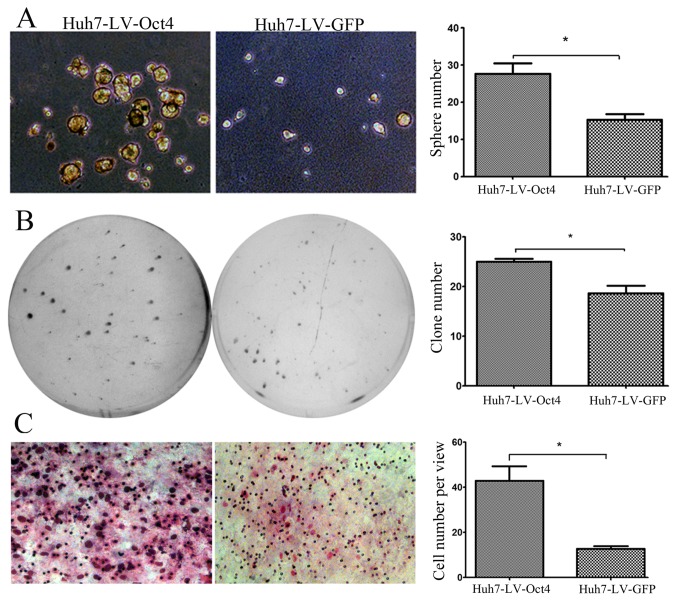
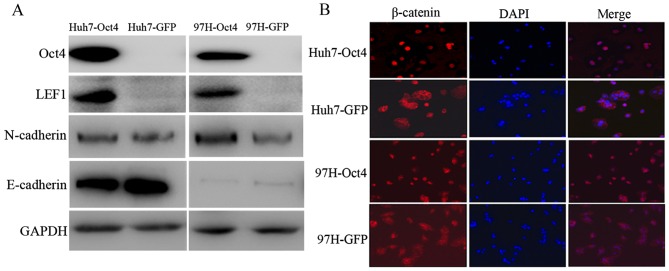
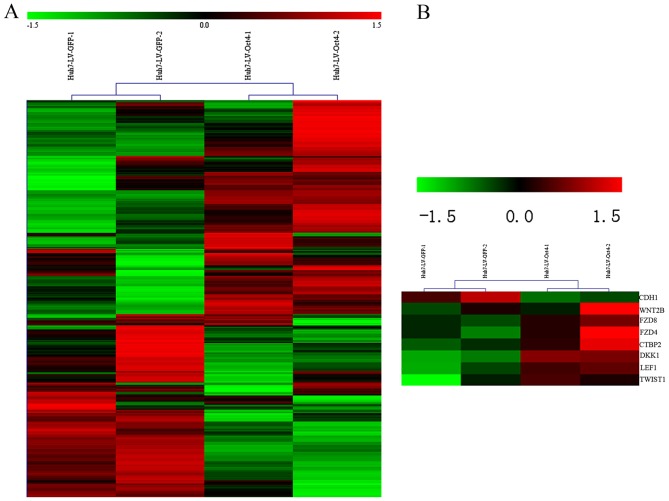
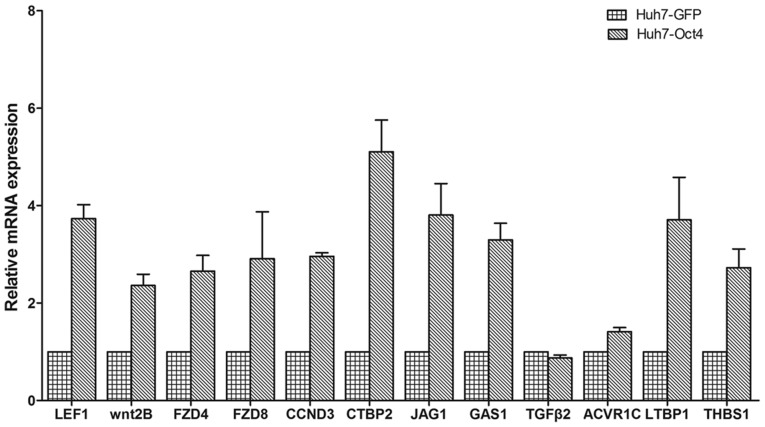
Octamer 4 (Oct4), a member of the Pit-Oct-Unc transcription factor family required to maintain self-renewal and pluripotency of embryonic stem cells, has been previously identified to be associated with tumorigenesis and malignant transformation of numerous types of cancer including hepatocellular carcinoma (HCC). The present data shows that Oct4 enhances cancer stem cell properties and increases invasion ability in the Huh7 cell line. To increase understanding of the role of Oct4 in HCC, the present study used a functional genomics approach and analyzed the resulting transcriptional profiles to identify Oct4-dependent genes in Huh7. Affymetrix GeneChip Human genome U133 Plus 2.0 Arrays were used to determine differential gene expression profiles and then validated by quantitative polymerase chain reaction. The present study found that altered expression of 673 genes (fold-change ≥2) affected multiple signaling pathways linked with self-renew and metastasis. Among these differentially expressed genes, the present study noticed that the key component of the WNT signaling pathway lymphoid enhancer binding factor 1 (LEF1) and Twist Family BHLH transcription factor 1 were upregulated by Oct4, whilst cadherin 2 was downregulated. Additional studies found that the nuclear β-catenin aggregation was increased in Oct4 overexpressed HCC cell lines. These results suggest that Oct4 regulates LEF1 to active LEF1/β-catenin dependent WNT signaling pathway and promote epithelial-mesenchymal transition. The present findings provide novel mechanistic insight into an important role of Oct4 in HCC.
八聚体4(Oct4)是维持胚胎干细胞自我更新和多能性所需的Pit-Oct-Unc转录因子家族成员,此前已被确定与包括肝细胞癌(HCC)在内的多种癌症的肿瘤发生和恶性转化有关。目前的数据表明,Oct4增强了肝癌细胞系Huh7的癌症干细胞特性并提高了其侵袭能力。为了加深对Oct4在肝癌中作用的理解,本研究采用功能基因组学方法并分析所得转录谱,以鉴定Huh7中Oct4依赖性基因。使用Affymetrix GeneChip人类基因组U133 Plus 2.0芯片来确定差异基因表达谱,然后通过定量聚合酶链反应进行验证。本研究发现,673个基因(倍数变化≥2)的表达改变影响了与自我更新和转移相关的多个信号通路。在这些差异表达基因中,本研究注意到WNT信号通路的关键成分淋巴样增强因子结合因子1(LEF1)和Twist家族BHLH转录因子1被Oct4上调,而钙黏蛋白2被下调。进一步的研究发现,在Oct4过表达的肝癌细胞系中,核β-连环蛋白聚集增加。这些结果表明,Oct4通过调节LEF1激活LEF1/β-连环蛋白依赖性WNT信号通路并促进上皮-间质转化。本研究结果为Oct4在肝癌中的重要作用提供了新的机制性见解。