Longley Rhea J, França Camila T, White Michael T, Kumpitak Chalermpon, Sa-Angchai Patiwat, Gruszczyk Jakub, Hostetler Jessica B, Yadava Anjali, King Christopher L, Fairhurst Rick M, Rayner Julian C, Tham Wai-Hong, Nguitragool Wang, Sattabongkot Jetsumon, Mueller Ivo
Walter and Eliza Hall Institute of Medical Research, Melbourne, Australia.
Mahidol Vivax Research Unit, Faculty of Tropical Medicine, Mahidol University, Bangkok, Thailand.
Malar J. 2017 Apr 28;16(1):178. doi: 10.1186/s12936-017-1826-8.
Thailand is aiming to eliminate malaria by the year 2024. Plasmodium vivax has now become the dominant species causing malaria within the country, and a high proportion of infections are asymptomatic. A better understanding of antibody dynamics to P. vivax antigens in a low-transmission setting, where acquired immune responses are poorly characterized, will be pivotal for developing new strategies for elimination, such as improved surveillance methods and vaccines. The objective of this study was to characterize total IgG antibody levels to 11 key P. vivax proteins in a village of western Thailand.
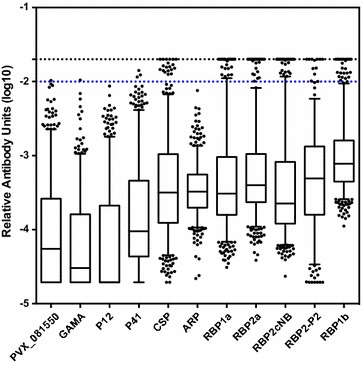
Plasma samples from 546 volunteers enrolled in a cross-sectional survey conducted in 2012 in Kanchanaburi Province were utilized. Total IgG levels to 11 different proteins known or predicted to be involved in reticulocyte binding or invasion (ARP, GAMA, P41, P12, PVX_081550, and five members of the PvRBP family), as well as the leading pre-erythrocytic vaccine candidate (CSP) were measured using a multiplexed bead-based assay. Associations between IgG levels and infection status, age, and spatial location were explored.
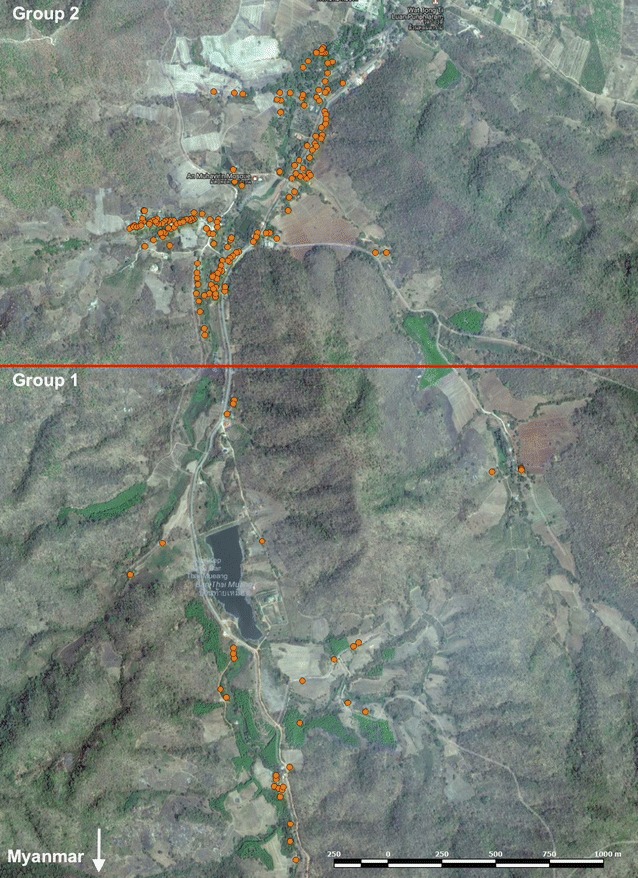
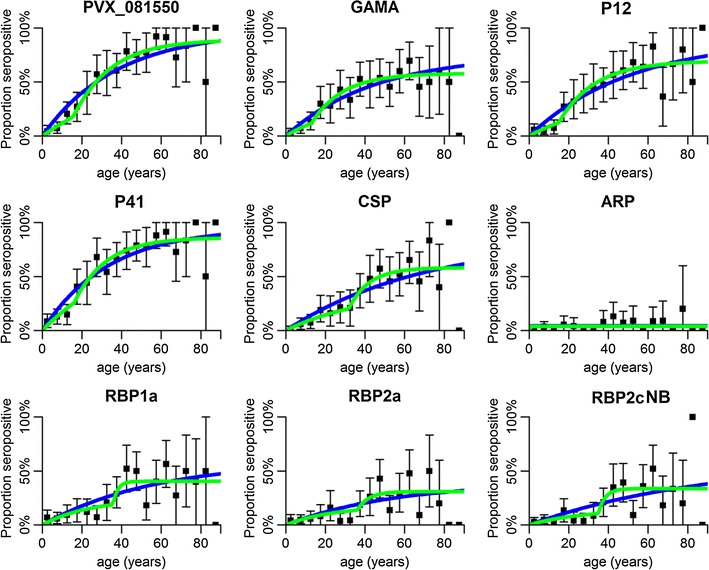
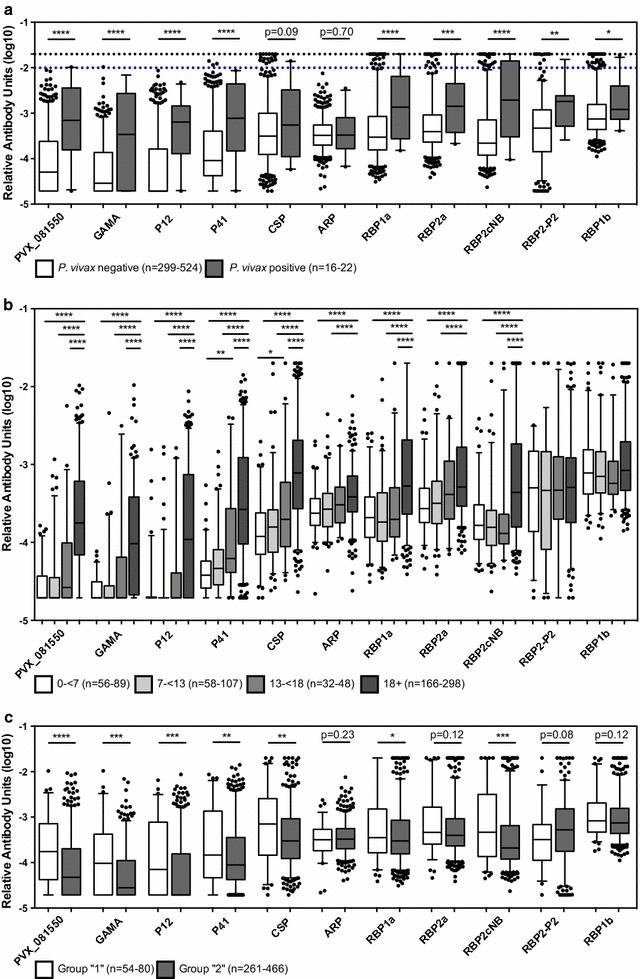
Individuals from a low-transmission region of western Thailand reacted to all 11 P. vivax recombinant proteins. Significantly greater IgG levels were observed in the presence of a current P. vivax infection, despite all infected individuals being asymptomatic. IgG levels were also higher in adults (18 years and older) than in children. For most of the proteins, higher IgG levels were observed in individuals living closer to the Myanmar border and further away from local health services.
Robust IgG responses were observed to most proteins and IgG levels correlated with surrogates of exposure, suggesting these antigens may serve as potential biomarkers of exposure, immunity, or both.
泰国的目标是到2024年消除疟疾。间日疟原虫现已成为该国引起疟疾的主要物种,并且很大一部分感染是无症状的。在获得性免疫反应特征不明确的低传播环境中,更好地了解针对间日疟原虫抗原的抗体动态,对于制定消除疟疾的新策略(如改进监测方法和疫苗)至关重要。本研究的目的是在泰国西部的一个村庄中,对11种关键间日疟原虫蛋白的总IgG抗体水平进行特征分析。
利用了2012年在北碧府进行的横断面调查中招募的546名志愿者的血浆样本。使用基于多重珠的检测方法,测量了针对11种已知或预测参与网织红细胞结合或入侵的不同蛋白(ARP、GAMA、P41、P12、PVX_081550以及PvRBP家族的五个成员)以及主要的红细胞前期疫苗候选物(CSP)的总IgG水平。探讨了IgG水平与感染状态、年龄和空间位置之间的关联。
来自泰国西部低传播地区的个体对所有11种间日疟原虫重组蛋白都有反应。尽管所有感染个体均无症状,但在当前间日疟原虫感染的情况下,观察到IgG水平显著更高。成年人(18岁及以上)的IgG水平也高于儿童。对于大多数蛋白,在居住距离缅甸边境更近且距离当地医疗服务更远的个体中观察到更高的IgG水平。
观察到对大多数蛋白有强烈的IgG反应,并且IgG水平与暴露替代指标相关,这表明这些抗原可能作为暴露、免疫或两者的潜在生物标志物。