Vaissière Anaïs, Aldrian Gudrun, Konate Karidia, Lindberg Mattias F, Jourdan Carole, Telmar Anthony, Seisel Quentin, Fernandez Frédéric, Viguier Véronique, Genevois Coralie, Couillaud Franck, Boisguerin Prisca, Deshayes Sébastien
Centre de Recherche de Biologie cellulaire de Montpellier, UMR 5237 CNRS, 1919 Route de Mende, 34293, Montpellier, France.
Sys2Diag, UMR 9005-CNRS/ALCEDIAG, 1682 Rue de la Valsiere, 34184, Montpellier, France.
J Nanobiotechnology. 2017 Apr 28;15(1):34. doi: 10.1186/s12951-017-0269-2.
Small interfering RNAs (siRNAs) are powerful tools to control gene expression. However, due to their poor cellular permeability and stability, their therapeutic development requires a specific delivery system. Among them, cell-penetrating peptides (CPP) have been shown to transfer efficiently siRNA inside the cells. Recently we developed amphipathic peptides able to self-assemble with siRNAs as peptide-based nanoparticles and to transfect them into cells. However, despite the great potential of these drug delivery systems, most of them display a low resistance to proteases.
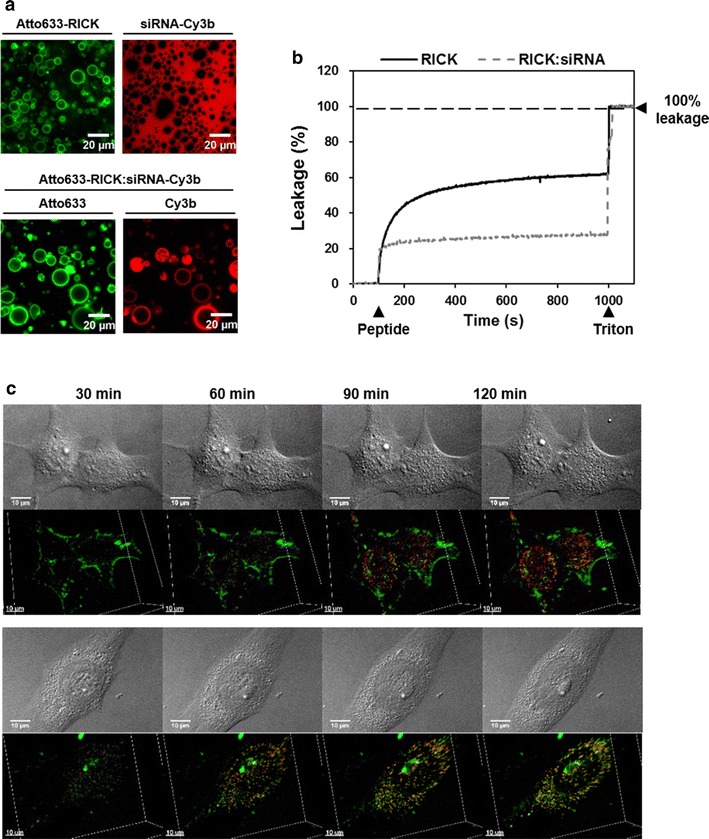
Here, we report the development and characterization of a new CPP named RICK corresponding to the retro-inverso form of the CADY-K peptide. We show that RICK conserves the main biophysical features of its L-parental homologue and keeps the ability to associate with siRNA in stable peptide-based nanoparticles. Moreover the RICK:siRNA self-assembly prevents siRNA degradation and induces inhibition of gene expression.
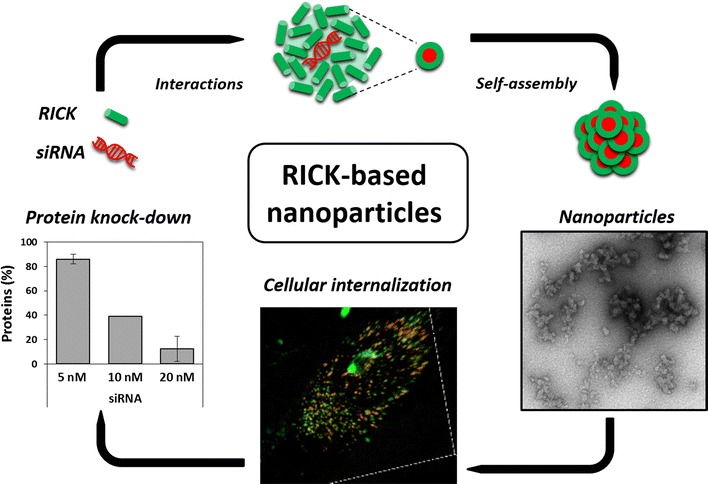
This new approach consists in a promising strategy for future in vivo application, especially for targeted anticancer treatment (e.g. knock-down of cell cycle proteins). Graphical abstract RICK-based nanoparticles: RICK peptides and siRNA self-assemble in peptide-based nanoparticles to penetrate into the cells and to induce target protein knock-down.
小干扰RNA(siRNAs)是控制基因表达的有力工具。然而,由于其较差的细胞通透性和稳定性,其治疗性开发需要特定的递送系统。其中,细胞穿透肽(CPP)已被证明能有效地将siRNA转运到细胞内。最近,我们开发了一种两亲性肽,它能够与siRNAs自组装形成基于肽的纳米颗粒,并将其转染到细胞中。然而,尽管这些药物递送系统具有巨大潜力,但它们中的大多数对蛋白酶的抗性较低。
在此,我们报告了一种名为RICK的新型CPP的开发和表征,它对应于CADY-K肽的反向异构体形式。我们表明,RICK保留了其L-亲本同源物的主要生物物理特征,并保持了与siRNA在稳定的基于肽的纳米颗粒中结合的能力。此外,RICK:siRNA自组装可防止siRNA降解并诱导基因表达抑制。
这种新方法是一种有前途的策略,可用于未来的体内应用,特别是用于靶向抗癌治疗(例如敲低细胞周期蛋白)。图形摘要:基于RICK的纳米颗粒:RICK肽和siRNA在基于肽的纳米颗粒中自组装,以穿透细胞并诱导靶蛋白敲低。