Lopez-Medina Eduardo, Melgar Mario, Gaensbauer James T, Bandyopadhyay Ananda S, Borate Bhavesh R, Weldon William C, Rüttimann Ricardo, Ward Joel, Clemens Ralf, Asturias Edwin J
Department of Pediatrics, Universidad del Valle and Centro de Estudios en Infectología Pediátrica, Cali, Colombia.
Hospital Roosevelt and University Francisco Marroquin School of Medicine, Guatemala City, Guatemala.
Vaccine. 2017 Jun 16;35(28):3591-3597. doi: 10.1016/j.vaccine.2017.04.041. Epub 2017 Apr 25.
Since April 2016 inactivated poliovirus vaccine (IPV) has been the only routine source of polio type 2 protection worldwide. With IPV supply constraints, data on comparability of immunogenicity and safety will be important to optimally utilize available supplies from different manufacturers.
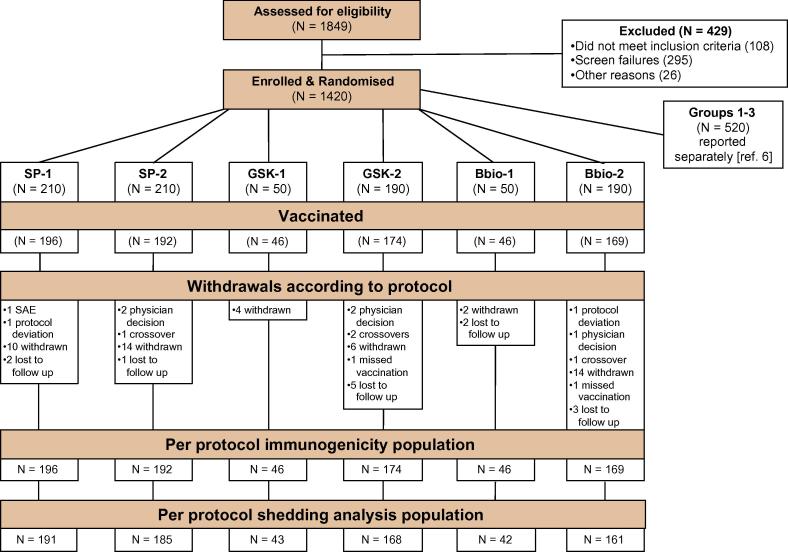
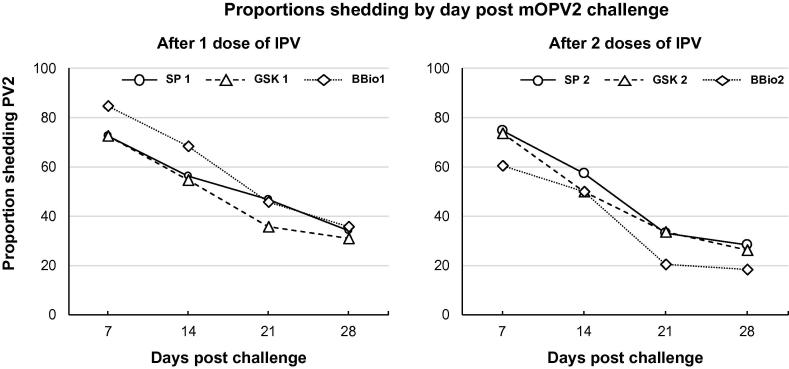
In this multicenter phase IV study, 900 Latin American infants randomly assigned to six study groups received three doses of bOPV at 6, 10 and 14weeks and either one IPV dose at 14weeks (groups SP-1, GSK-1 and BBio-1) or two IPV doses at 14 and 36weeks (groups SP-2, GSK-2 and BBio-2) from three different manufacturers. Children were challenged with mOPV2 at either 18 (one IPV dose) or 40weeks (two IPV doses) and stools were collected weekly for 4weeks to assess viral shedding. Serum neutralizing antibodies were measured at various time points pre and post vaccination. Serious adverse events and important medical events (SAE and IME) were monitored for 6months after last study vaccine.
At week 18, 4weeks after one dose of IPV, overall type 2 seroconversion rates were 80.4%, 80.4% and 73.3% for SP-1, GSK-1 and BBio-1 groups, respectively; and 92.6%, 96.8% and 88.0% in those who were seronegative before IPV administration. At 40weeks, 4weeks after a second IPV dose, type 2 seroconversion rates were ≥99% for any of the three manufacturers. There were no significant differences in fecal shedding index endpoint (SIE) after one or two IPV doses (SP: 2.3 [95% CI: 2.1-2.6]); GSK: 2.2 [1.7-2.5]; BBio 1.8 [1.5-2.3]. All vaccines appeared safe, with no vaccine-related SAE or IME.
Current WHO prequalified IPV vaccines are safe and induce similar humoral and intestinal immunity after one or two doses. The parent study was registered with ClinicalTrials.gov, number NCT01831050.
自2016年4月起,灭活脊髓灰质炎病毒疫苗(IPV)已成为全球范围内脊髓灰质炎2型保护的唯一常规来源。鉴于IPV供应受限,免疫原性和安全性可比性的数据对于优化利用不同制造商的现有供应至关重要。
在这项多中心IV期研究中,900名拉丁美洲婴儿被随机分配到六个研究组,在6、10和14周龄时接受三剂bOPV,并在14周龄时接受一剂IPV(SP - 1组、GSK - 1组和BBio - 1组),或在14周龄和36周龄时接受两剂IPV(SP - 2组、GSK - 2组和BBio - 2组),IPV来自三个不同制造商。儿童在18周龄(一剂IPV)或40周龄(两剂IPV)时用mOPV2进行激发,并连续4周每周收集粪便以评估病毒排泄情况。在接种疫苗前后的不同时间点测量血清中和抗体。在最后一剂研究疫苗后6个月监测严重不良事件和重要医学事件(SAE和IME)。
在18周龄,即一剂IPV接种后4周,SP - 1组、GSK - 1组和BBio - 1组的总体2型血清转化率分别为80.4%、80.4%和73.3%;在IPV接种前血清阴性的儿童中,血清转化率分别为92.6%、96.8%和88.0%。在40周龄,即第二剂IPV接种后4周,三个制造商中任何一个的2型血清转化率均≥99%。一剂或两剂IPV后的粪便排泄指数终点(SIE)无显著差异(SP:2.3 [95%CI:2.1 - 2.6]);GSK:2.2 [1.7 - 2.5];BBio 1.8 [1.5 - 2.3]。所有疫苗似乎都是安全的,没有与疫苗相关的SAE或IME。
目前世卫组织预认证的IPV疫苗是安全的,在接种一剂或两剂后可诱导相似的体液和肠道免疫。母研究已在ClinicalTrials.gov注册,编号为NCT01831050。