Qi Han, Wan Chao, Zhang Liang, Wang Junye, Song Ze, Zhang Rong, Zhang Zhenfeng, Fan Weijun
Department of Imaging and Interventional Radiology, Sun Yat-sen University Cancer Center, State Key Laboratory of Oncology in South China, Collaborative Innovation Center of Cancer Medicine, Guangzhou, China.
Department of Thoracic Surgery, Sun Yat-sen University Cancer Center, State Key Laboratory of Oncology in South China, Collaborative Innovation Center of Cancer Medicine, Guangzhou, China.
Oncotarget. 2017 Jun 13;8(24):38793-38801. doi: 10.18632/oncotarget.17044.
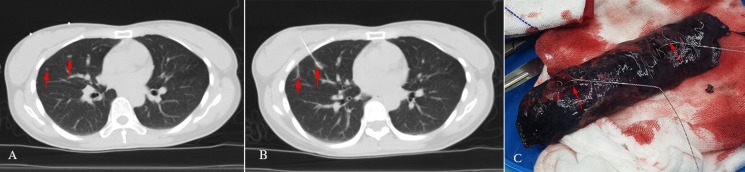
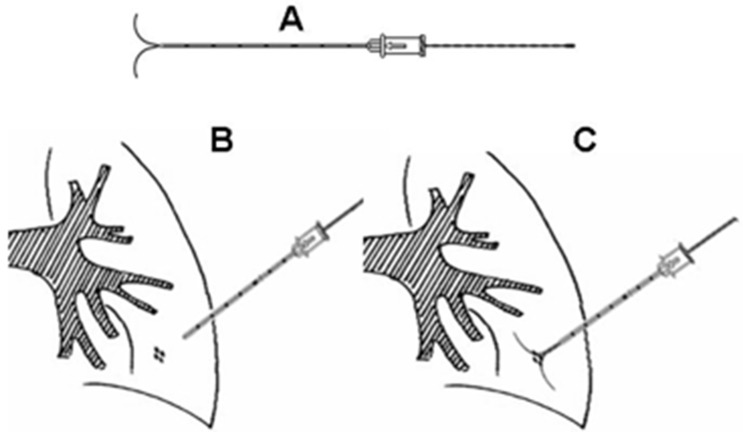
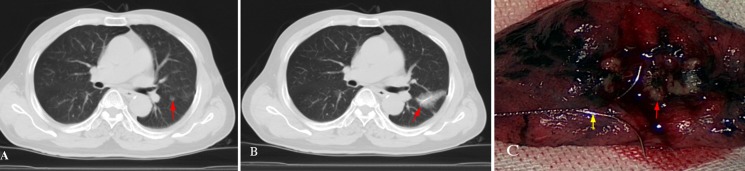
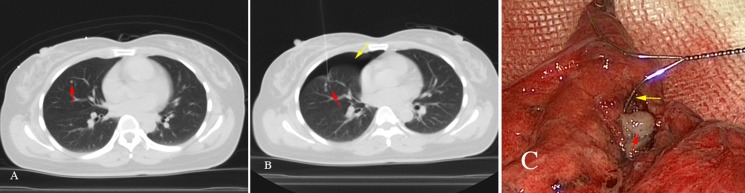
To assess the feasibility of computed tomography (CT)-guided localization using a specific long dual-barbed hookwire in resection of pulmonary nodules with the size of 20mm or less by video-assisted thoracoscopic surgery (VATS) and to discuss the necessity of early treatment of small pulmonary nodules by VATS.
All the nodules were successfully localized with hook wire under CT guidance. The 34 nodules had a mean diameter of 8.9 ± 3.8 mm and a mean distance from the most superficial edge of the nodules to the visceral pleura of 21.4 ± 12.4 mm. The mean length of time for CT-guided percutaneous localization was 9.0 ± 3.8 minutes. Asymptomatic pneumothorax and parenchyma hemorrhage were observed in 1 patient (3.2%) and 5 patients (16.1%), respectively. VATS successfully resected all the lesions after localization. The mean VATS operation time was 2.6 ± 1.2 hours (range, 0.8-5.2 hours). 24 (70.6%) malignant nodules and 10 benign nodules were discovered after surgery.
Between March 2012 and August 2014, 31 patients with 34 small pulmonary lesions underwent CT-guided hook wire localization and VATS resection. The efficacy of preoperative localization was evaluated in terms of procedure time, VATS success rate and associated complications of localization. And the pathology and imaging diagnosis of all nodules were recorded.
The CT-guided Hook-wire localization for pulmonary nodules with the size of 20 mm or less is an effective and safe technique to assist VATS. Once small pulmonary nodules change in size or number, it is necessary to treat in an early and aggressive way with minimally invasive surgery.
评估在电视辅助胸腔镜手术(VATS)切除直径20mm及以下肺结节时,使用特定的长双倒刺钩丝进行计算机断层扫描(CT)引导定位的可行性,并探讨VATS早期治疗小肺结节的必要性。
所有结节均在CT引导下成功通过钩丝定位。34个结节的平均直径为8.9±3.8mm,结节最浅表边缘至脏层胸膜的平均距离为21.4±12.4mm。CT引导下经皮定位的平均时间为9.0±3.8分钟。分别有1例患者(3.2%)出现无症状气胸,5例患者(16.1%)出现实质内出血。定位后VATS成功切除所有病变。VATS的平均手术时间为2.6±1.2小时(范围0.8 - 5.2小时)。术后发现24个(70.6%)恶性结节和10个良性结节。
2012年3月至2014年8月,31例患有34个小肺病变的患者接受了CT引导下钩丝定位及VATS切除。从操作时间、VATS成功率及定位相关并发症方面评估术前定位的效果。记录所有结节的病理及影像诊断结果。
CT引导下对直径20mm及以下肺结节进行钩丝定位是协助VATS的一种有效且安全的技术。一旦小肺结节的大小或数量发生变化,有必要以微创外科手术进行早期积极治疗。