Mossie Tilahun Belete, Sibhatu Adam Kiros, Dargie Abate, Ayele Ashenafi Damte
Psychiatry Unit, School of Nursing, College of Health Sciences, Mekelle University, Ethiopia.
College of Health Sciences, Debre Birhan University, Debre Birhan, Ethiopia.
Ethiop J Health Sci. 2017 Jan;27(1):59-66. doi: 10.4314/ejhs.v27i1.8.
Antenatal depression is one of the common problems during pregnancy with a magnitude of 20% to 30% globally. It can negatively endanger women's and off springs lives. As there are scarce reports on this area in Northern Ethiopia, it is important to carry out different studies that explore the magnitude of the problem and related factors in rural areas. The aim of this study is thus to assess the magnitude of antenatal depressive symptoms and associated factors among women at Maichew Town, North Ethiopia.
A facility based cross sectional study was conducted among 196 pregnant women from April to June 2015. Pregnant women who had antenatal care follow-ups at the public health facilities were included in the study. Through proportional allocation to each facility, systematic random sampling technique was used to select the study participants. We used the local language version of Beck Depression Inventory to assess depressive symptoms with a cutoff point of 14 or more. Data was collected by trained Psychiatric Nurses; data entry and analysis were processed by SPSS window 20. The level of significance was determined using odds ratio and 95% confidence interval.
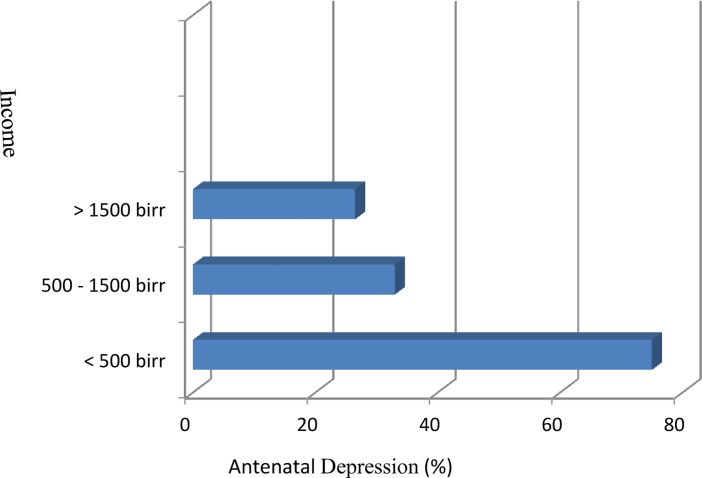
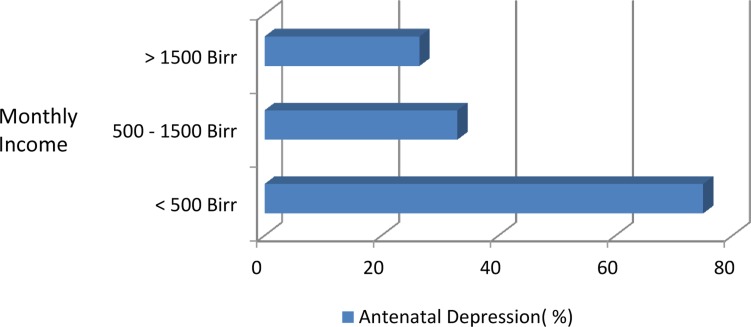
About 16.3% of the participants had never given birth before, and 46.4% and 42.3% were in the third and second trimesters of pregnancy respectively. Unwanted pregnancy was reported by 25.5% of the participants. Among those with previous pregnancy, 7.1% had previous obstetric complication. The magnitude of depression was 31.1%. Pregnant women with low level of income (AOR=3.66 (95%CI; 1.12, 11.96)), unmarried (AOR=4.07 (95% CI; 1.18, 14.04)) and house wives (AOR= 4.24 (1.38, 13.03)) were risk groups for depression.
Antenatal depression is a common problem; thus screening activities of depression in antenatal care services should be emphasized with more concern to unmarried women, those with low level of income and house wives.
产前抑郁是孕期常见问题之一,全球发生率为20%至30%。它会对女性及其后代的生命构成负面影响。由于埃塞俄比亚北部关于这一领域的报道很少,开展不同研究以探究农村地区该问题的严重程度及相关因素很重要。因此,本研究的目的是评估埃塞俄比亚北部迈丘镇女性产前抑郁症状的严重程度及相关因素。
2015年4月至6月,在196名孕妇中开展了一项基于机构的横断面研究。研究纳入了在公共卫生机构接受产前检查随访的孕妇。通过按比例分配到每个机构,采用系统随机抽样技术选取研究参与者。我们使用当地语言版本的贝克抑郁量表评估抑郁症状,临界值为14分及以上。数据由经过培训的精神科护士收集;数据录入和分析通过SPSS 20窗口进行。使用比值比和95%置信区间确定显著性水平。
约16.3%的参与者从未生育过,46.4%和42.3%的参与者分别处于妊娠晚期和中期。25.5%的参与者报告意外怀孕。在有过怀孕经历的人中,7.1%有过产科并发症。抑郁发生率为31.1%。低收入孕妇(比值比=3.66(95%置信区间:[1.12, 11.96]))、未婚孕妇(比值比=4.07(95%置信区间:[1.18, 14.04]))和家庭主妇(比值比=4.24([1.38, 13.03]))是抑郁的风险群体。
产前抑郁是一个常见问题;因此,应在产前护理服务中强调抑郁筛查活动,尤其要关注未婚女性、低收入女性和家庭主妇。