Liu Ying, Zhong Mingtian, Xi Chang, Jin Xinhu, Zhu Xiongzhao, Yao Shuqiao, Yi Jinyao
Medical Psychological Center, Second Xiangya Hospital, Central South UniversityChangsha, China.
Center for Studies of Psychological Application, School of Psychology, South China Normal UniversityGuangzhou, China.
Front Behav Neurosci. 2017 Apr 18;11:67. doi: 10.3389/fnbeh.2017.00067. eCollection 2017.
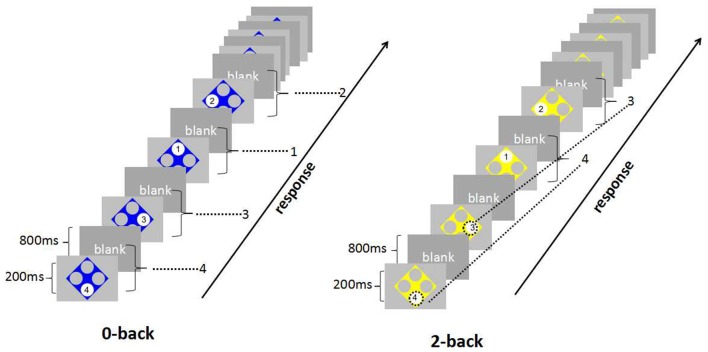
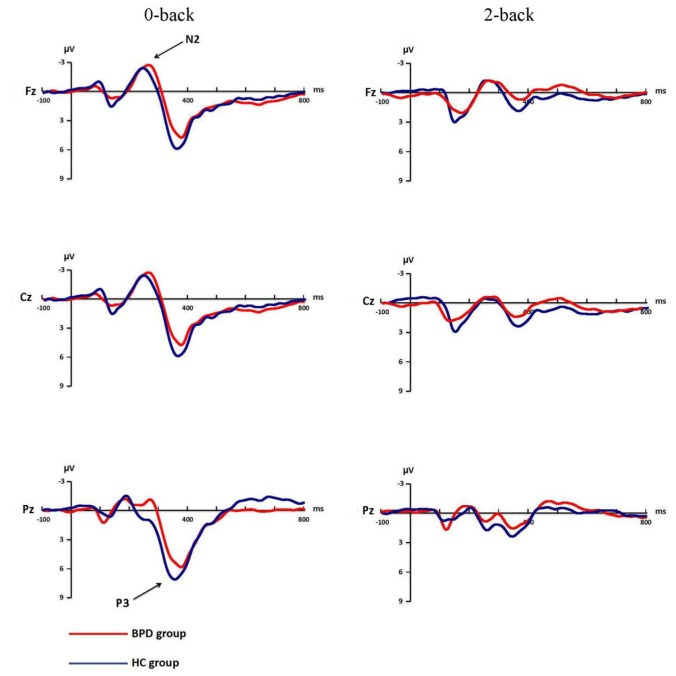
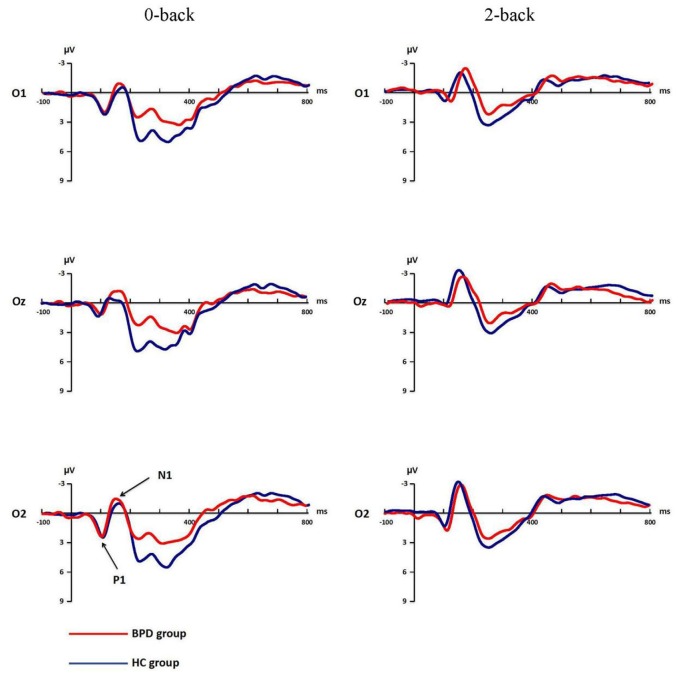
Whereas some studies have demonstrated impaired working memory (WM) among patients with borderline personality disorder (BPD), these findings have not been consistent. Furthermore, there is a lack of neurophysiological evidence about WM function in patients with BPD. The goal of this study was to examine WM function in patients with BPD by using event-related potentials (ERPs). An additional goal was to explore whether characteristics of BPD (i.e., impulsiveness and emotional instability) are associated with WM impairment. A modified version of the N-back task (0- and 2-back) was used to measure WM. ERPs were recorded in 22 BPD patients and 21 age-, handedness-, and sex-matched healthy controls (HCs) while they performed the WM task. The results revealed that there were no significant group differences for behavioral variables (reaction time and accuracy rate) or for latencies and amplitudes of P1 and N1 (all > 0.05). BPD patients had lower P3 amplitudes and longer N2 latencies than HC, independent of WM load (low load: 0-back; high load: 2-back). Impulsiveness was not correlated with N2 latency or P3 amplitude, and no correlations were found between N2 latency or P3 amplitude and affect intensity scores in any WM load (all > 0.05). In conclusion, the lower P3 amplitudes and longer N2 latencies in BPD patients suggested that they might have some dysfunction of neural activities in sub-processing in WM, while impulsiveness and negative affect might not have a close relationship with these deficits.
尽管一些研究表明边缘型人格障碍(BPD)患者存在工作记忆(WM)受损的情况,但这些发现并不一致。此外,目前缺乏关于BPD患者WM功能的神经生理学证据。本研究的目的是通过使用事件相关电位(ERP)来检查BPD患者的WM功能。另一个目的是探讨BPD的特征(即冲动性和情绪不稳定性)是否与WM损害有关。使用改良版的N-back任务(0-back和2-back)来测量WM。在22名BPD患者和21名年龄、利手和性别匹配的健康对照者(HCs)执行WM任务时记录ERP。结果显示,行为变量(反应时间和准确率)以及P1和N1的潜伏期和波幅在两组之间均无显著差异(均>0.05)。与HC相比,BPD患者的P3波幅较低,N2潜伏期较长,且与WM负荷无关(低负荷:0-back;高负荷:2-back)。冲动性与N2潜伏期或P3波幅无关,在任何WM负荷下,N2潜伏期或P3波幅与情感强度评分之间均无相关性(均>0.05)。总之,BPD患者较低的P3波幅和较长的N2潜伏期表明,他们在WM的子处理过程中可能存在一些神经活动功能障碍,而冲动性和负面影响可能与这些缺陷没有密切关系。