Loffredo Stefania, Borriello Francesco, Iannone Raffaella, Ferrara Anne L, Galdiero Maria R, Gigantino Vincenzo, Esposito Pasquale, Varricchi Gilda, Lambeau Gerard, Cassatella Marco A, Granata Francescopaolo, Marone Gianni
Division of Clinical Immunology and Allergy, Center for Basic and Clinical Immunology Research (CISI), University of Naples Federico II, Naples, Italy.
Division of Infectious Diseases, Department of Medicine, Boston Children's Hospital, Boston, MA, USA.
Front Immunol. 2017 Apr 19;8:443. doi: 10.3389/fimmu.2017.00443. eCollection 2017.
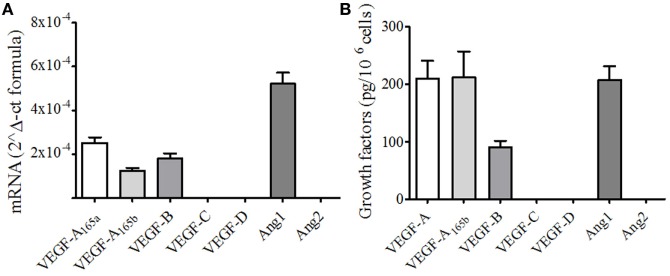
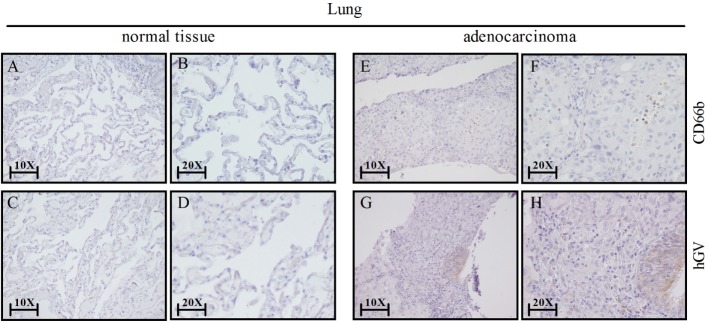
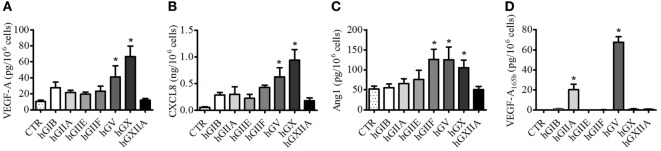
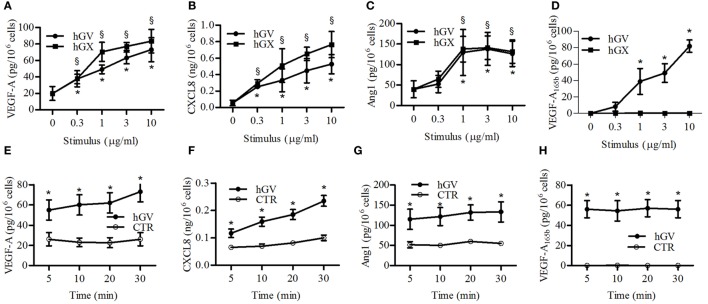
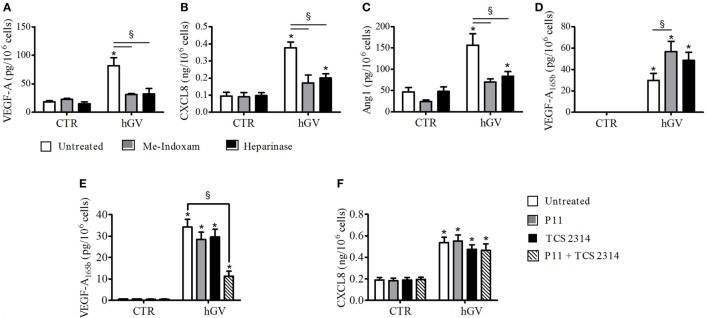
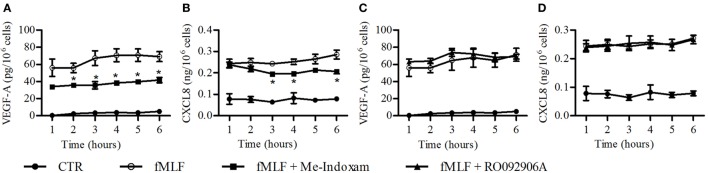
Secreted phospholipases A (sPLAs) are extracellular enzymes that catalyze the release of free fatty acids and lysophospholipids from membrane phospholipids and also bind to different receptors (e.g., PLAR1 or integrins). To date, 12 mammalian sPLAs have been identified, which play a critical role in pathophysiological processes including inflammation and cancer. sPLAs activate immune cells such as human neutrophils (PMNs) by enzymatic activity- or receptor-mediated mechanisms. In addition, human PMNs synthesize and store human group V (hGV) and human group X (hGX) sPLAs in their granules, but only the former is released upon cellular activation. We investigated the effects of sPLAs on the release of proangiogenic and antiangiogenic factors by PMNs. We found that exogenous hGV and hGX sPLAs induce the release of vascular endothelial growth factor (VEGF)-A, angiopoietin 1 (Ang1), and CXCL8/IL-8. Only hGV induces the secretion of the antiangiogenic isoform of VEGF-A, namely, VEGF-A. While the release of VEGF-A, Ang1, and CXCL8/IL-8 was likely mediated by hGV enzymatic activity and/or binding to PLAR1 and heparan sulfate proteoglycans, the release of VEGF-A requires the interaction with αβ and αβ integrins. We also provide evidence that endogenous hGV released by -formyl-met-leu-phe (fMLF)-activated PMNs is involved in the release of angiogenic factors. The translational relevance of these data is supported by our findings that hGV expression is increased in human samples of lung cancer which are infiltrated by PMNs. Overall, our results suggest that the hGV-neutrophil axis may play a relevant role in the modulation of cancer-related inflammation and angiogenesis.
分泌型磷脂酶A(sPLAs)是一种细胞外酶,可催化从膜磷脂中释放游离脂肪酸和溶血磷脂,还能与不同受体(如PLAR1或整合素)结合。迄今为止,已鉴定出12种哺乳动物sPLAs,它们在包括炎症和癌症在内的病理生理过程中起关键作用。sPLAs通过酶活性或受体介导的机制激活免疫细胞,如人类中性粒细胞(PMN)。此外,人类PMN在其颗粒中合成并储存人类V组(hGV)和人类X组(hGX)sPLAs,但只有前者在细胞活化时释放。我们研究了sPLAs对PMN释放促血管生成和抗血管生成因子的影响。我们发现,外源性hGV和hGX sPLAs可诱导血管内皮生长因子(VEGF)-A、血管生成素1(Ang1)和CXCL8/IL-8的释放。只有hGV能诱导VEGF-A的抗血管生成异构体即VEGF-A的分泌。虽然VEGF-A、Ang1和CXCL8/IL-8的释放可能是由hGV酶活性和/或与PLAR1及硫酸乙酰肝素蛋白聚糖结合介导的,但VEGF-A的释放需要与αβ和αβ整合素相互作用。我们还提供证据表明,由甲酰甲硫氨酸亮氨酸苯丙氨酸(fMLF)激活的PMN释放的内源性hGV参与了血管生成因子的释放。我们发现在被PMN浸润的肺癌人类样本中hGV表达增加,这支持了这些数据的转化相关性。总体而言,我们的结果表明,hGV-中性粒细胞轴可能在癌症相关炎症和血管生成的调节中发挥相关作用。