Kopp Markus, Rychlik Michael
Chair of Analytical Food Chemistry, Technische Universität München, Freising, Germany.
Institute for Food & Health, Technical University of Munich, Freising, Germany.
Front Nutr. 2017 Apr 18;4:9. doi: 10.3389/fnut.2017.00009. eCollection 2017.
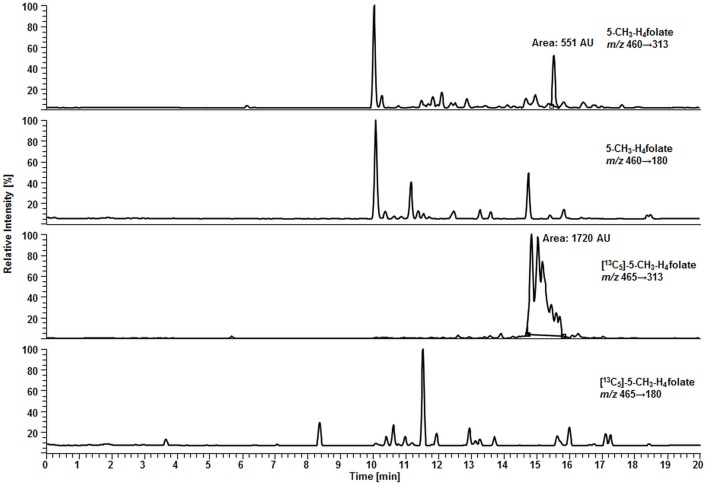
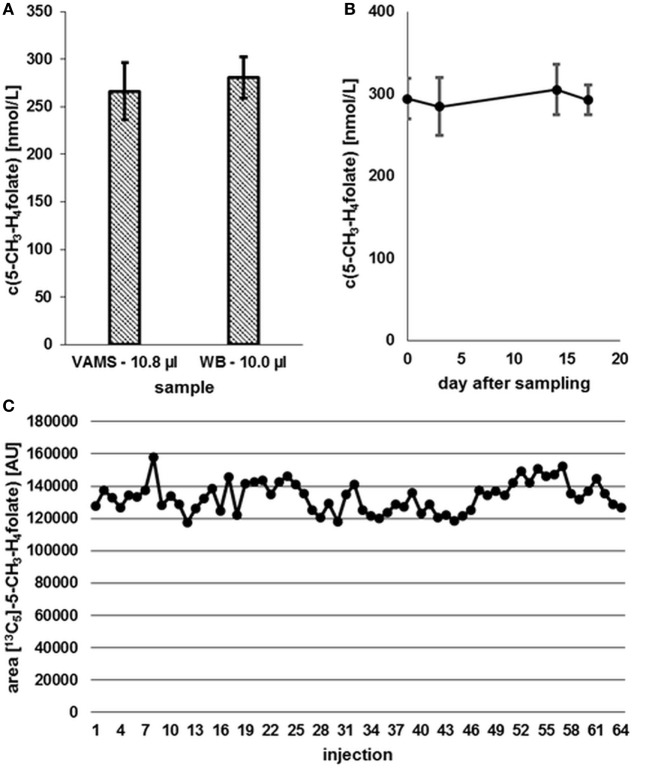
Volumetric absorptive microsamplers (VAMS) have been developed recently as a promising tool for clinical blood sampling. Compared to dried blood spot samples analyzed by accurate stable isotope dilution assays (SIDAs), the new technique could provide further substantial miniaturizing of folate assays by eliminating hematocrit effects and uneven analyte distribution within the sample. Herein, we present a miniaturized SIDA coupled with LC-MS/MS measurement of 5-methyltetrahydrofolic acid as main folate vitamer in whole blood (WB) using [C]-5-methyltetrahydrofolic acid as internal standard. Elution and extraction of only 10.8 μL-dried WB were carried out by centrifugation followed by enzymatic treatment for polyglutamate deconjugation. Matrix separation was achieved by heating and centrifugation. To verify applicability, WB folate status of 11 volunteers was screened. Limits of detection and limits of quantitation were 9 and 26 nmol·L, respectively, which is sufficiently low for screening folate status. Recoveries were 97 (±5.8), 99 (±2.8), and 96 (±6.1)% for 800, 400, and 200 nmol L 5-methyltetrahydrofolic acid, respectively. Precision of the LC-MS/MS instrument and inter-assay precision trials revealed CVs of 8.1 and 3.5% (294 nmol L), respectively, thus confirming reproducible and precise quantitation. Compared to fresh WB, no significant degradation of 5-methyltetrahydrofolate was observed after 2.5 h of drying at room temperature. VAMS 5-CH-Hfolate was stable for at least 3 weeks at -20°C. In our pilot study, accurate and diagnostically conclusive determination of folate status was verified. Nevertheless, blood sampling should be performed by trained individuals to avoid substantial errors concerning the absorbed volume. Endogenous folate in rat serum and chicken pancreas caused a significant background especially at low blood 5-CH-Hfolate levels and, thus, for polyglutamate deconjugation, these background folates or alternative mixtures need to be removed. The superior feasibility of a minimized blood collection with VAMS allows further progress regarding time- and cost-effective methodologies in newborn or population screenings for 5-methyltetrahydrofolate status. Further steps toward minimization could include an automated assay coupled with UPLC-MS/MS.
容积吸收性微量采样器(VAMS)最近已被开发出来,作为一种很有前景的临床血液采样工具。与通过精确稳定同位素稀释分析(SIDA)分析的干血斑样本相比,这项新技术可以通过消除血细胞比容效应和样本中分析物分布不均,进一步大幅缩小叶酸检测的规模。在此,我们展示了一种小型化的SIDA,它以[C]-5-甲基四氢叶酸为内标,结合液相色谱-串联质谱(LC-MS/MS)对全血(WB)中作为主要叶酸维生素形式的5-甲基四氢叶酸进行测量。仅10.8 μL干全血的洗脱和提取通过离心,然后进行酶处理以实现聚谷氨酸去共轭。通过加热和离心实现基质分离。为验证适用性,对11名志愿者的全血叶酸状态进行了筛查。检测限和定量限分别为9和26 nmol·L,对于筛查叶酸状态来说足够低。800、400和200 nmol L的5-甲基四氢叶酸的回收率分别为97(±5.8)%、99(±2.8)%和96(±6.1)%。LC-MS/MS仪器的精密度和批间精密度试验分别显示变异系数为8.1%和3.5%(294 nmol L),从而证实了可重复且精确的定量。与新鲜全血相比,在室温下干燥2.5小时后,未观察到5-甲基四氢叶酸有明显降解。VAMS 5-CH-H叶酸在-20°C下至少稳定3周。在我们的初步研究中,验证了对叶酸状态进行准确且具有诊断决定性的测定。然而,血液采样应由训练有素的人员进行,以避免吸收体积方面的重大误差。大鼠血清和鸡胰腺中的内源性叶酸会造成显著背景,尤其是在低血5-CH-H叶酸水平时,因此,对于聚谷氨酸去共轭,需要去除这些背景叶酸或替代混合物。使用VAMS进行最小化血液采集的卓越可行性使得在新生儿或人群中筛查5-甲基四氢叶酸状态的时间和成本效益方法方面能够取得进一步进展。朝着最小化的进一步步骤可能包括与超高效液相色谱-串联质谱联用的自动化检测。