Knerr Sarah, Hu Elaine Y, Zeliadt Steven B
University of Washington, Department of Health Services.
VA Puget Sound Health Care System Health Services Research and Development Service.
EGEMS (Wash DC). 2017 Mar 13;5(1):1269. doi: 10.13063/2327-9214.1269. eCollection 2017.
The frequency of neutropenia associated with lung cancer chemotherapy outside of randomized trials is largely unknown because administrative coding underestimates its prevalence. This study compared International Classification of Diseases (ICD) diagnosis codes and electronic laboratory results, alone and in combination, for identifying neutropenia events.
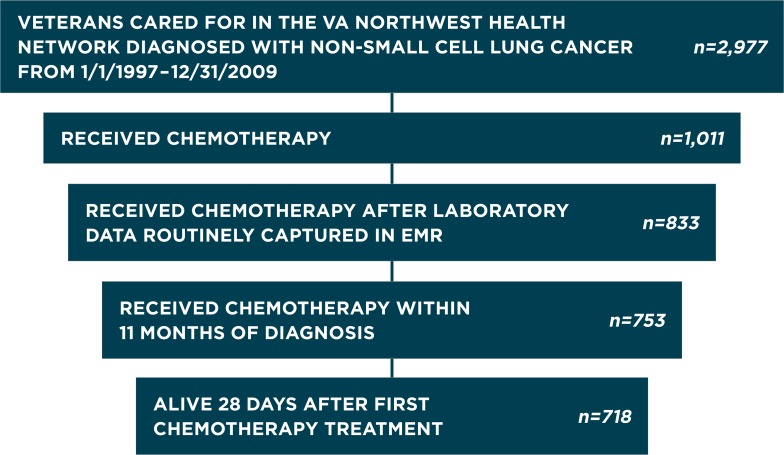
Retrospective cohort study of 718 veterans receiving their first course of chemotherapy for non-small cell lung cancer. Incidence of neutropenia was assessed using electronic laboratory results and ICD-9 codes captured in the Department of Veterans Affairs (VA) electronic medical records (EMR).
A total of 118 of 718 patients (16.4 percent) were identified with an absolute neutrophil count (ANC) less than 1,000 cells/mm, while only 49 of 718 patients (6.8 percent) had ICD-9 codes for neutropenia. Using the combination of laboratory results and diagnosis codes, 136 of 718 patients (18.9 percent) experienced a neutropenic event. Compared to laboratory results as a gold standard, diagnosis codes were specific (not present for individuals without a laboratory-documented low ANC), but not sensitive (missing for many individuals with a low ANC documented in their laboratory test results).
Relying on ICD codes to identify neutropenia in administrative data likely results in under-reporting. The emerging availability of electronic laboratory results provides an opportunity to more accurately quantify patterns of neutropenia, identify individual risk factors, and assess clinical management practices-including use of colony-stimulating factor prophylaxis-in large community cohorts.
在随机试验之外,与肺癌化疗相关的中性粒细胞减少症的发生率很大程度上未知,因为行政编码低估了其患病率。本研究比较了国际疾病分类(ICD)诊断代码和电子实验室结果单独及联合使用时识别中性粒细胞减少症事件的情况。
对718名接受非小细胞肺癌首次化疗疗程的退伍军人进行回顾性队列研究。使用退伍军人事务部(VA)电子病历(EMR)中记录的电子实验室结果和ICD - 9代码评估中性粒细胞减少症的发生率。
718名患者中有118名(16.4%)被确定绝对中性粒细胞计数(ANC)低于1000个细胞/mm³,而718名患者中只有49名(6.8%)有中性粒细胞减少症的ICD - 9代码。结合实验室结果和诊断代码,718名患者中有136名(18.9%)经历了中性粒细胞减少事件。与作为金标准的实验室结果相比,诊断代码具有特异性(无实验室记录低ANC的个体不存在),但不敏感(许多实验室检查结果记录有低ANC的个体未被识别)。
依靠ICD代码在行政数据中识别中性粒细胞减少症可能导致报告不足。电子实验室结果的逐渐可得为更准确地量化中性粒细胞减少症模式、识别个体风险因素以及评估临床管理实践(包括使用集落刺激因子预防)提供了机会,在大型社区队列中亦是如此。