Roper Jatin, Tammela Tuomas, Cetinbas Naniye Malli, Akkad Adam, Roghanian Ali, Rickelt Steffen, Almeqdadi Mohammad, Wu Katherine, Oberli Matthias A, Sánchez-Rivera Francisco J, Park Yoona K, Liang Xu, Eng George, Taylor Martin S, Azimi Roxana, Kedrin Dmitriy, Neupane Rachit, Beyaz Semir, Sicinska Ewa T, Suarez Yvelisse, Yoo James, Chen Lillian, Zukerberg Lawrence, Katajisto Pekka, Deshpande Vikram, Bass Adam J, Tsichlis Philip N, Lees Jacqueline, Langer Robert, Hynes Richard O, Chen Jianzhu, Bhutkar Arjun, Jacks Tyler, Yilmaz Ömer H
The David H. Koch Institute for Integrative Cancer Research at MIT, Cambridge, Massachusetts, USA.
Division of Gastroenterology, Tufts Medical Center, Boston, Massachusetts, USA.
Nat Biotechnol. 2017 Jun;35(6):569-576. doi: 10.1038/nbt.3836. Epub 2017 May 1.
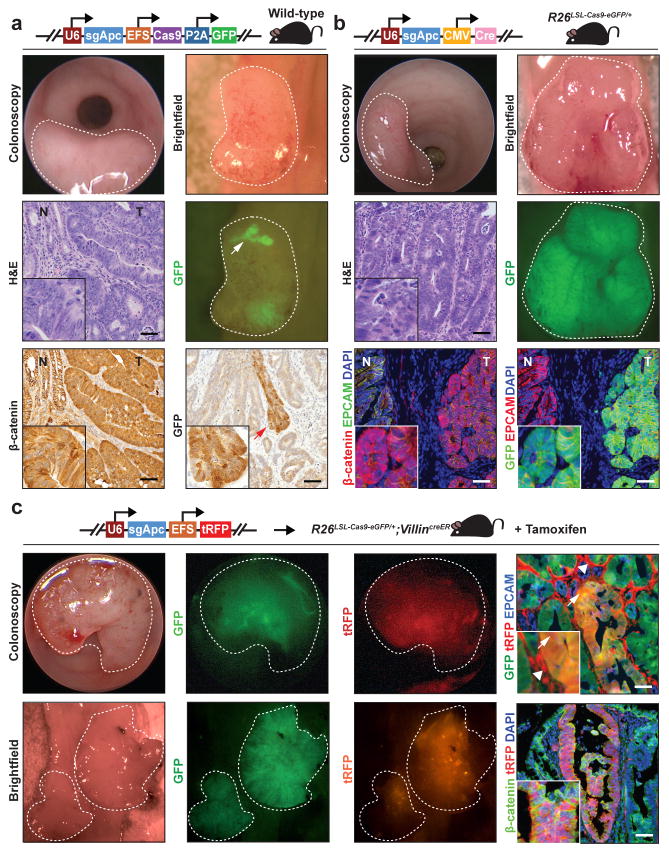
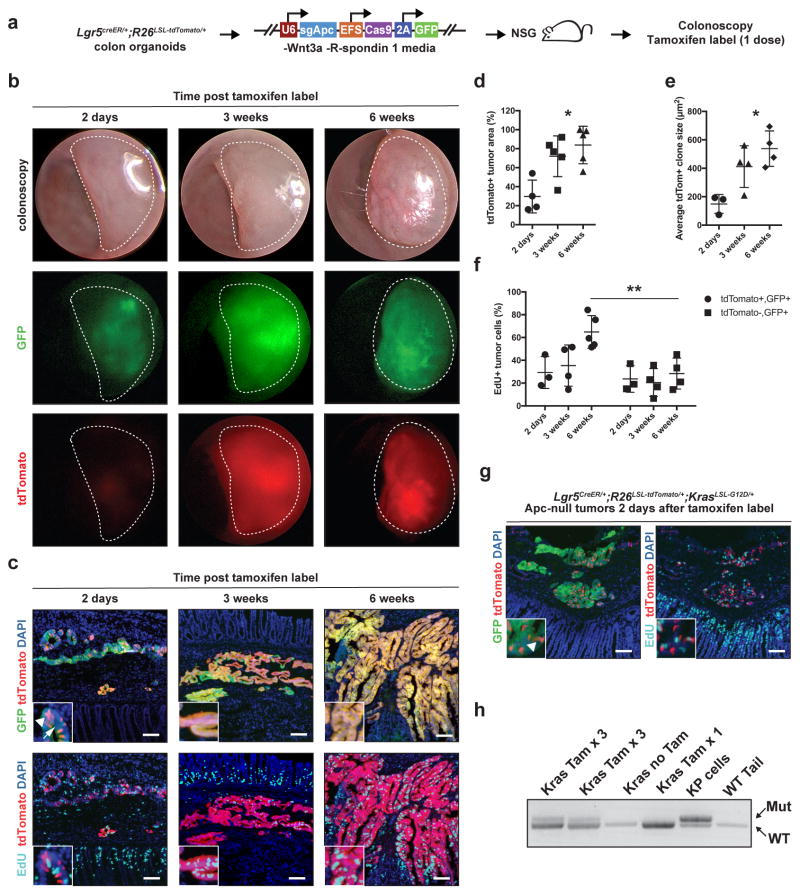
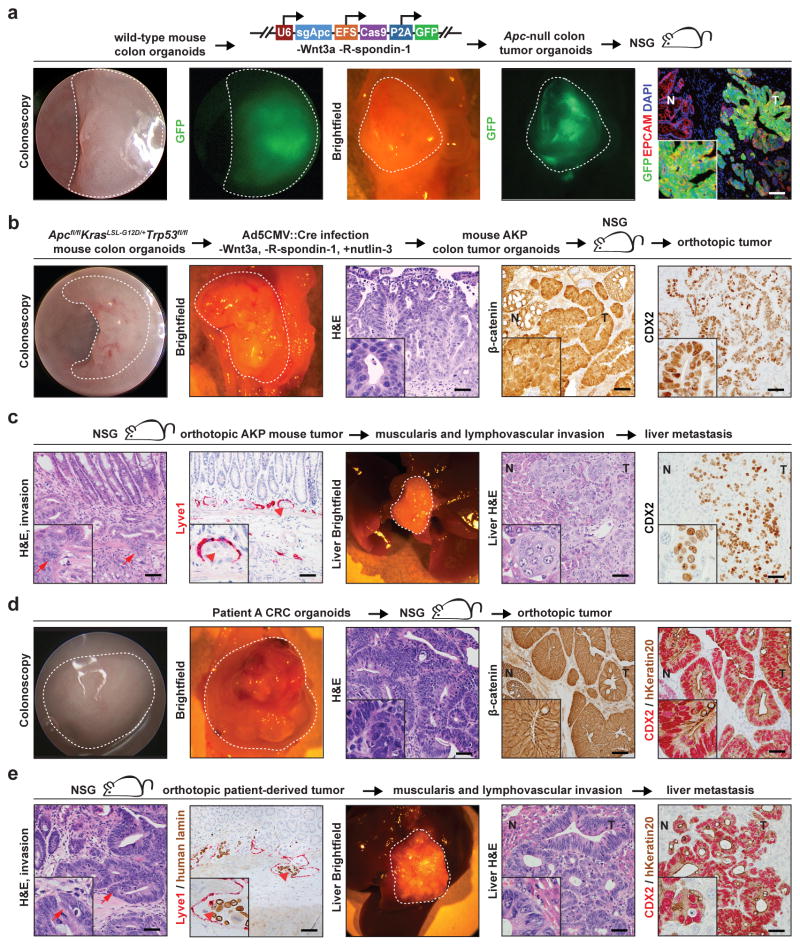
In vivo interrogation of the function of genes implicated in tumorigenesis is limited by the need to generate and cross germline mutant mice. Here we describe approaches to model colorectal cancer (CRC) and metastasis, which rely on in situ gene editing and orthotopic organoid transplantation in mice without cancer-predisposing mutations. Autochthonous tumor formation is induced by CRISPR-Cas9-based editing of the Apc and Trp53 tumor suppressor genes in colon epithelial cells and by orthotopic transplantation of Apc-edited colon organoids. ApcΔ/Δ;Kras;Trp53Δ/Δ (AKP) mouse colon organoids and human CRC organoids engraft in the distal colon and metastasize to the liver. Finally, we apply the orthotopic transplantation model to characterize the clonal dynamics of Lgr5 stem cells and demonstrate sequential activation of an oncogene in established colon adenomas. These experimental systems enable rapid in vivo characterization of cancer-associated genes and reproduce the entire spectrum of tumor progression and metastasis.
由于需要生成并杂交种系突变小鼠,对参与肿瘤发生的基因功能进行体内研究受到限制。在此,我们描述了用于模拟结直肠癌(CRC)及其转移的方法,这些方法依赖于在没有癌症易感突变的小鼠中进行原位基因编辑和原位类器官移植。通过基于CRISPR-Cas9对结肠上皮细胞中的Apc和Trp53肿瘤抑制基因进行编辑,并通过原位移植经Apc编辑的结肠类器官,可诱导自发肿瘤形成。ApcΔ/Δ;Kras;Trp53Δ/Δ(AKP)小鼠结肠类器官和人CRC类器官可植入远端结肠并转移至肝脏。最后,我们应用原位移植模型来表征Lgr5干细胞的克隆动态,并证明在已形成的结肠腺瘤中癌基因的顺序激活。这些实验系统能够在体内快速鉴定癌症相关基因,并重现肿瘤进展和转移的全谱过程。