Kriegel Franziska, Ermann Niklas, Forbes Ruaridh, Dulin David, Dekker Nynke H, Lipfert Jan
Department of Physics, Nanosystems Initiative Munich, and Center for Nanoscience, LMU Munich, Amalienstrasse 54, 80799 Munich, Germany.
Department of Bionanoscience, Kavli Institute of Nanoscience, Delft University of Technology, Van der Maasweg 9, 2629 HZ Delft, The Netherlands.
Nucleic Acids Res. 2017 Jun 2;45(10):5920-5929. doi: 10.1093/nar/gkx280.
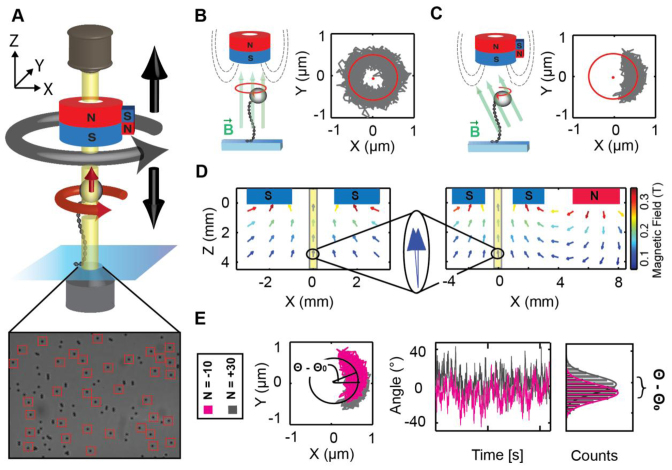
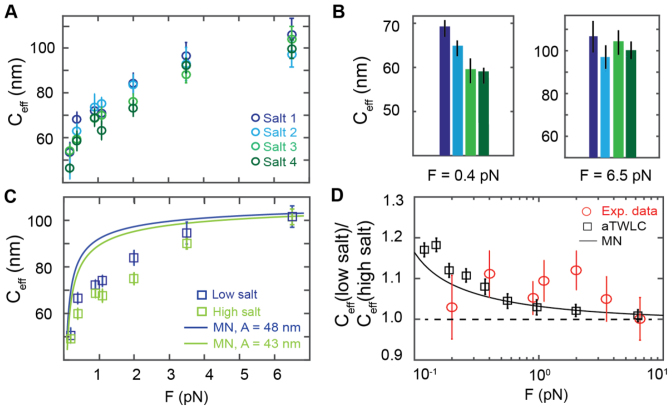
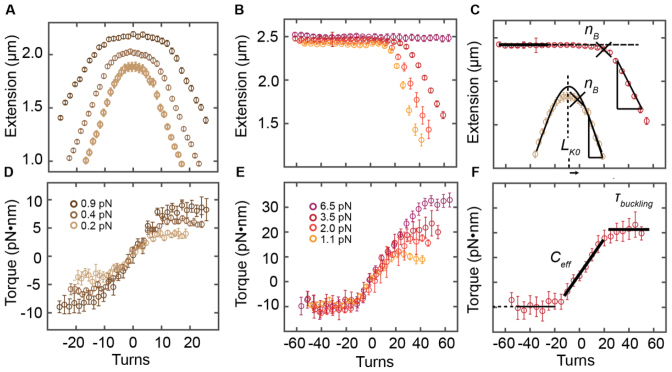
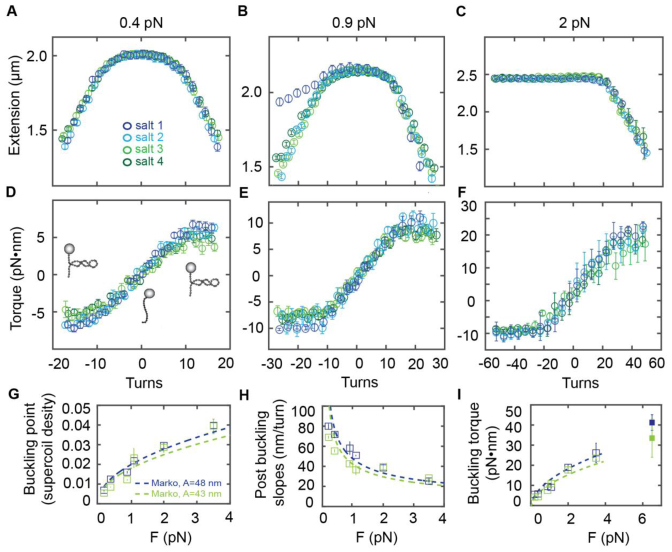
The mechanical properties of DNA fundamentally constrain and enable the storage and transmission of genetic information and its use in DNA nanotechnology. Many properties of DNA depend on the ionic environment due to its highly charged backbone. In particular, both theoretical analyses and direct single-molecule experiments have shown its bending stiffness to depend on salt concentration. In contrast, the salt-dependence of the twist stiffness of DNA is much less explored. Here, we employ optimized multiplexed magnetic torque tweezers to study the torsional stiffness of DNA under varying salt conditions as a function of stretching force. At low forces (<3 pN), the effective torsional stiffness is ∼10% smaller for high salt conditions (500 mM NaCl or 10 mM MgCl2) compared to lower salt concentrations (20 mM NaCl and 100 mM NaCl). These differences, however, can be accounted for by taking into account the known salt dependence of the bending stiffness. In addition, the measured high-force (6.5 pN) torsional stiffness values of C = 103 ± 4 nm are identical, within experimental errors, for all tested salt concentration, suggesting that the intrinsic torsional stiffness of DNA does not depend on salt.
DNA的力学性质从根本上限制并促成了遗传信息的存储、传递及其在DNA纳米技术中的应用。由于DNA具有高度带电的骨架,其许多性质都依赖于离子环境。特别是,理论分析和直接的单分子实验均表明,其弯曲刚度取决于盐浓度。相比之下,DNA扭转刚度对盐的依赖性则较少被研究。在此,我们采用优化的多路复用磁扭矩镊子,来研究在不同盐条件下,作为拉伸力函数的DNA扭转刚度。在低力(<3 pN)下,与较低盐浓度(20 mM NaCl和100 mM NaCl)相比,高盐条件(500 mM NaCl或10 mM MgCl2)下的有效扭转刚度小约10%。然而,考虑到已知的弯曲刚度对盐的依赖性,这些差异是可以解释的。此外,在所有测试盐浓度下,测得的C = 103 ± 4 nm的高力(6.5 pN)扭转刚度值在实验误差范围内是相同的,这表明DNA的固有扭转刚度不依赖于盐。