Vanderlinden Willem, Skoruppa Enrico, Kolbeck Pauline J, Carlon Enrico, Lipfert Jan
Department of Physics and Center for NanoScience (CeNS), LMU Munich, Amalienstrasse 54, 80799 Munich, Germany.
Department of Physics and Debye Institute for Nanomaterials Science, Utrecht University, Princetonplein 1, 3584 CC Utrecht, The Netherlands.
PNAS Nexus. 2022 Nov 22;1(5):pgac268. doi: 10.1093/pnasnexus/pgac268. eCollection 2022 Nov.
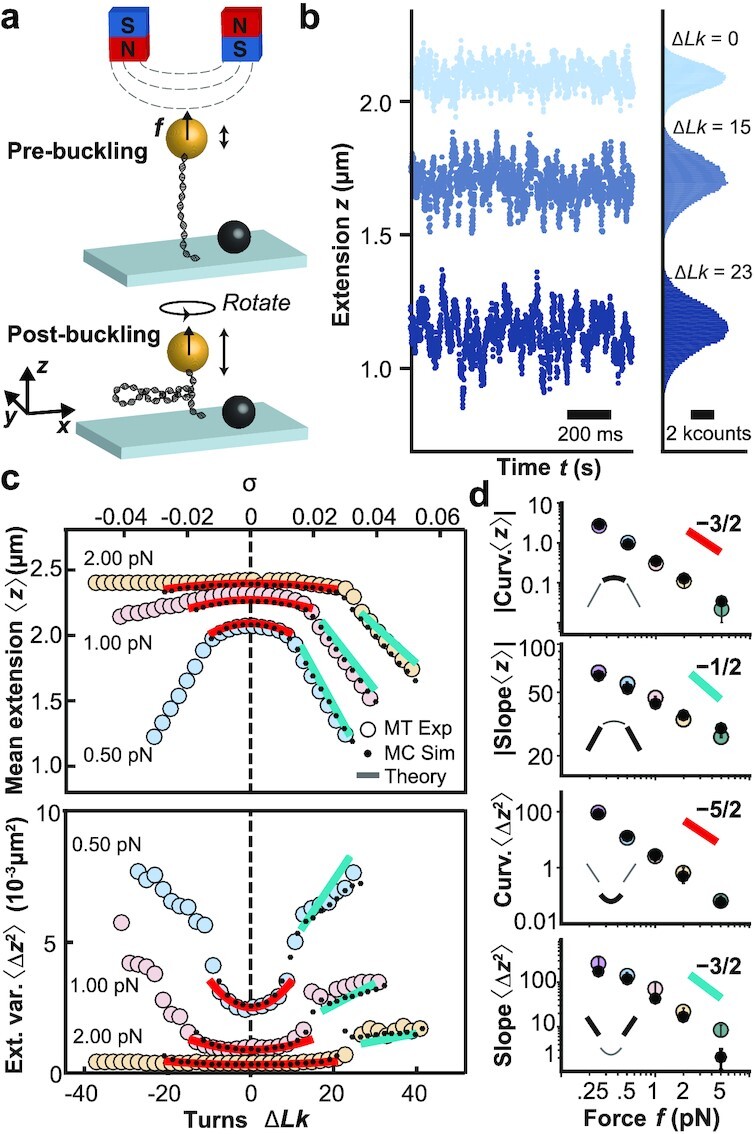
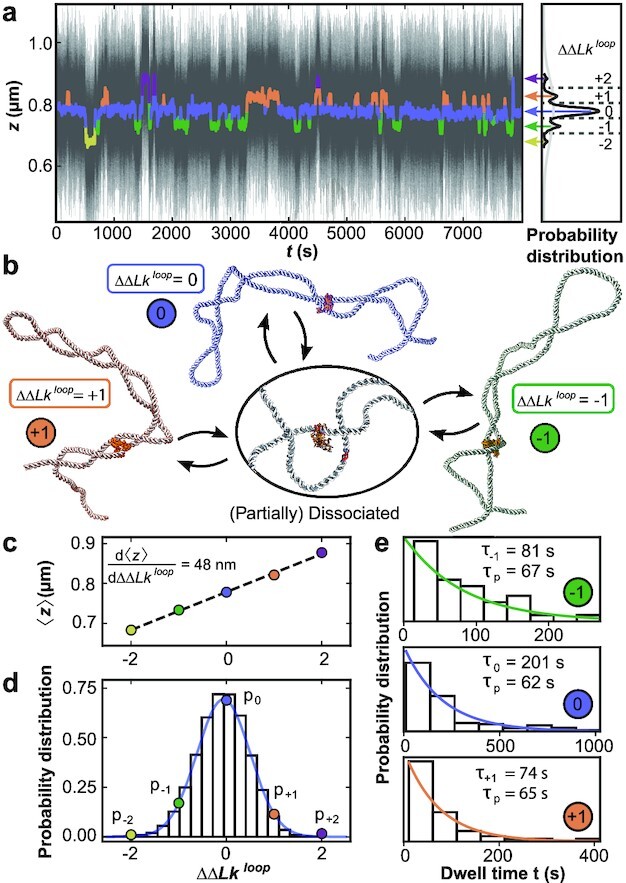
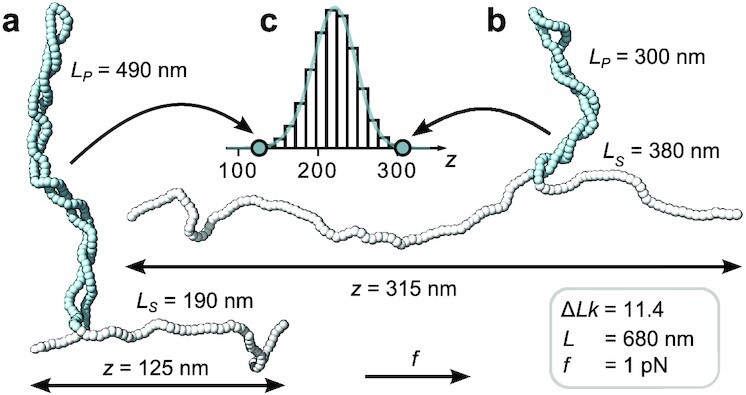
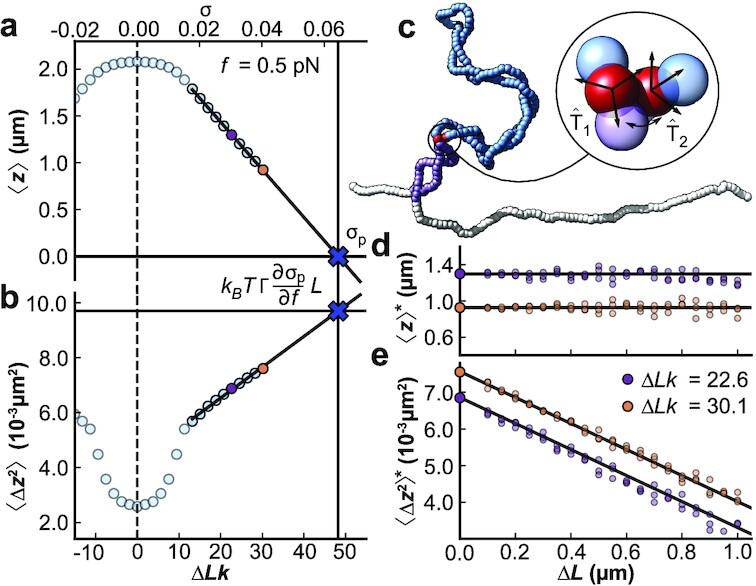
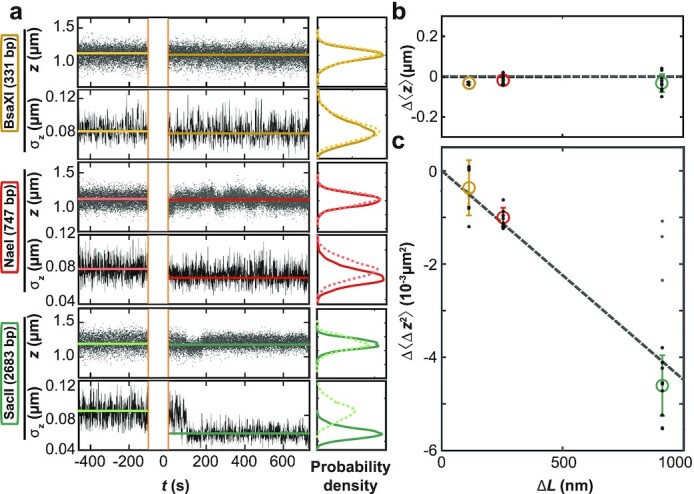
DNA supercoiling is a key regulatory mechanism that orchestrates DNA readout, recombination, and genome maintenance. DNA-binding proteins often mediate these processes by bringing two distant DNA sites together, thereby inducing (transient) topological domains. In order to understand the dynamics and molecular architecture of protein-induced topological domains in DNA, quantitative and time-resolved approaches are required. Here, we present a methodology to determine the size and dynamics of topological domains in supercoiled DNA in real time and at the single-molecule level. Our approach is based on quantifying the extension fluctuations-in addition to the mean extension-of supercoiled DNA in magnetic tweezers (MT). Using a combination of high-speed MT experiments, Monte Carlo simulations, and analytical theory, we map out the dependence of DNA extension fluctuations as a function of supercoiling density and external force. We find that in the plectonemic regime, the extension variance increases linearly with increasing supercoiling density and show how this enables us to determine the formation and size of topological domains. In addition, we demonstrate how the transient (partial) dissociation of DNA-bridging proteins results in the dynamic sampling of different topological states, which allows us to deduce the torsional stiffness of the plectonemic state and the kinetics of protein-plectoneme interactions. We expect our results to further the understanding and optimization of magnetic tweezer measurements and to enable quantification of the dynamics and reaction pathways of DNA processing enzymes in the context of physiologically relevant forces and supercoiling densities.
DNA超螺旋是一种关键的调控机制,它协调DNA的读取、重组和基因组维护。DNA结合蛋白通常通过将两个远距离的DNA位点聚集在一起介导这些过程,从而诱导(瞬时)拓扑结构域。为了理解蛋白质诱导的DNA拓扑结构域的动力学和分子结构,需要定量和时间分辨的方法。在这里,我们提出了一种在单分子水平实时测定超螺旋DNA中拓扑结构域大小和动力学的方法。我们的方法基于除了磁镊(MT)中超螺旋DNA的平均伸长外,还对伸长波动进行量化。通过结合高速MT实验、蒙特卡罗模拟和解析理论,我们描绘出DNA伸长波动作为超螺旋密度和外力函数的依赖性。我们发现在螺旋缠绕状态下,伸长方差随超螺旋密度的增加而线性增加,并展示了这如何使我们能够确定拓扑结构域的形成和大小。此外,我们展示了DNA桥连蛋白的瞬时(部分)解离如何导致不同拓扑状态的动态采样,这使我们能够推断螺旋缠绕状态的扭转刚度和蛋白质 - 螺旋缠绕相互作用的动力学。我们期望我们的结果能进一步加深对磁镊测量的理解和优化,并能够在生理相关的力和超螺旋密度背景下量化DNA加工酶的动力学和反应途径。