Chen Xiaofan, Zhu Weifeng, Tan Jing, Nie Heyun, Liu Liangming, Yan Dongmei, Zhou Xu, Sun Xin
Chinese Cochrane Centre, Chinese Evidence-Based Medicine Centre, West China Hospital, Sichuan University, Chengdu, Sichuang, China.
Evidence-Based Medicine Research Centre, Jiangxi University of Traditional Chinese Medicine, Nanchang, Jiangxi, China.
Oncotarget. 2017 Apr 18;8(16):27510-27519. doi: 10.18632/oncotarget.15550.
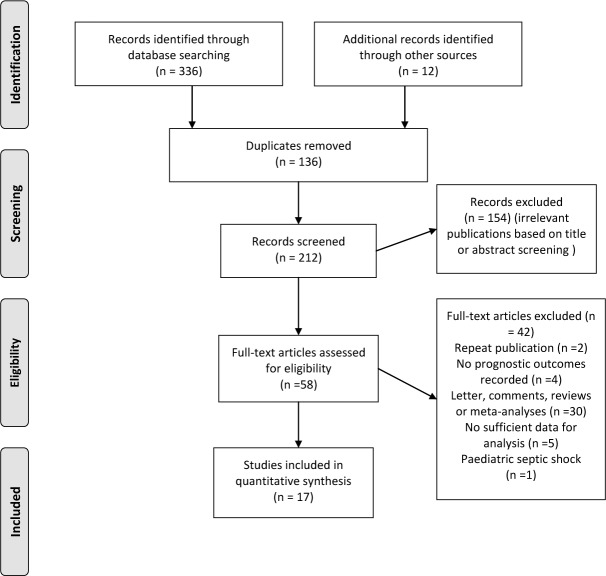
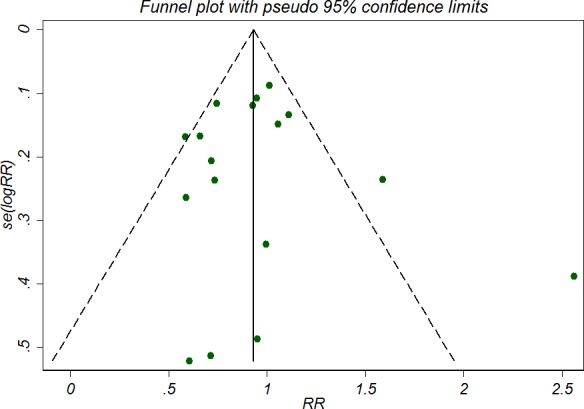
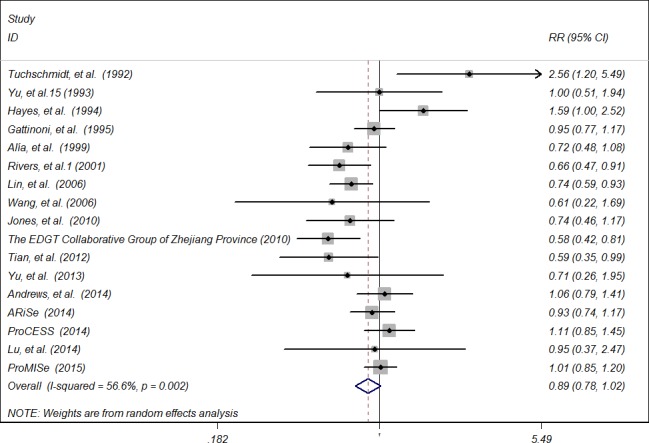
Various trials and meta-analyses have reported conflicting results concerning the application of early goal-directed therapy (EGDT) for sepsis and septic shock. The aim of this study was to update the evidence by performing a systematic review and meta-analysis. Multiple databases were searched from initial through August, 2016 for randomized controlled trials (RCTs) which investigated the associations between the use of EGDT and mortality in patients with sepsis or septic shock. Meta-analysis was performed using random-effects model and heterogeneity was examined through subgroup analyses. The primary outcome of interest was patient all-cause mortality including hospital or ICU mortality. Seventeen RCTs including 6207 participants with 3234 in the EGDT group and 2973 in the control group were eligible for this study. Meta-analysis showed that EGDT did not significantly reduce hospital or intensive care unit (ICU) mortality (relative risk [RR] 0.89, 95% CI 0.78 to 1.02) compared with control group for patients with sepsis or septic shock. The findings of subgroup analyses stratified by study region, number of research center, year of enrollment, clinical setting, sample size, timing of EGDT almost remained constant with that of the primary analysis. Our findings provide evidence that EGDT offers neutral survival effects for patients with sepsis or septic shock. Further meta-analyses based on larger well-designed RCTs or individual patient data meta-analysis are required to explore the survival benefits of EDGT in patients with sepsis or septic shock.
关于早期目标导向治疗(EGDT)在脓毒症和脓毒性休克中的应用,各种试验和荟萃分析报告的结果相互矛盾。本研究的目的是通过进行系统评价和荟萃分析来更新证据。从最初到2016年8月,对多个数据库进行了检索,以查找调查EGDT的使用与脓毒症或脓毒性休克患者死亡率之间关联的随机对照试验(RCT)。使用随机效应模型进行荟萃分析,并通过亚组分析检查异质性。感兴趣的主要结局是患者全因死亡率,包括医院或重症监护病房(ICU)死亡率。17项RCT符合本研究要求,共纳入6207名参与者,其中EGDT组3234名,对照组2973名。荟萃分析表明,对于脓毒症或脓毒性休克患者,与对照组相比,EGDT并未显著降低医院或重症监护病房(ICU)死亡率(相对风险[RR] 0.89,95%可信区间0.78至1.02)。按研究地区、研究中心数量、入组年份、临床环境、样本量、EGDT时机分层的亚组分析结果与主要分析结果基本一致。我们的研究结果表明,EGDT对脓毒症或脓毒性休克患者的生存影响呈中性。需要基于更大规模、设计良好的RCT或个体患者数据荟萃分析进行进一步的荟萃分析,以探索EGDT对脓毒症或脓毒性休克患者的生存益处。