Hayes Richard, Floyd Sian, Schaap Ab, Shanaube Kwame, Bock Peter, Sabapathy Kalpana, Griffith Sam, Donnell Deborah, Piwowar-Manning Estelle, El-Sadr Wafaa, Beyers Nulda, Ayles Helen, Fidler Sarah
Department of Infectious Disease Epidemiology, London School of Hygiene & Tropical Medicine, London, United Kingdom.
Zambart, University of Zambia School of Medicine, Lusaka, Zambia.
PLoS Med. 2017 May 2;14(5):e1002292. doi: 10.1371/journal.pmed.1002292. eCollection 2017 May.
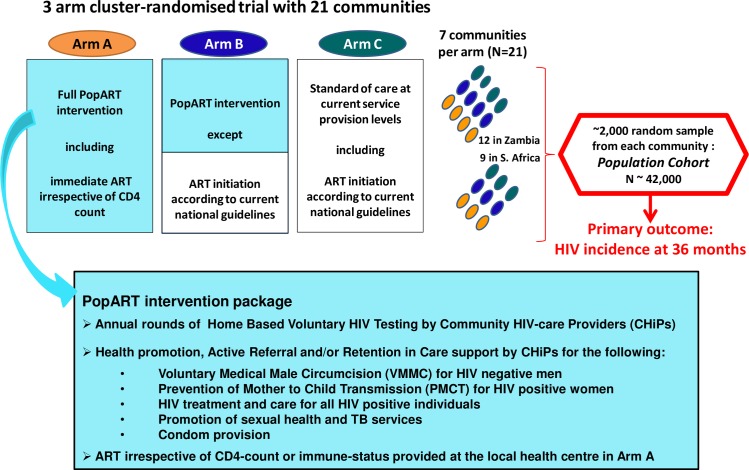
The Joint United Nations Programme on HIV/AIDS (UNAIDS) 90-90-90 targets require that, by 2020, 90% of those living with HIV know their status, 90% of known HIV-positive individuals receive sustained antiretroviral therapy (ART), and 90% of individuals on ART have durable viral suppression. The HPTN 071 (PopART) trial is measuring the impact of a universal testing and treatment intervention on population-level HIV incidence in 21 urban communities in Zambia and South Africa. We report observational data from four communities in Zambia to assess progress towards the UNAIDS targets after 1 y of the PopART intervention.
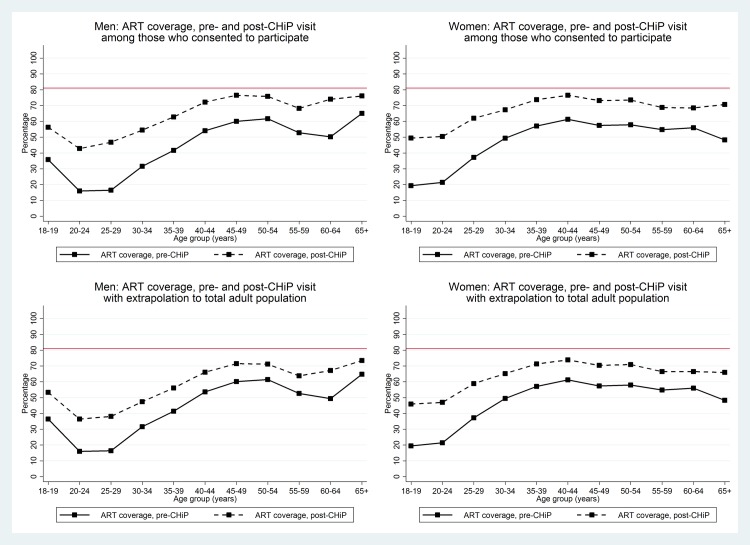
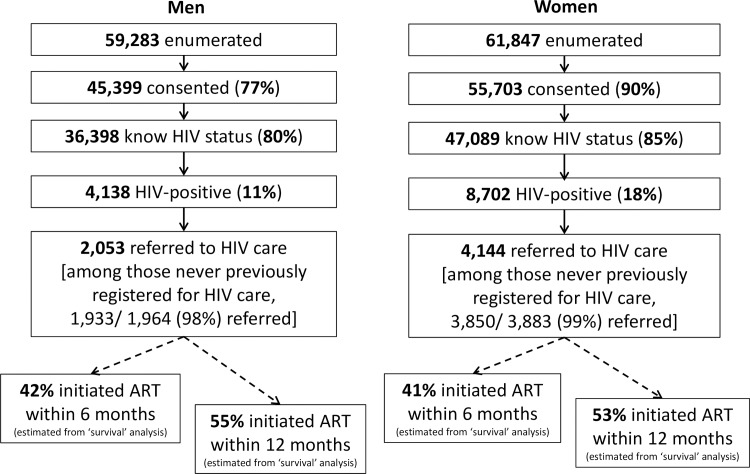
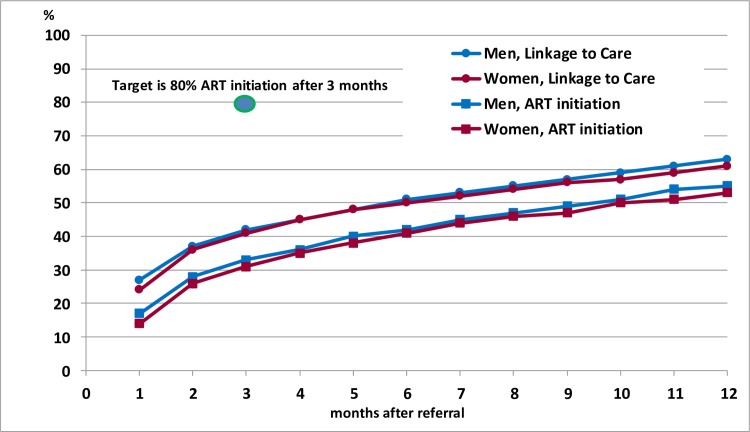
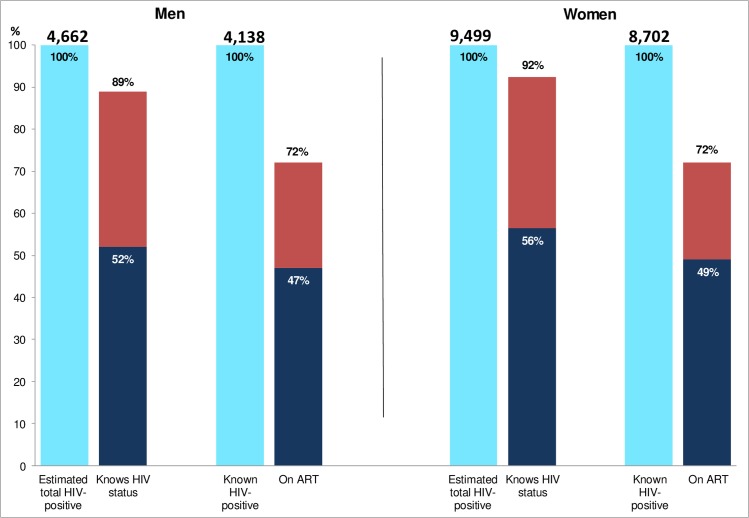
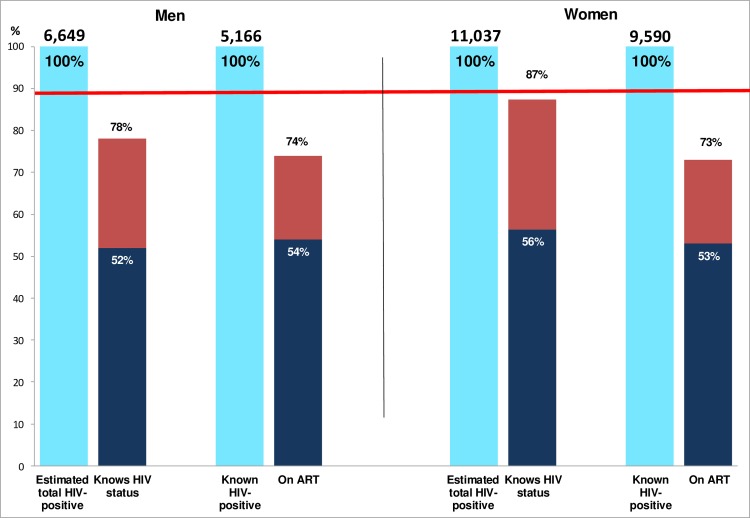
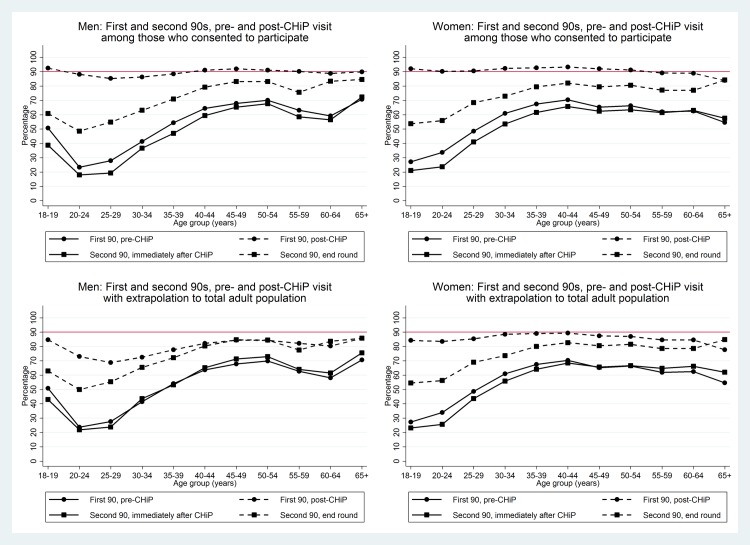
The PopART intervention comprises annual rounds of home-based HIV testing delivered by community HIV-care providers (CHiPs) who also support linkage to care, ART retention, and other services. Data from four communities in Zambia receiving the full intervention (including immediate ART for all individuals with HIV) were used to determine proportions of participants who knew their HIV status after the CHiP visit; proportions linking to care and initiating ART following referral; and overall proportions of HIV-infected individuals who knew their status (first 90 target) and the proportion of these on ART (second 90 target), pre- and post-intervention. We are not able to assess progress towards the third 90 target at this stage of the study. Overall, 121,130 adults (59,283 men and 61,847 women) were enumerated in 46,714 households during the first annual round (December 2013 to June 2015). Of the 45,399 (77%) men and 55,703 (90%) women consenting to the intervention, 80% of men and 85% of women knew their HIV status after the CHiP visit. Of 6,197 HIV-positive adults referred by CHiPs, 42% (95% CI: 40%-43%) initiated ART within 6 mo and 53% (95% CI: 52%-55%) within 12 mo. In the entire population, the estimated proportion of HIV-positive adults who knew their status increased from 52% to 78% for men and from 56% to 87% for women. The estimated proportion of known HIV-positive individuals on ART increased overall from 54% after the CHiP visit to 74% by the end of the round for men and from 53% to 73% for women. The estimated overall proportion of HIV-positive adults on ART, irrespective of whether they knew their status, increased from 44% to 61%, compared with the 81% target (the product of the first two 90 targets). Coverage was lower among young men and women than in older age groups. The main limitation of the study was the need for assumptions concerning knowledge of HIV status and ART coverage among adults not consenting to the intervention or HIV testing, although our conclusions were robust in sensitivity analyses.
In this analysis, acceptance of HIV testing among those consenting to the intervention was high, although linkage to care and ART initiation took longer than expected. Knowledge of HIV-positive status increased steeply after 1 y, almost attaining the first 90 target in women and approaching it in men. The second 90 target was more challenging, with approximately three-quarters of known HIV-positive individuals on ART by the end of the annual round. Achieving higher test uptake in men and more rapid linkage to care will be key objectives during the second annual round of the intervention.
ClinicalTrials.gov NCT01900977.
联合国艾滋病规划署(UNAIDS)的90-90-90目标要求,到2020年,90%的艾滋病病毒感染者知晓自身感染状况,90%已知感染艾滋病病毒的个体接受持续抗逆转录病毒治疗(ART),且90%接受ART治疗的个体实现病毒学持久抑制。HPTN 071(PopART)试验正在评估一项普遍检测与治疗干预措施对赞比亚和南非21个城市社区人群层面艾滋病病毒发病率的影响。我们报告来自赞比亚四个社区的观察性数据,以评估PopART干预1年后在实现UNAIDS目标方面取得的进展。
PopART干预包括由社区艾滋病护理提供者(CHiPs)每年进行的上门艾滋病病毒检测,这些提供者还支持与护理的联系、ART治疗的留存以及其他服务。来自赞比亚接受全面干预(包括为所有艾滋病病毒感染者立即提供ART治疗)的四个社区的数据,用于确定在CHiPs上门后知晓自身艾滋病病毒感染状况的参与者比例;转诊后与护理建立联系并开始接受ART治疗的比例;以及干预前后知晓自身感染状况的艾滋病病毒感染者的总体比例(第一个90%目标)和接受ART治疗的比例(第二个90%目标)。在本研究阶段,我们无法评估在实现第三个90%目标方面的进展。总体而言,在第一轮年度检测(2013年12月至2015年6月)期间,在46,714户家庭中统计了121,130名成年人(59,283名男性和61,847名女性)。在同意参与干预的45,399名(77%)男性和55,703名(90%)女性中,80%的男性和85%的女性在CHiPs上门后知晓了自身的艾滋病病毒感染状况。在CHiPs转诊的6,197名艾滋病病毒阳性成年人中,42%(95%置信区间:40%-43%)在6个月内开始接受ART治疗,53%(95%置信区间:52%-55%)在12个月内开始接受治疗。在整个人口中,估计知晓自身感染状况的艾滋病病毒阳性成年人比例,男性从52%增至78%,女性从56%增至87%。估计已知感染艾滋病病毒且接受ART治疗的个体比例总体上从CHiPs上门后的54%增至该轮结束时的74%,男性从53%增至73%,女性从53%增至73%。估计接受ART治疗的艾滋病病毒阳性成年人的总体比例,无论其是否知晓自身感染状况,从44%增至61%,而目标比例为81%(前两个90%目标的乘积)。年轻男性和女性中的覆盖率低于老年人群体。本研究的主要局限性在于,对于未同意参与干预或未接受艾滋病病毒检测的成年人,需要对其艾滋病病毒感染状况知晓率和ART治疗覆盖率进行假设,尽管我们的结论在敏感性分析中是稳健的。
在本分析中,同意参与干预的人群中对艾滋病病毒检测的接受度较高,尽管与护理的联系以及开始接受ART治疗的时间比预期更长。1年后,艾滋病病毒阳性状况的知晓率急剧上升,女性几乎达到第一个90%目标,男性接近该目标。第二个90%目标更具挑战性,到年度检测结束时,约四分之三已知感染艾滋病病毒的个体接受了ART治疗。在第二轮年度干预中,提高男性的检测参与率以及更快地与护理建立联系将是关键目标。
ClinicalTrials.gov NCT01900977