Voorde Pia C Ten, Rasmussen Jeppe V, Olsen Bo S, Brorson Stig
Department of Orthopedic Surgery , Herlev Hospital, University of Copenhagen, Copenhagen , Denmark.
Acta Orthop. 2015 Jun;86(3):293-7. doi: 10.3109/17453674.2015.1018761. Epub 2015 Feb 12.
There is no consensus on which type of shoulder prosthesis should be used in patients with rheumatoid arthritis (RA). We describe patients with RA who were treated with shoulder replacement, regarding patient-reported outcome, prosthesis survival, and causes of revision, and we compare outcome after resurfacing hemi-arthroplasty (RHA) and stemmed hemi-arthroplasty (SHA).
We used data from the national Danish Shoulder Arthroplasty Registry and included patients with RA who underwent shoulder arthroplasty in Denmark between 2006 and 2010. Patient-reported outcome was obtained 1-year postoperatively using the Western Ontario Osteoarthritis of the Shoulder index (WOOS), and rates of revision were calculated by checking revisions reported until December 2011. The patient-reported outcome of RHA was compared to that of SHA using regression analysis with adjustment for age, sex, and previous surgery.
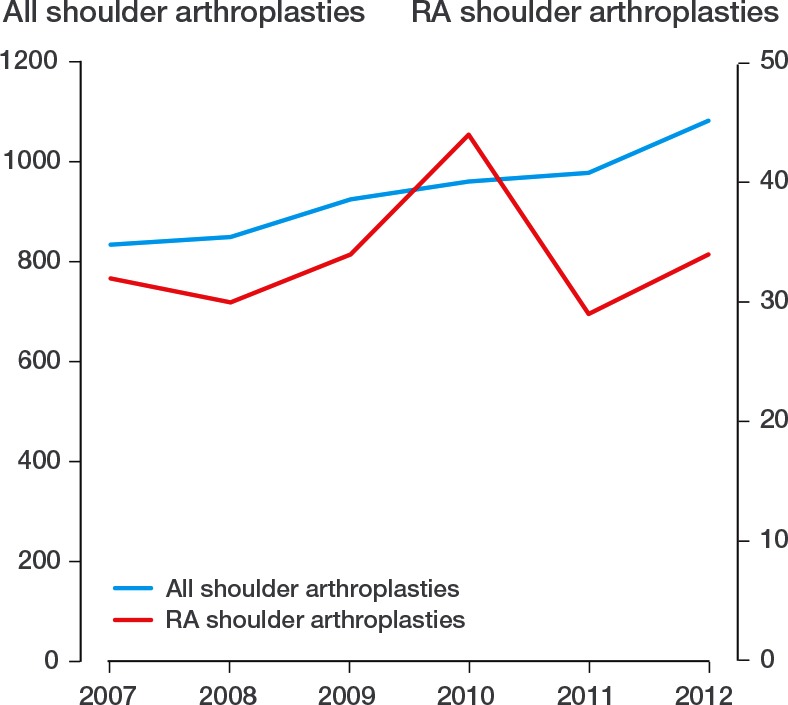
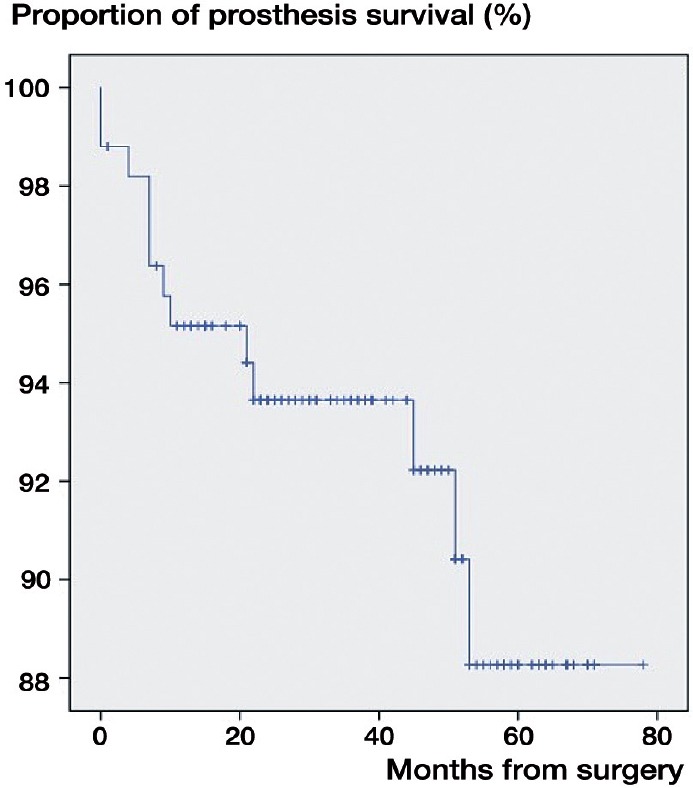
During the study period, 167 patients underwent shoulder arthroplasty because of rheumatoid arthritis, 80 (48%) of whom received RHA and 34 (26%) of whom received SHA. 16 patients were treated with total stemmed shoulder arthroplasty (TSA), and 24 were treated with reverse shoulder arthroplasty (rTSA). 130 patients returned a completed questionnaire, and the total mean WOOS score was 63. The cumulative 5-year revision rate was 7%. Most revisions occurred after RHA, with a revision rate of 14%. Mean WOOS score was similar for RHA and for SHA.
This study shows that shoulder arthroplasty, regardless of design, is a good option in terms of reducing pain and improving function in RA patients. The high revision rate in the RHA group suggests that other designs may offer better implant survival. However, this should be confirmed in larger studies.
对于类风湿性关节炎(RA)患者应使用哪种类型的肩部假体尚无共识。我们描述了接受肩部置换治疗的RA患者的患者报告结局、假体生存率及翻修原因,并比较了表面置换半关节成形术(RHA)和带柄半关节成形术(SHA)后的结局。
我们使用了丹麦国家肩部置换登记处的数据,纳入了2006年至2010年间在丹麦接受肩部置换术的RA患者。术后1年使用西安大略肩关节炎指数(WOOS)获得患者报告结局,并通过检查截至2011年12月报告的翻修情况计算翻修率。使用回归分析对年龄、性别和既往手术进行调整,比较RHA和SHA的患者报告结局。
在研究期间,167例患者因类风湿性关节炎接受了肩部置换术,其中80例(48%)接受了RHA,34例(26%)接受了SHA。16例患者接受了全柄肩部置换术(TSA),24例患者接受了反置肩部置换术(rTSA)。130例患者返回了完整的问卷,总平均WOOS评分为63分。5年累计翻修率为7%。大多数翻修发生在RHA后,翻修率为14%。RHA和SHA的平均WOOS评分相似。
本研究表明,无论设计如何,肩部置换术在减轻RA患者疼痛和改善功能方面都是一个不错的选择。RHA组的高翻修率表明其他设计可能提供更好的假体生存率。然而,这一点应在更大规模的研究中得到证实。