Kohmoto Tomohiro, Okamoto Nana, Naruto Takuya, Murata Chie, Ouchi Yuya, Fujita Naoko, Inagaki Hidehito, Satomura Shigeko, Okamoto Nobuhiko, Saito Masako, Masuda Kiyoshi, Kurahashi Hiroki, Imoto Issei
Department of Human Genetics, Graduate School of Biomedical Sciences, Tokushima University, 3-18-15 Kuramoto-cho, Tokushima, 770-8503 Japan.
Department of Oral and Maxillofacial Surgery, Kobe University Graduate School of Medicine, 7-5-1 Kusunoki-cho, Chuo-ku, Kobe, Hyogo 650-0017 Japan.
Mol Cytogenet. 2017 Apr 28;10:15. doi: 10.1186/s13039-017-0316-6. eCollection 2017.
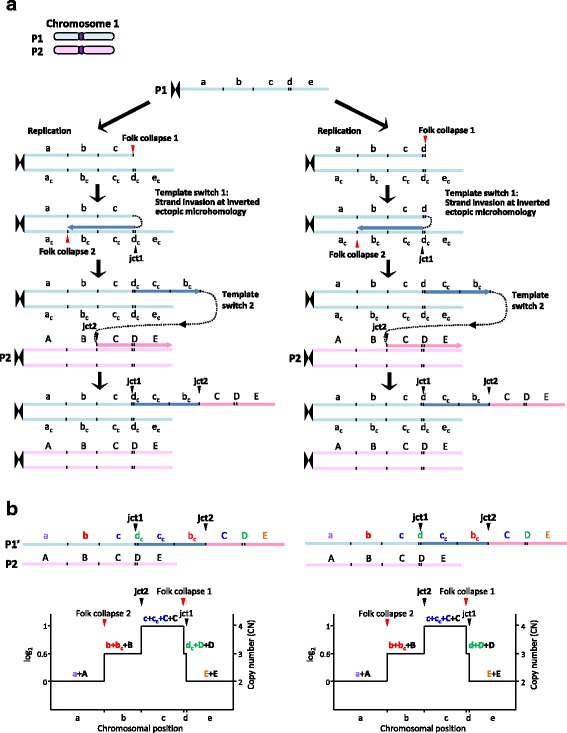
Complex genomic rearrangements (CGRs) consisting of interstitial triplications in conjunction with uniparental isodisomy (isoUPD) have rarely been reported in patients with multiple congenital anomalies (MCA)/intellectual disability (ID). One-ended DNA break repair coupled with microhomology-mediated break-induced replication (MMBIR) has been recently proposed as a possible mechanism giving rise to interstitial copy number gains and distal isoUPD, although only a few cases providing supportive evidence in human congenital diseases with MCA have been documented.
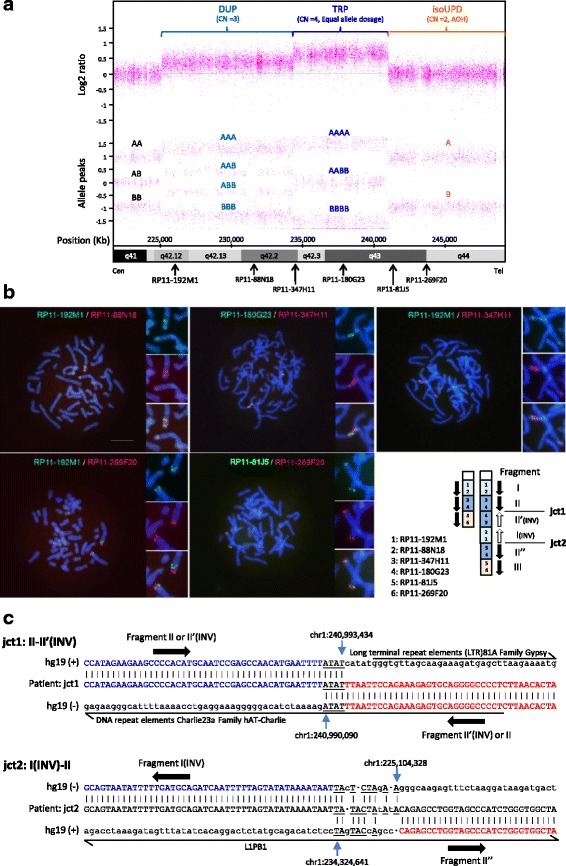
Here, we report on the chromosomal microarray (CMA)-based identification of the first known case with concurrent interstitial duplication at 1q42.12-q42.2 and triplication at 1q42.2-q43 followed by isoUPD for the remainder of chromosome 1q (at 1q43-qter). In distal 1q duplication/triplication overlapping with 1q42.12-q43, variable clinical features have been reported, and our 25-year-old patient with MCA/ID presented with some of these frequently described features. Further analyses including the precise mapping of breakpoint junctions within the CGR in a sequence level suggested that the CGR found in association with isoUPD in our case is a triplication with flanking duplications, characterized as a triplication with a particularly long duplication-inverted triplication-duplication (DUP-TRP/INV-DUP) structure. Because microhomology was observed in both junctions between the triplicated region and the flanking duplicated regions, our case provides supportive evidence for recently proposed replication-based mechanisms, such as MMBIR, underlying the formation of CGRs + isoUPD implicated in chromosomal disorders.
To the best of our knowledge, this is the first case of CGRs + isoUPD observed in 1q and having DUP-TRP/INV-DUP structure with a long proximal duplication, which supports MMBIR-based model for genomic rearrangements. Molecular cytogenetic analyses using CMA containing single-nucleotide polymorphism probes with further analyses of the breakpoint junctions are recommended in cases suspected of having complex chromosomal abnormalities based on discrepancies between clinical and conventional cytogenetic findings.
由间质性重复与单亲同源二体(isoUPD)共同构成的复杂基因组重排(CGRs)在患有多种先天性异常(MCA)/智力残疾(ID)的患者中鲜有报道。尽管在人类患有MCA的先天性疾病中仅有少数病例提供了支持性证据,但最近有人提出,一端DNA断裂修复与微同源性介导的断裂诱导复制(MMBIR)可能是导致间质性拷贝数增加和远端isoUPD的一种机制。
在此,我们报告了首例基于染色体微阵列(CMA)鉴定出的病例,该病例在1q42.12 - q42.2处存在间质性重复,在1q42.2 - q43处存在三倍体,随后1q染色体的其余部分(1q43 - qter)出现isoUPD。在与1q42.12 - q43重叠的1q远端重复/三倍体中,已有多种可变临床特征的报道,我们这位患有MCA/ID的25岁患者表现出了其中一些常见特征。包括在序列水平上对CGR内断点连接进行精确映射在内的进一步分析表明,我们病例中与isoUPD相关的CGR是一种带有侧翼重复的三倍体,其特征为具有特别长的重复 - 倒位三倍体 - 重复(DUP - TRP/INV - DUP)结构。由于在三倍体区域与侧翼重复区域之间的两个连接处均观察到微同源性,我们的病例为最近提出的基于复制的机制(如MMBIR)提供了支持性证据,该机制是涉及染色体疾病的CGRs + isoUPD形成的基础。
据我们所知,这是在1q中观察到的首例具有DUP - TRP/INV - DUP结构且近端重复较长的CGRs + isoUPD病例,它支持基于MMBIR 的基因组重排模型。对于基于临床和传统细胞遗传学结果之间的差异而怀疑存在复杂染色体异常的病例,建议使用包含单核苷酸多态性探针的CMA进行分子细胞遗传学分析,并进一步分析断点连接。