Chatham W, Chadha A, Fettiplace J, Kleoudis C, Bass D, Roth D, Gordon D
1 University of Alabama at Birmingham, Birmingham, USA.
2 Austin Regional Clinic, Austin, USA.
Lupus. 2017 Dec;26(14):1483-1490. doi: 10.1177/0961203317703495. Epub 2017 May 3.
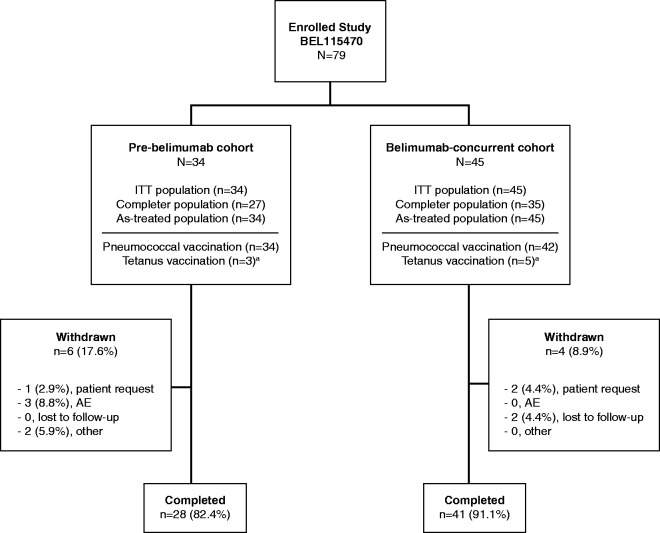
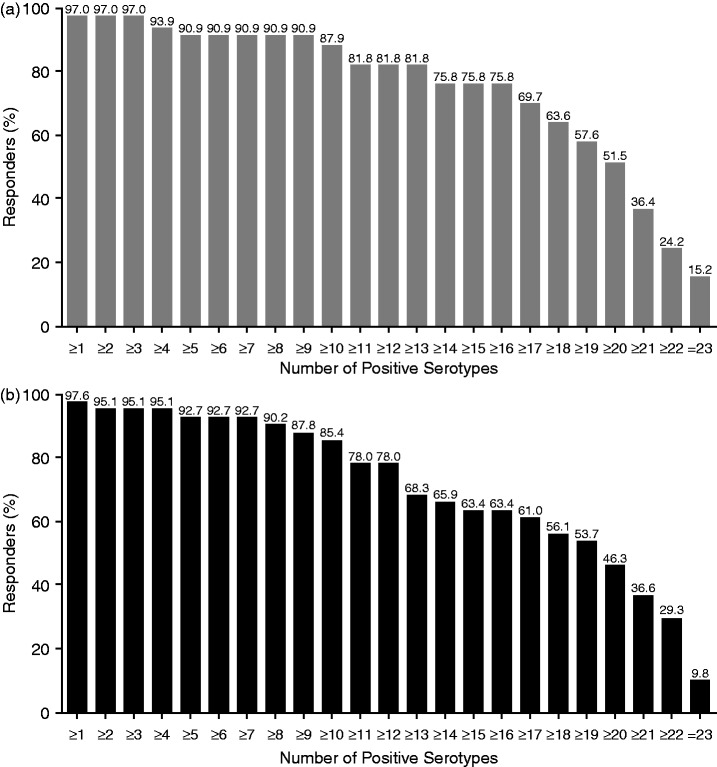
Objective Intravenous belimumab 10 mg/kg is approved as an add-on therapy in patients with active, autoantibody-positive systemic lupus erythematosus. This study aimed to assess the impact of belimumab on immune response to pneumococcal vaccination in patients with systemic lupus erythematosus. Methods This was a Phase 4, open-label study (GSK BEL115470; NCT01597492) conducted in the United States. Patients were randomized (7:9) to receive a 23-valent pneumococcal vaccination four weeks prior to (pre-belimumab cohort) or 24 weeks after (belimumab-concurrent cohort) commencing four-weekly belimumab 10 mg/kg intravenous treatment plus standard systemic lupus erythematosus therapy. Analyses of vaccine titers were performed on the as-treated population (received ≥1 dose of belimumab). The primary endpoint was the proportion of patients with positive antibody responses (≥2-fold increase from pre-vaccination levels, or post-vaccination level ≥ 0.6 µg/mL if pre-vaccination levels were unquantifiable) to ≥1 of 23 pneumococcal vaccine serotypes, four weeks post vaccination. Other endpoints included the proportion of patients with positive antibody responses to ≥2 to ≥10, and ≥11-23 (post hoc analysis) of serotypes. Safety was assessed by monitoring adverse events. Results Seventy-nine patients received pneumococcal vaccination (pre-belimumab cohort, n = 34; belimumab-concurrent cohort, n = 45). The majority (87.3% [69/79]) completed the study; 10 (12.7%) withdrew (patient request, n = 3; adverse event, n = 3; lost to follow-up, n = 2; other, n = 2). At Week 4 post-vaccination, 97.0% (32/33) and 97.6% (40/41) of patients (pre-belimumab and concurrent belimumab cohorts, respectively) had a positive response to ≥1 of 23 pneumococcal serotypes. Over 85% of patients in both cohorts responded to ≥10 of serotypes, approximately 80% responded to ≥12 serotypes, and approximately two-thirds responded to ≥16 serotypes. Little difference was observed between cohorts across a broad response, up to 23 serotypes. Eight (23.5%) patients experienced an adverse event considered by the investigator to be treatment-related in the pre-belimumab cohort and four (8.9%) in the belimumab-concurrent cohort; seven patients experienced non-fatal serious adverse events (pre-belimumab cohort, 11.8% [ n = 4]; concurrent-belimumab cohort, 6.7% [ n = 3]), and no deaths were reported. Conclusion The proportion of patients generating a response to ≥1 pneumococcal serotype did not differ between the pre-belimumab and belimumab-concurrent cohorts; the proportions were also comparable across a broader response (from ≥2 serotypes to 23 serotypes).
目的 静脉注射贝利尤单抗10mg/kg被批准作为活动性、自身抗体阳性系统性红斑狼疮患者的一种附加疗法。本研究旨在评估贝利尤单抗对系统性红斑狼疮患者肺炎球菌疫苗免疫反应的影响。方法 这是一项在美国进行的4期开放标签研究(GSK BEL115470;NCT01597492)。患者被随机分组(7:9),在开始每四周静脉注射10mg/kg贝利尤单抗加标准系统性红斑狼疮治疗前四周(贝利尤单抗治疗前队列)或开始治疗后24周(贝利尤单抗同期队列)接受23价肺炎球菌疫苗接种。对接受治疗的人群(接受≥1剂贝利尤单抗)进行疫苗滴度分析。主要终点是接种疫苗四周后,对23种肺炎球菌疫苗血清型中≥1种产生阳性抗体反应(较接种前水平增加≥2倍,或接种前水平不可量化时接种后水平≥0.6μg/mL)的患者比例。其他终点包括对≥2至≥10种以及≥11 - 23种血清型产生阳性抗体反应的患者比例(事后分析)。通过监测不良事件评估安全性。结果 79例患者接受了肺炎球菌疫苗接种(贝利尤单抗治疗前队列,n = 34;贝利尤单抗同期队列,n = 45)。大多数(87.3% [69/79])完成了研究;10例(12.7%)退出(患者要求,n = 3;不良事件,n = 3;失访,n = 2;其他,n = 2)。接种疫苗后第4周,(分别为贝利尤单抗治疗前和同期贝利尤单抗队列)97.0%(32/33)和97.6%(40/41)的患者对23种肺炎球菌血清型中≥1种产生阳性反应。两个队列中超过85%的患者对≥10种血清型有反应,约80%的患者对≥12种血清型有反应,约三分之二的患者对≥16种血清型有反应。在对多达23种血清型的广泛反应中,两个队列之间观察到的差异很小。8例(23.5%)患者在贝利尤单抗治疗前队列中经历了研究者认为与治疗相关的不良事件,在贝利尤单抗同期队列中有4例(8.9%);7例患者经历了非致命严重不良事件(贝利尤单抗治疗前队列,11.8% [n = 4];同期贝利尤单抗队列,6.7% [n = 3]),未报告死亡病例。结论 贝利尤单抗治疗前和同期贝利尤单抗队列中对≥1种肺炎球菌血清型产生反应的患者比例无差异;在更广泛的反应(从≥2种血清型到23种血清型)中比例也相当。