Schunk Michaela, Reitmeir Peter, Rückert-Eheberg Ina-Maria, Tamayo Teresa, Schipf Sabine, Meisinger Christa, Peters Annette, Scheidt-Nave Christa, Ellert Ute, Hartwig Saskia, Kluttig Alexander, Völzke Henry, Holle Rolf
Helmholtz Zentrum München, German Research Center for Environmental Health (GmbH), Institute of Health Economics and Health Care Management, Neuherberg, Germany.
German Center for Diabetes Research (DZD), Partner Site Helmholtz Zentrum München, Germany.
PLoS One. 2017 May 3;12(5):e0176895. doi: 10.1371/journal.pone.0176895. eCollection 2017.
The objective of this analysis is to compare people with prevalent type 2 diabetes, incident type 2 diabetes and without diabetes with respect to longitudinal change in health-related quality of life (HRQOL) when adjusting for baseline determinants of HRQOL.
Primary baseline and follow-up data from three regional and one national population-based cohort studies in Germany were pooled for analysis. HRQOL was measured using physical and mental health summary scores (PCS and MCS) from the German version of the Short Form Health Survey with 36 or 12 items. Mean score change per observation year was compared between the three groups (prevalent diabetes, incident diabetes, no diabetes) based on linear regression models.
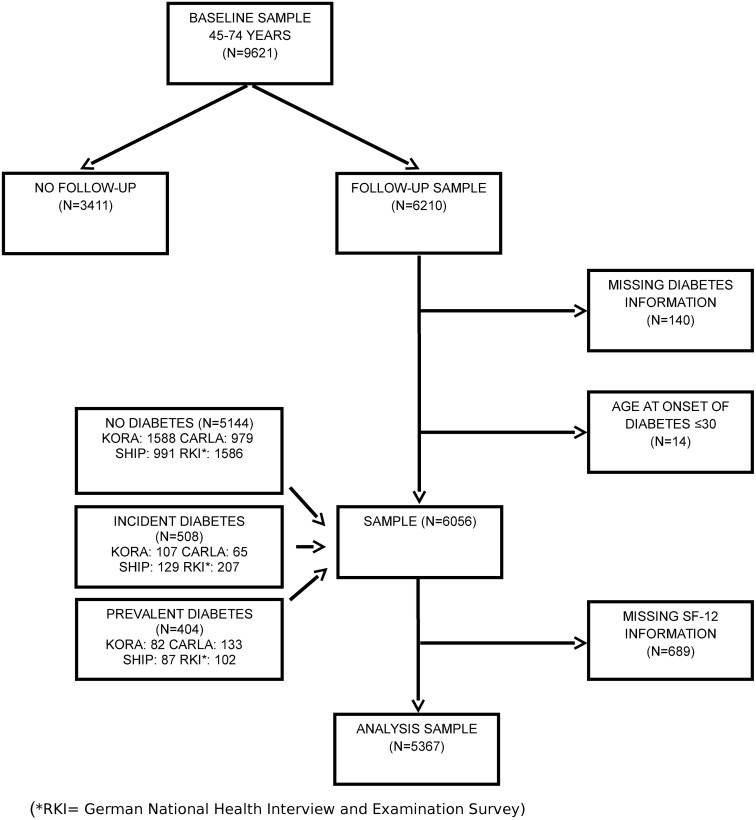
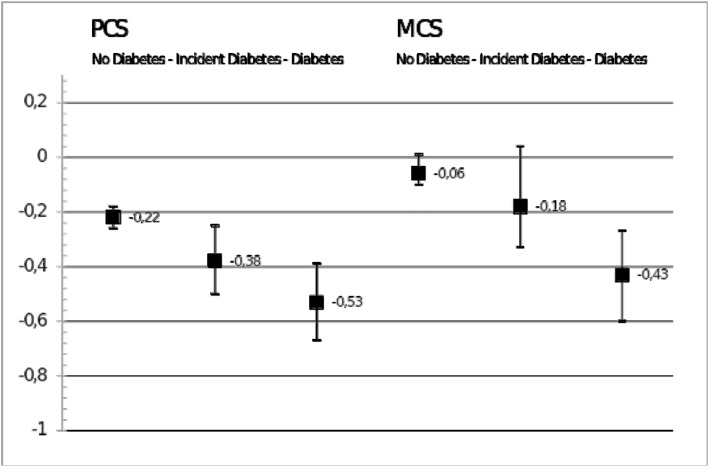
The analysis included pooled data from 5367 people aged 45-74 years at baseline. Of these, 85.5% reported no diabetes at baseline and follow-up, 6.3% reported diabetes at both baseline and follow-up (prevalent diabetes), and 8.2% reported diabetes only at follow-up (incident diabetes). Over a mean observation period of 8.7 years, annual decline in HRQOL scores is pronounced at 0.27-0.32 (PCS) and 0.34-0.38 (MCS) in the group with prevalent diabetes compared with people without diabetes. Those with incident diabetes showed intermediate values but did not differ significantly from people without diabetes after adjustment for covariates in the full model.
Compared with data from cross-sectional analysis, the HRQOL loss associated with prevalent diabetes appears to be much larger than previously assumed.
本分析的目的是在调整健康相关生活质量(HRQOL)的基线决定因素后,比较患有2型糖尿病、新发2型糖尿病和无糖尿病的人群在HRQOL方面的纵向变化。
汇总了德国三项地区性和一项全国性基于人群的队列研究的主要基线和随访数据进行分析。使用德国版36项或12项简短健康调查问卷中的身体和心理健康汇总评分(PCS和MCS)来测量HRQOL。基于线性回归模型比较了三组(糖尿病患者、新发糖尿病患者、无糖尿病患者)之间每年的平均评分变化。
分析纳入了5367名基线年龄在45 - 74岁的人群的汇总数据。其中,85.5%的人在基线和随访时均报告无糖尿病,6.3%的人在基线和随访时均报告患有糖尿病(糖尿病患者),8.2%的人仅在随访时报告患有糖尿病(新发糖尿病患者)。在平均8.7年的观察期内,与无糖尿病的人群相比,糖尿病患者组的HRQOL评分每年显著下降0.27 - 0.32(PCS)和0.34 - 0.38(MCS)。新发糖尿病患者的数值处于中间水平,但在全模型中调整协变量后与无糖尿病的人群无显著差异。
与横断面分析的数据相比,与糖尿病患者相关的HRQOL损失似乎比之前假设的要大得多。