Department of Medicine, Division of Nephrology, University of Utah and VA Medical Centers, Salt Lake City, Utah, USA.
SymbioCellTech, LLC, Salt Lake City, Utah, USA.
Stem Cells Transl Med. 2017 Jul;6(7):1631-1643. doi: 10.1002/sctm.17-0005. Epub 2017 May 3.
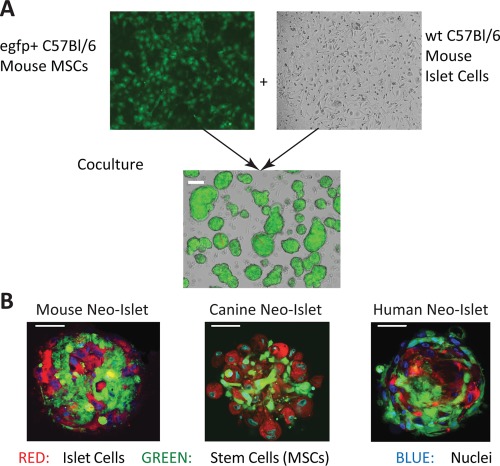
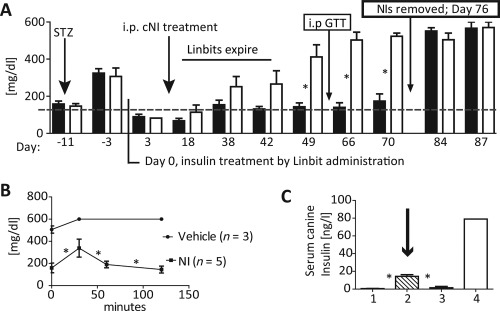
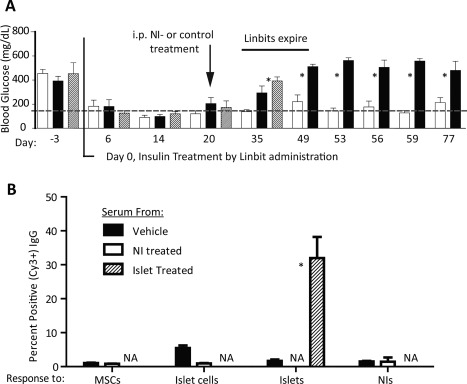
Novel interventions that reestablish endogenous insulin secretion and thereby halt progressive end-organ damage and prolong survival of patients with autoimmune Type 1 diabetes mellitus (T1DM) are urgently needed. While this is currently accomplished with allogeneic pancreas or islet transplants, their utility is significantly limited by both the scarcity of organ donors and life-long need for often-toxic antirejection drugs. Coadministering islets with bone marrow-derived mesenchymal stem cells (MSCs) that exert robust immune-modulating, anti-inflammatory, anti-apoptotic, and angiogenic actions, improves intrahepatic islet survival and function. Encapsulation of insulin-producing cells to prevent immune destruction has shown both promise and failures. Recently, stem cell-derived insulin secreting β-like cells induced euglycemia in diabetic animals, although their clinical use would still require encapsulation or anti-rejection drugs. Instead of focusing on further improvements in islet transplantation, we demonstrate here that the intraperitoneal administration of islet-sized "Neo-Islets" (NIs), generated by in vitro coaggregation of allogeneic, culture-expanded islet cells with high numbers of immuno-protective and cyto-protective MSCs, resulted in their omental engraftment in immune-competent, spontaneously diabetic nonobese diabetic (NOD) mice. This achieved long-term glycemic control without immunosuppression and without hypoglycemia. In preparation for an Food and Drug Administration-approved clinical trial in dogs with T1DM, we show that treatment of streptozotocin-diabetic NOD/severe combined immunodeficiency mice with identically formed canine NIs produced durable euglycemia, exclusively mediated by dog-specific insulin. We conclude that this novel technology has significant translational relevance for canine and potentially clinical T1DM as it effectively addresses both the organ donor scarcity (>80 therapeutic NI doses/donor pancreas can be generated) and completely eliminates the need for immunosuppression. Stem Cells Translational Medicine 2017;6:1631-1643.
需要新的干预措施来重新建立内源性胰岛素分泌,从而阻止自身免疫性 1 型糖尿病(T1DM)患者进行性终末器官损伤并延长其生存时间。虽然目前可以通过同种异体胰腺或胰岛移植来实现这一目标,但由于器官供体的稀缺性以及终生需要经常使用有毒的抗排斥药物,其应用受到了极大的限制。与骨髓来源的间充质干细胞(MSCs)共给予胰岛,可发挥强大的免疫调节、抗炎、抗凋亡和血管生成作用,从而改善肝内胰岛的存活和功能。用胰岛素产生细胞进行包封以防止免疫破坏已经显示出既有希望又有失败。最近,来源于干细胞的胰岛素分泌β样细胞在糖尿病动物中诱导了血糖正常化,尽管它们的临床应用仍需要包封或抗排斥药物。我们没有专注于进一步改善胰岛移植,而是在此展示了通过体外共聚集同种异体、培养扩增的胰岛细胞与大量免疫保护和细胞保护 MSC 生成胰岛大小的“Neo-Islets”(NIs),然后经腹腔给予这些胰岛大小的“Neo-Islets”(NIs),可使其在免疫活性、自发性糖尿病非肥胖型糖尿病(NOD)小鼠的大网膜中移植。这种方法实现了长期血糖控制,而无需免疫抑制且无低血糖。为了在 T1DM 犬中进行获得食品和药物管理局批准的临床试验,我们证明了用同种异体形成的犬 NIs 治疗链脲佐菌素诱导的糖尿病 NOD/严重联合免疫缺陷小鼠可产生持久的血糖正常化,这完全由犬特异性胰岛素介导。我们得出结论,这种新技术对犬和潜在的临床 T1DM 具有重要的转化相关性,因为它有效地解决了器官供体稀缺性(>80 个治疗性 NI 剂量/供体胰腺可产生)和完全消除了对免疫抑制的需求。Stem Cells Translational Medicine 2017;6:1631-1643.