Michopoulos Spyridon, Manios Efstathios, Kourkoutas Helias, Argyriou Konstantinos, Leonidakis Georgios, Zampeli Evanthia, Stamatelopoulos Kimon, Dimopoulos Athanasios-Meletios
Gastroenterology Unit, "Alexandra" Hospital (Spyridon Michopoulos, Helias Kourkoutas, Konstantinos Argyriou, Georgios Leonidakis, Evanthia Zampeli).
Department of Clinical Therapeutics, National and Kapodistrian University of Athens, Medical School, Alexandra Hospital (Efstathios Manios, Kimon Stamatelopoulos, Athanasios-Meletios Dimopoulos), Athens, Greece.
Ann Gastroenterol. 2017;30(3):315-321. doi: 10.20524/aog.2017.0127. Epub 2017 Feb 9.
Compliance rates for colorectal cancer (CRC) screening are much lower than those desired. Appropriate information on CRC risks and screening methods is supposed to stimulate motivation for screening. We aimed to identify parameters associated with the decision for CRC screening and colonoscopy in a population expected to have high awareness of disease prevention.
In a single-center, cross-sectional study, we used an anonymous questionnaire (AQ) to record the demographics, habits and screening behavior for cancers and other common diseases of all employees older than 50 years in our hospital.
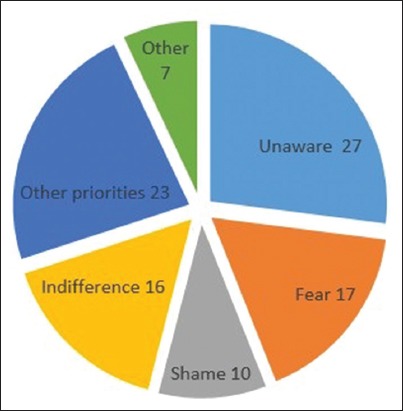
Among 287 active employees, 83% (n=237) answered the AQ (age 55±4 years). Thirty percent (n=70) underwent colonoscopy while 17% (n=40) underwent CRC screening (39/40) colonoscopy). Comparatively, among women 97% had a Pap-smear, 92% a mammography, while among men 83% had been tested for serum prostate-specific antigen. Age, male sex, alcohol consumption and university education correlated positively with CRC screening (P<0.05 for all). After multivariate analysis, university education remained an independent determinant of CRC screening (OR 2.488, 95%CI 1.096-5.648; P=0.029). Among subjects who had not undergone colonoscopy in the past, ignorance of the need for CRC screening (OR 0.360, 95%CI 0.150-0.867; P=0.023) and indifference to undergo such a procedure (OR 0.188, 95%CI 0.066-0.537; P=0.002) were independent determinants for not planning a future screening colonoscopy.
Education was the most important factor in the decision to undergo CRC screening. Colonoscopy was the preferred screening method. Ignorance of and indifference to CRC risks were the major obstacles for a future screening colonoscopy.
结直肠癌(CRC)筛查的依从率远低于预期。关于CRC风险和筛查方法的适当信息理应能激发筛查的积极性。我们旨在确定在一个预期对疾病预防有较高认识的人群中,与CRC筛查和结肠镜检查决策相关的参数。
在一项单中心横断面研究中,我们使用匿名问卷(AQ)记录了我院所有50岁以上员工的人口统计学特征、习惯以及癌症和其他常见疾病的筛查行为。
在287名在职员工中,83%(n = 237)回答了AQ(年龄55±4岁)。30%(n = 70)接受了结肠镜检查,而17%(n = 40)进行了CRC筛查(39/40为结肠镜检查)。相比之下,女性中97%进行了巴氏涂片检查,92%进行了乳房X线摄影检查,而男性中83%接受了血清前列腺特异性抗原检测。年龄、男性性别、饮酒和大学教育与CRC筛查呈正相关(均P<0.05)。多因素分析后,大学教育仍然是CRC筛查的独立决定因素(OR 2.488,95%CI 1.096 - 5.648;P = 0.029)。在过去未接受结肠镜检查的受试者中,对CRC筛查需求的无知(OR 0.360,95%CI 0.150 - 0.867;P = 0.023)和对进行该检查的冷漠态度(OR 0.188,95%CI 0.066 - 0.537;P = 0.002)是不计划未来进行筛查结肠镜检查的独立决定因素。
教育是决定是否进行CRC筛查的最重要因素。结肠镜检查是首选的筛查方法。对CRC风险的无知和冷漠是未来进行筛查结肠镜检查的主要障碍。