Deng Chao, Gu Ya-Juan, Zhang Hong, Zhang Jun
Department of Anesthesiology, First Affiliated Hospital, School of Medicine, Shihezi University, Shihezi, Xinjiang Uygur Autonomous Region, China.
Department of Obstetrics and Gynecology, First Affiliated Hospital, School of Medicine, Shihezi University, Shihezi, Xinjiang Uygur Autonomous Region, China.
Neural Regen Res. 2017 Mar;12(3):464-469. doi: 10.4103/1673-5374.202925.
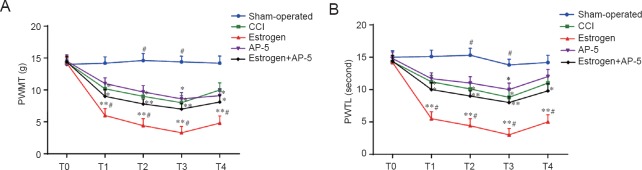
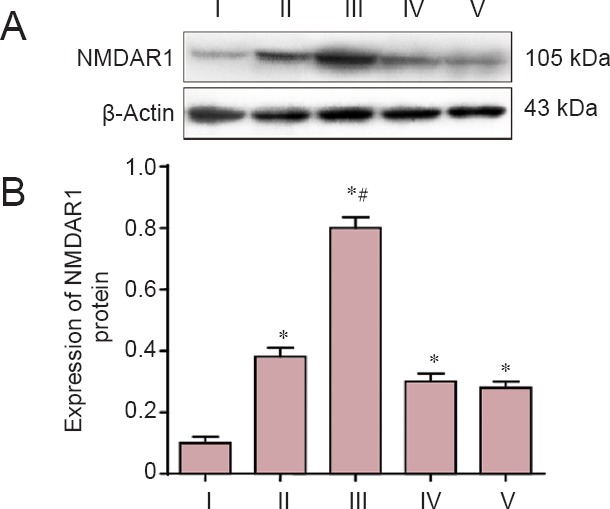
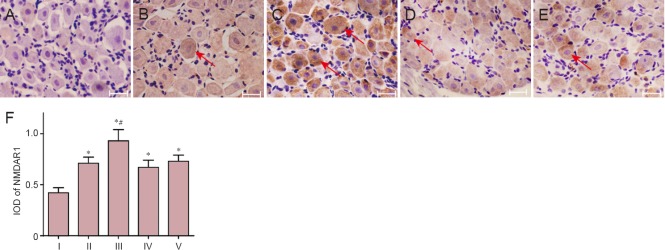
Estrogen affects the generation and transmission of neuropathic pain, but the specific regulatory mechanism is still unclear. Activation of the N-methyl-D-aspartate acid receptor 1 (NMDAR1) plays an important role in the production and maintenance of hyperalgesia and allodynia. The present study was conducted to determine whether a relationship exists between estrogen and NMDAR1 in peripheral nerve pain. A chronic sciatic nerve constriction injury model of chronic neuropathic pain was established in rats. These rats were then subcutaneously injected with 17β-estradiol, the NMDAR1 antagonist D(-)-2-amino-5-phosphonopentanoic acid (AP-5), or both once daily for 15 days. Compared with injured drug naïve rats, rats with chronic sciatic nerve injury that were administered estradiol showed a lower paw withdrawal mechanical threshold and a shorter paw withdrawal thermal latency, indicating increased sensitivity to mechanical and thermal pain. Estrogen administration was also associated with increased expression of NMDAR1 immunoreactivity (as assessed by immunohistochemistry) and protein (as determined by western blot assay) in spinal dorsal root ganglia. This 17β-estradiol-induced increase in NMDAR1 expression was blocked by co-administration with AP-5, whereas AP-5 alone did not affect NMDAR1 expression. These results suggest that 17β-estradiol administration significantly reduced mechanical and thermal pain thresholds in rats with chronic constriction of the sciatic nerve, and that the mechanism for this increased sensitivity may be related to the upregulation of NMDAR1 expression in dorsal root ganglia.
雌激素影响神经性疼痛的产生和传导,但其具体调控机制仍不清楚。N-甲基-D-天冬氨酸受体1(NMDAR1)的激活在痛觉过敏和异常性疼痛的产生及维持中起重要作用。本研究旨在确定在外周神经疼痛中雌激素与NMDAR1之间是否存在关联。在大鼠中建立慢性神经性疼痛的坐骨神经慢性缩窄损伤模型。然后,这些大鼠每天皮下注射一次17β-雌二醇、NMDAR1拮抗剂D-(-)-2-氨基-5-磷酸戊酸(AP-5)或两者,持续15天。与未用药的损伤大鼠相比,给予雌二醇的慢性坐骨神经损伤大鼠表现出较低的爪部撤离机械阈值和较短的爪部撤离热潜伏期,表明对机械性和热性疼痛的敏感性增加。给予雌激素还与脊髓背根神经节中NMDAR1免疫反应性表达增加(通过免疫组织化学评估)和蛋白质表达增加(通过蛋白质印迹分析测定)相关。与AP-5共同给药可阻断17β-雌二醇诱导的NMDAR1表达增加,而单独使用AP-5不影响NMDAR1表达。这些结果表明,给予17β-雌二醇可显著降低坐骨神经慢性缩窄大鼠的机械性和热性疼痛阈值,这种敏感性增加的机制可能与背根神经节中NMDAR1表达上调有关。