Sun Yingying, Li Yuanhai, Sun Yajuan, Wang Xing, Ye Hongwu, Yuan Xianren
1 Department of Anesthesiology, Anhui Provincial Children's Hospital, Hefei, Anhui, China.
2 Department of Anesthesiology, The First Affiliated Hospital of Anhui Medical University, Hefei, Anhui, China.
J Int Med Res. 2017 Jun;45(3):973-983. doi: 10.1177/0300060517699467. Epub 2017 Mar 21.
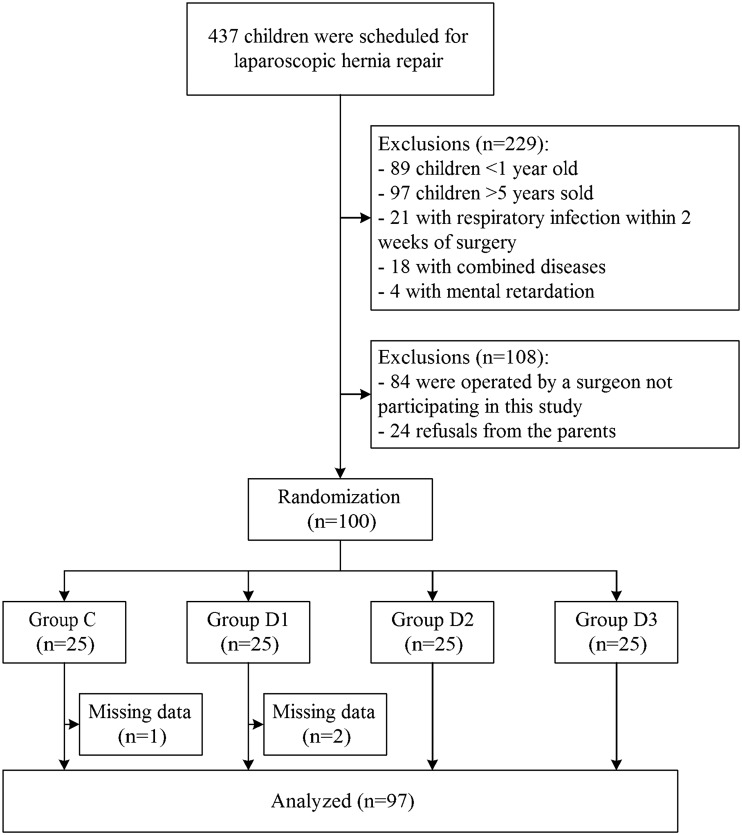
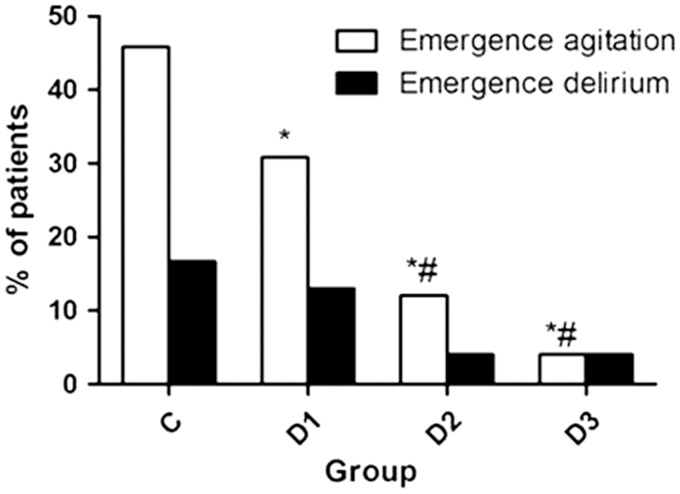
Objective To evaluate the safety and efficacy of dexmedetomidine (Dex) to prevent emergence agitation (EA) and delirium (ED) in children undergoing laparoscopic hernia repair under general anesthesia. Methods 100 children (1-5 years, 10-25 kg) were randomized into four groups: controls (saline) and intravenous Dex at 0.25, 0.5, and 1.0 µg/kg (D1, D2, D3, respectively). Dex/saline infusion was started following anesthesia. EA and ED were evaluated on a 5-point scale. Results For the C, D1, D2, and D3 groups, respectively, EA frequencies were 45.8%, 30.4%, 12%, 4%; ED frequencies 29.1%, 13%, 4%, 4%; CHIPPS scores 8, 6, 3, 3; sevoflurane doses from 13.2 ± 3.4 (controls) to 9.4 ± 3.5 ml (D3). Intervals until mask removal/spontaneous eye opening were significantly longer for D2 and D3 than controls. PACU stay was longer for D3. Conclusions There was significantly less postoperative EA and pain, with less sevoflurane required, using Dex.
目的 评估右美托咪定(Dex)预防全身麻醉下接受腹腔镜疝修补术儿童出现苏醒期躁动(EA)和谵妄(ED)的安全性和有效性。方法 将100名1至5岁、体重10至25千克的儿童随机分为四组:对照组(生理盐水)以及静脉注射0.25、0.5和1.0µg/kg的Dex(分别为D1、D2、D3组)。麻醉后开始输注Dex/生理盐水。采用5分制评估EA和ED。结果 C组、D1组、D2组和D3组的EA发生率分别为45.8%、30.4%、12%、4%;ED发生率分别为29.1%、13%、4%、4%;CHIPPS评分分别为8分、6分、3分、3分;七氟醚用量从对照组的13.2±3.4毫升降至D3组的9.4±3.5毫升。D2组和D3组至面罩移除/自主睁眼的间隔时间显著长于对照组。D3组在麻醉后恢复室的停留时间更长。结论 使用Dex可显著减少术后EA和疼痛,且所需七氟醚更少。