Azizkhani Reza, Kouhestani Soheila, Heydari Farhad, Esmailian Mehrdad, Feizi Awat, Khalilian Gourtani Bahar, Safavi Mohammadreza
Department of Emergency Medicine, School of Medicine, Isfahan University of Medical Sciences, Isfahan, Iran.
Department of Biostatistics and Epidemiology, School of Health, Isfahan University of Medical Sciences, Isfahan, Iran.
J Res Med Sci. 2021 Aug 30;26:61. doi: 10.4103/jrms.JRMS_661_20. eCollection 2021.
Ketamine has been a safe and effective sedative agent commonly used for painful pediatric procedures in the emergency department (ED). This study aimed to compare the effect of dexmedetomidine (Dex) and propofol when used as co-administration with ketamine on recovery agitation in children who underwent procedural sedation.
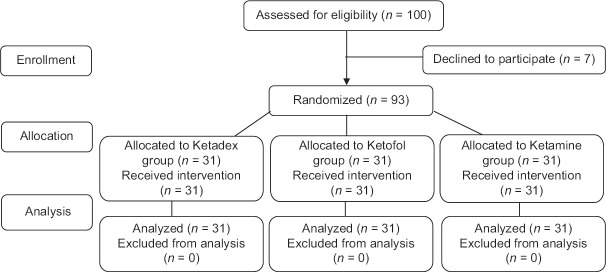
In this prospective, randomized, and double-blind clinical trial, 93 children aged between 3 and 17 years with American Society of Anesthesiologists Class I and II undergoing short procedures in the ED were enrolled and assigned into three equal groups to receive either ketadex (Dex 0.7 μg/kg and ketamine 1 mg/kg), ketofol (propofol 0.5 mg/kg and ketamine 0.5 mg/kg), or ketamine alone (ketamine1 mg/kg) intravenously. Incidence and severity of recovery agitation were evaluated using the Richmond Agitation-Sedation Scale and compared between the groups.
There was no statistically significant difference between the three groups with respect to age, gender, and weight ( > 0.05). The incidence of recovery agitation was 3.2% in the ketadex group, 22.6% in the ketofol group, and 22.6% in the ketamine group ( = 0.002, children undergoing short procedures were recruited). There was a less unpleasant recovery reaction (hallucination, crying, and nightmares) in the ketadex group compared with the ketofol and ketamine groups ( < 0.05). There was no difference in the incidence of oxygen desaturation between the groups ( = 0.30).
The co-administering of Dex to ketamine could significantly reduce the incidence and severity of recovery agitation in children sedated in the ED.
氯胺酮一直是急诊科用于小儿疼痛性操作的一种安全有效的镇静剂。本研究旨在比较右美托咪定(Dex)和丙泊酚与氯胺酮联合使用时对接受程序性镇静的儿童苏醒期躁动的影响。
在这项前瞻性、随机、双盲临床试验中,93名年龄在3至17岁、美国麻醉医师协会分级为I级和II级、在急诊科接受短时间操作的儿童被纳入研究,并被平均分为三组,分别静脉注射酮右美(Dex 0.7μg/kg和氯胺酮1mg/kg)、酮丙泊酚(丙泊酚0.5mg/kg和氯胺酮0.5mg/kg)或单独使用氯胺酮(氯胺酮1mg/kg)。使用里士满躁动 - 镇静量表评估苏醒期躁动的发生率和严重程度,并在组间进行比较。
三组在年龄、性别和体重方面无统计学显著差异(P>0.05)。酮右美组苏醒期躁动的发生率为3.2%,酮丙泊酚组为22.6%,氯胺酮组为22.6%(P = 0.002,纳入了接受短时间操作的儿童)。与酮丙泊酚组和氯胺酮组相比,酮右美组的苏醒反应(幻觉、哭闹和噩梦)不那么令人不适(P<0.05)。各组间氧饱和度降低的发生率无差异(P = 0.30)。
氯胺酮与Dex联合使用可显著降低急诊科镇静儿童苏醒期躁动的发生率和严重程度。