
EnHERV:特定人类内源性逆转录病毒模式及其邻近基因的富集分析。
EnHERV: Enrichment analysis of specific human endogenous retrovirus patterns and their neighboring genes.
作者信息
Tongyoo Pumipat, Avihingsanon Yingyos, Prom-On Santhitham, Mutirangura Apiwat, Mhuantong Wuttichai, Hirankarn Nattiya
机构信息
Inter-Department Program of Biomedical Sciences, Faculty of Graduate School, Chulalongkorn University, Bangkok, Thailand.
Center of Excellence in Immunology and Immune Mediated Diseases, Faculty of Medicine, Chulalongkorn University, Bangkok, Thailand.
出版信息
PLoS One. 2017 May 4;12(5):e0177119. doi: 10.1371/journal.pone.0177119. eCollection 2017.
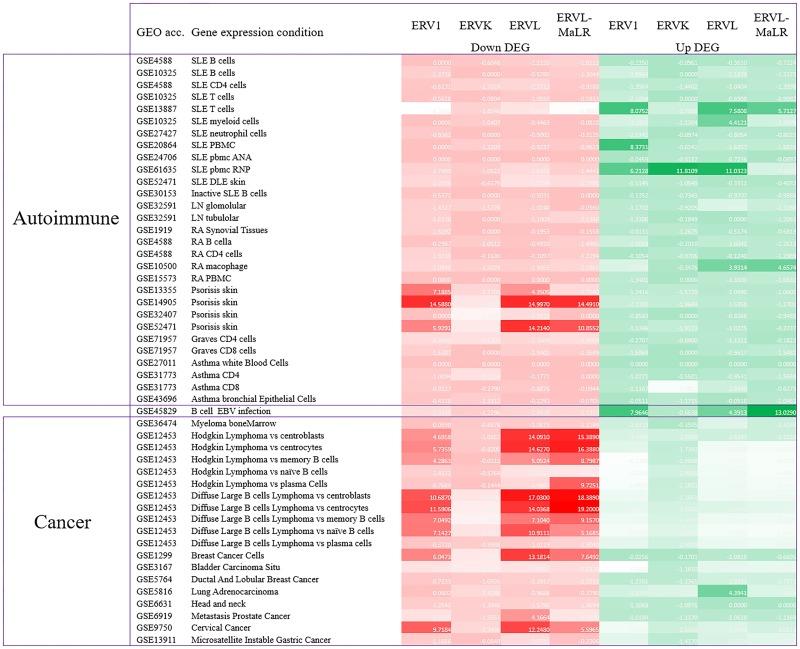
Human endogenous retroviruses (HERVs) are flanked by long terminal repeats (LTRs), which contain the regulation part of the retrovirus. Remaining HERVs constitute 7% to 8% of the present day human genome, and most have been identified as solo LTRs. The HERV sequences have been associated with several molecular functions as well as certain diseases in human, but their roles in human diseases are yet to be established. We designed EnHERV to make accessible the identified endogenous retrovirus repetitive sequences from Repbase Update (a database of eukaryotic repetitive elements) that are present in the human genome. Defragmentation process was done to improve the RepeatMasker annotation output. The defragmented elements were used as core database in EnHERV. EnHERV is available at http://sysbio.chula.ac.th/enherv and can be searched using either gene lists of user interest or HERV characteristics. Besides the search function, EnHERV also provides an enrichment analysis function that allows users to perform enrichment analysis between selected HERV characteristics and user-input gene lists, especially genes with the expression profile of a certain disease. EnHERV will facilitate exploratory studies of specific HERV characteristics that control gene expression patterns related to various disease conditions. Here we analyzed 25 selected HERV groups/names from all four HERV superfamilies, using the sense and anti-sense directions of the HERV and gene expression profiles from 49 specific tissue and disease conditions. We found that intragenic HERVs were associated with down-regulated genes in most cancer conditions and in psoriatic skin tissues and associated with up-regulated genes in immune cells particularly from systemic lupus erythematosus (SLE) patients. EnHERV allowed the analysis of how different types of LTRs were differentially associated with specific gene expression profiles in particular disease conditions for further studies into their mechanisms and functions.
人类内源性逆转录病毒(HERV)两侧是长末端重复序列(LTR),其中包含逆转录病毒的调控部分。现存的HERV序列占当今人类基因组的7%至8%,且大多数已被鉴定为单独的LTR。HERV序列与多种分子功能以及人类的某些疾病相关,但它们在人类疾病中的作用尚待确定。我们设计了EnHERV,以便从Repbase Update(一个真核生物重复元件数据库)中获取人类基因组中已识别的内源性逆转录病毒重复序列。通过碎片化处理来改进RepeatMasker注释输出。碎片化后的元件被用作EnHERV的核心数据库。EnHERV可在http://sysbio.chula.ac.th/enherv获取,可使用用户感兴趣的基因列表或HERV特征进行搜索。除了搜索功能外,EnHERV还提供富集分析功能,允许用户在选定的HERV特征与用户输入的基因列表(特别是具有特定疾病表达谱的基因)之间进行富集分析。EnHERV将有助于对控制与各种疾病状况相关的基因表达模式的特定HERV特征进行探索性研究。在此,我们使用HERV的正义链和反义链方向以及来自49种特定组织和疾病状况的基因表达谱,分析了来自所有四个HERV超家族的25个选定的HERV组/名称。我们发现,基因内HERV在大多数癌症状况和银屑病皮肤组织中与下调基因相关,而在免疫细胞中,特别是系统性红斑狼疮(SLE)患者的免疫细胞中,与上调基因相关。EnHERV能够分析不同类型的LTR在特定疾病状况下如何与特定基因表达谱存在差异关联,以便进一步研究其机制和功能。


 Zotero 插件