Nellåker Christoffer, Yao Yuanrong, Jones-Brando Lorraine, Mallet François, Yolken Robert H, Karlsson Håkan
The Department of Neuroscience, Karolinska Institutet, Retzius väg 8, 171 77 Stockholm, Sweden.
Retrovirology. 2006 Jul 6;3:44. doi: 10.1186/1742-4690-3-44.
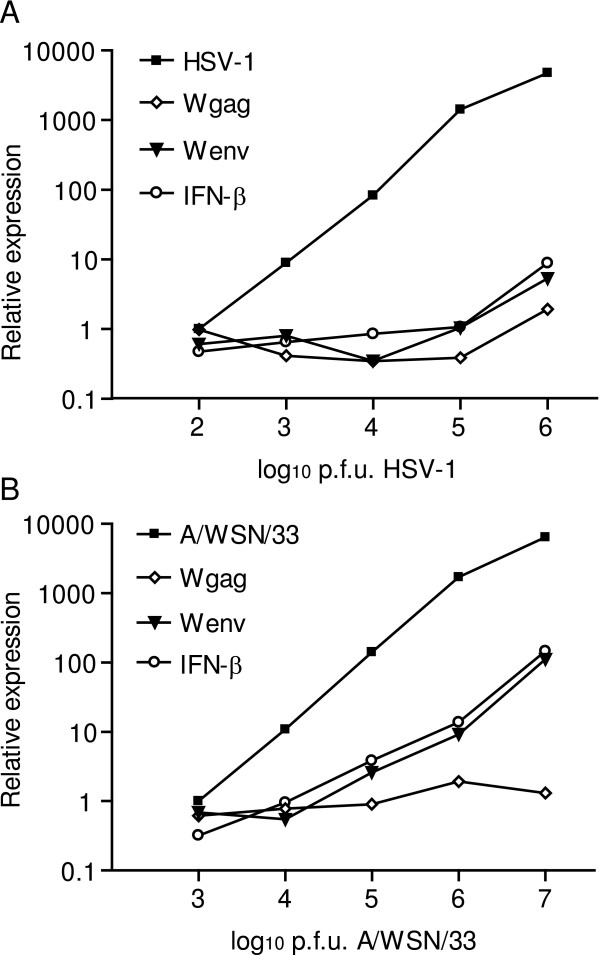
Aberrant expression of human endogenous retrovirus (HERV) elements in the W family has previously been associated with schizophrenia, multiple sclerosis and preeclampsia. Little is know regarding the basal expression, transcriptional regulation and functional significance of individual HERV-elements. Since viral infections have previously been reported to transactivate retroviral long terminal repeat regions we examined the basal expression of HERV-W elements and following infections by influenza A/WSN/33 and Herpes simplex 1 viruses in human cell-lines.
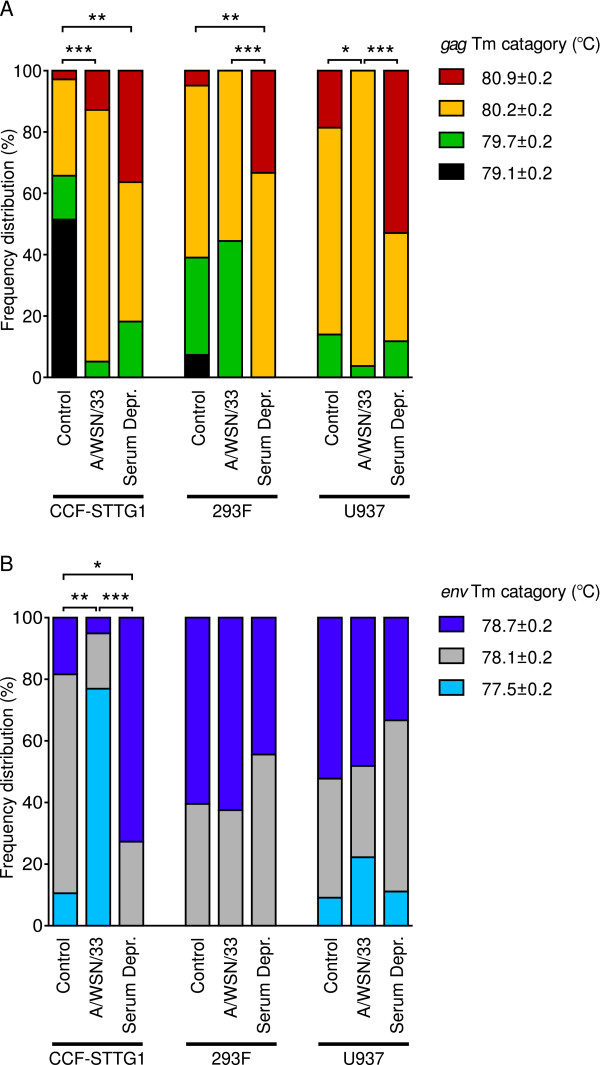
Relative levels of transcripts encoding HERV-W elements and cellular genes were analyzed by qPCR methods. An analysis of amplicon melting temperatures was used to detect variations in the frequencies of amplicons in discrete ranges of such melting temperatures. These frequency-distributions were taken as proxy markers for the repertoires of transcribed HERV-W elements in the cells.
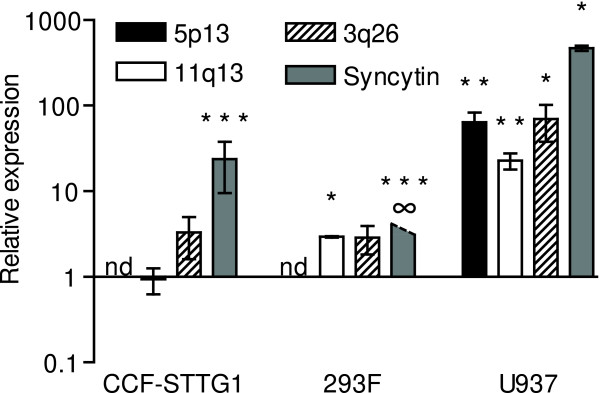
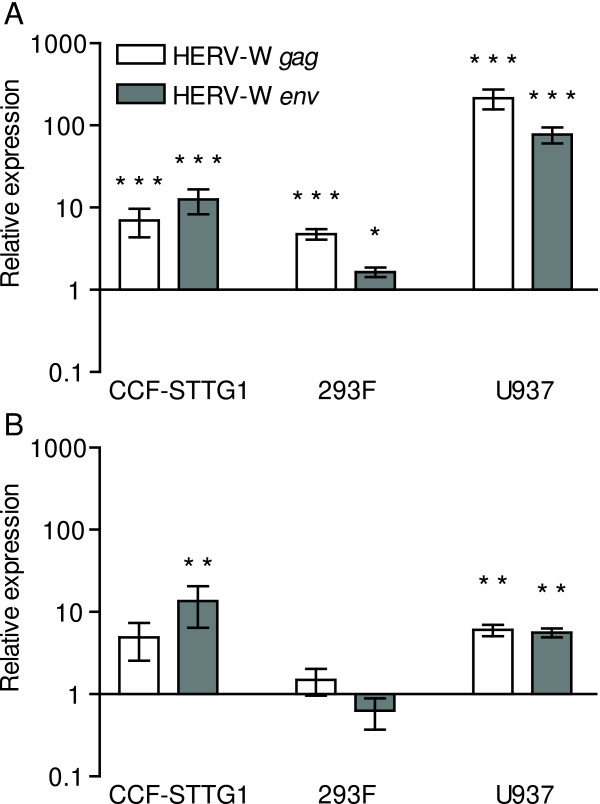
We report cell-specific expression patterns of HERV-W elements during base-line conditions. Expressed elements include those with intact regulatory long terminal repeat regions (LTRs) as well as elements flanked by truncated LTRs. Subsets of HERV-W elements were transactivated by viral infection in the different cell-lines. Transcriptional activation of these elements, including that encoding syncytin, was dependent on viral replication and was not induced by antiviral responses. Serum deprivation of cells induced similar changes in the expression of HERV-W elements suggesting that the observed phenomena are, in part, an effect of cellular stress.
We found that HERV-W elements, including elements lacking regulatory LTRs, are expressed in cell-specific patterns which can be modulated by environmental influences. This brings into light that mechanisms behind the regulation of expression of HERV-W elements are more complex than previously assumed and suggests biological functions of these transcripts.
先前已发现W家族人类内源性逆转录病毒(HERV)元件的异常表达与精神分裂症、多发性硬化症和先兆子痫有关。关于单个HERV元件的基础表达、转录调控和功能意义,人们了解甚少。由于先前有报道称病毒感染可反式激活逆转录病毒长末端重复序列区域,我们检测了HERV-W元件在人细胞系中的基础表达,以及甲型流感病毒/WSN/33和单纯疱疹病毒1感染后的表达情况。
采用qPCR方法分析编码HERV-W元件和细胞基因的转录本的相对水平。通过对扩增子解链温度的分析来检测不同解链温度范围内扩增子频率的变化。这些频率分布被用作细胞中转录的HERV-W元件文库的替代标记。
我们报告了HERV-W元件在基线条件下的细胞特异性表达模式。表达的元件包括具有完整调控长末端重复序列(LTR)的元件以及两侧为截短LTR的元件。在不同细胞系中,病毒感染可反式激活HERV-W元件的亚群。这些元件的转录激活,包括编码合胞素的元件,依赖于病毒复制,而非由抗病毒反应诱导。细胞血清饥饿诱导了HERV-W元件表达的类似变化,表明观察到的现象部分是细胞应激的作用。
我们发现,包括缺乏调控LTR的元件在内的HERV-W元件以细胞特异性模式表达,这种模式可受环境影响调节。这揭示了HERV-W元件表达调控背后的机制比先前设想的更为复杂,并提示了这些转录本的生物学功能。