Samarghandian Saeed, Azimi-Nezhad Mohsen, Borji Abasalt, Samini Mohammad, Farkhondeh Tahereh
Department of Basic Medical Sciences, Neyshabur University of Medical Sciences, Neyshabur, Iran.
Department of Medical Genetics, School of Medicine, Mashhad University of Medical Sciences, Mashhad, Iran.
BMC Complement Altern Med. 2017 May 4;17(1):249. doi: 10.1186/s12906-017-1753-9.
Oxidative stress through chronic stress destroys the brain function. There are many documents have shown that carnosol may have a therapeutic effect versus free radical induced diseases. The current research focused the protective effect of carnosol against the brain injury induced by the restraint stress.
The restraint stress induced by keeping animals in restrainers for 21 consecutive days. Thereafter, the rats were injected carnosol or vehicle for 21 consecutive days. At the end of experiment, all the rats were subjected to his open field test and forced swimming test. Afterwards, the rats were sacrificed for measuring their oxidative stress parameters. To measure the modifications in the biochemical aspects after the experiment, the activities of malondialdehyde (MDA), reduced glutathione (GSH), as well as superoxide dismutase (SOD), glutathione peroxidase (GPx), glutathione reductase (GR) and catalase (CAT) were evaluated in the whole brain.
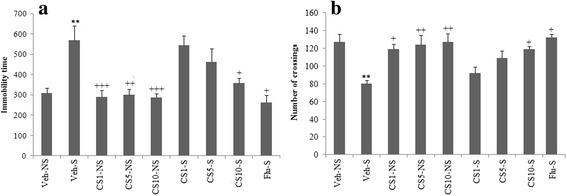
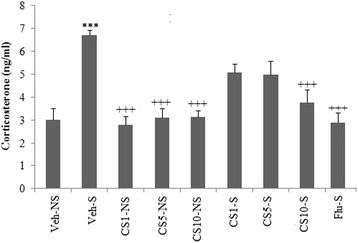
Our data showed that the animals received chronic stress had a raised immobility time versus the non-stressed animals (p < 0.01). Furthermore, chronic stress diminished the number of crossing in the animals that were subjected to the chronic stress versus the non-stressed rats (p < 0.01). Carnosol ameliorated this alteration versus the non-treated rats (p < 0.05). In the vehicle treated rats that submitted to the stress, the level of MDA levels was significantly increased (P < 0.001), and the levels of GSH and antioxidant enzymes were significantly decreased versus the non-stressed animals (P < 0.001). Carnosol treatment reduced the modifications in the stressed animals as compared with the control groups (P < 0.001). All of these carnosol effects were nearly similar to those observed with fluoxetine.
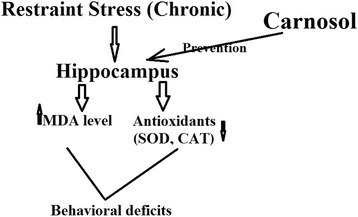
The current research shows that the protective effects of carnosol may be accompanied with enhanced antioxidant defenses and decreased oxidative injury.
慢性应激引起的氧化应激会损害脑功能。许多文献表明,鼠尾草酸可能对自由基诱导的疾病具有治疗作用。当前的研究聚焦于鼠尾草酸对束缚应激诱导的脑损伤的保护作用。
通过将动物连续21天置于束缚器中诱导束缚应激。此后,大鼠连续21天注射鼠尾草酸或赋形剂。实验结束时,所有大鼠均接受旷场试验和强迫游泳试验。之后,处死大鼠以测量其氧化应激参数。为了测量实验后生化方面的变化,评估了全脑中丙二醛(MDA)、还原型谷胱甘肽(GSH)以及超氧化物歧化酶(SOD)、谷胱甘肽过氧化物酶(GPx)、谷胱甘肽还原酶(GR)和过氧化氢酶(CAT)的活性。
我们的数据表明,与未应激的动物相比,接受慢性应激的动物静止不动时间增加(p < 0.01)。此外,与未应激的大鼠相比,慢性应激减少了接受慢性应激的动物的穿越次数(p < 0.01)。与未治疗的大鼠相比,鼠尾草酸改善了这种改变(p < 0.05)。在接受应激的赋形剂处理的大鼠中,MDA水平显著升高(P < 0.001),与未应激的动物相比,GSH和抗氧化酶水平显著降低(P < 0.001)。与对照组相比,鼠尾草酸处理减少了应激动物的变化(P < 0.001)。鼠尾草酸的所有这些作用与氟西汀观察到的作用几乎相似。
当前的研究表明,鼠尾草酸的保护作用可能伴随着抗氧化防御增强和氧化损伤减少。