Islam Barira, Stadlbauer Petr, Gil-Ley Alejandro, Pérez-Hernández Guillermo, Haider Shozeb, Neidle Stephen, Bussi Giovanni, Banas Pavel, Otyepka Michal, Sponer Jiri
Institute of Biophysics, Academy of Sciences of the Czech Republic , Královopolská 135, 612 65 Brno, Czech Republic.
Regional Centre of Advanced Technologies and Materials, Department of Physical Chemistry, Faculty of Science, Palacký University , 17. listopadu 1192/12, 771 46 Olomouc, Czech Republic.
J Chem Theory Comput. 2017 Jun 13;13(6):2458-2480. doi: 10.1021/acs.jctc.7b00226. Epub 2017 May 18.
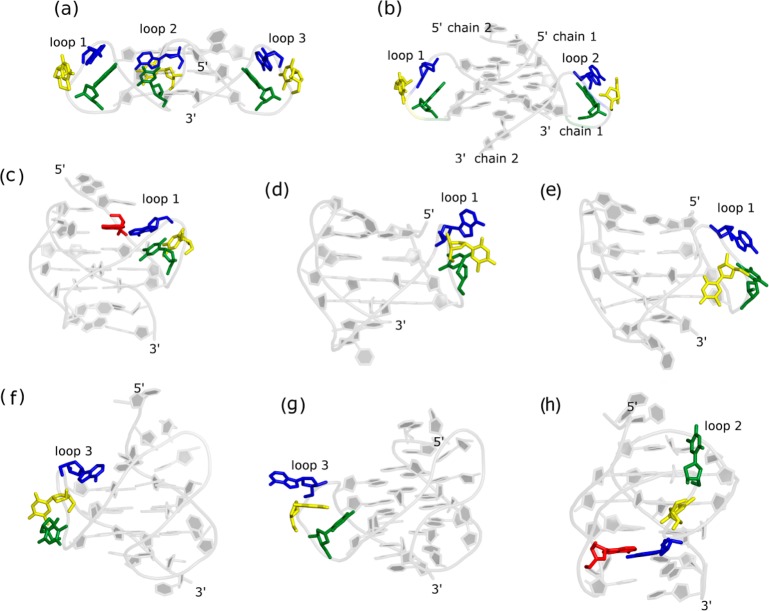
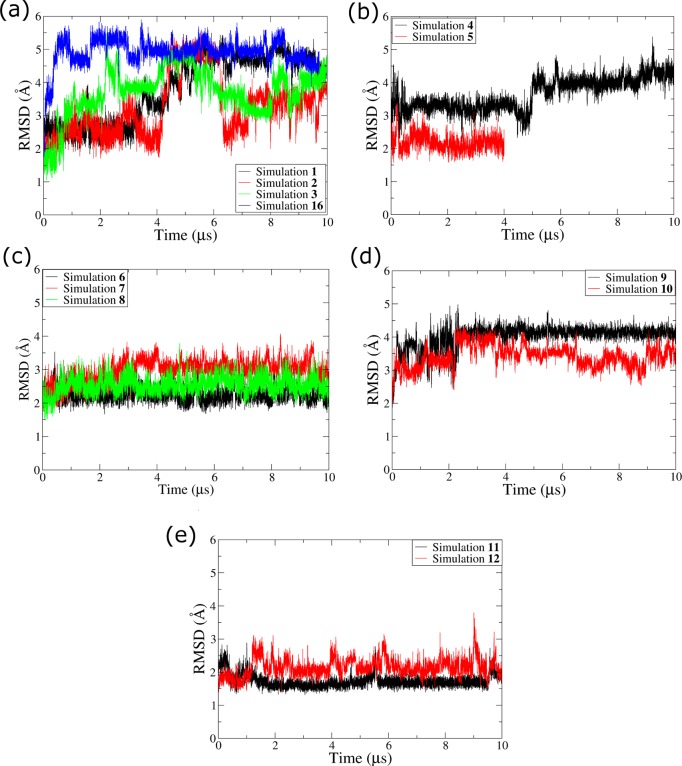
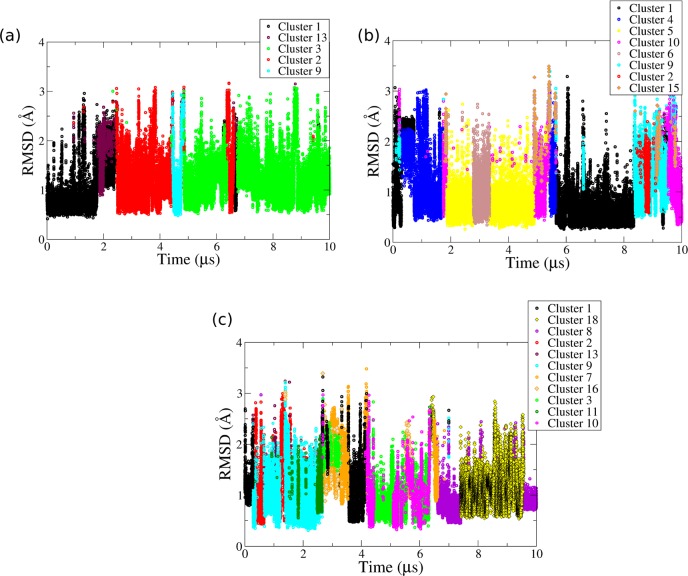
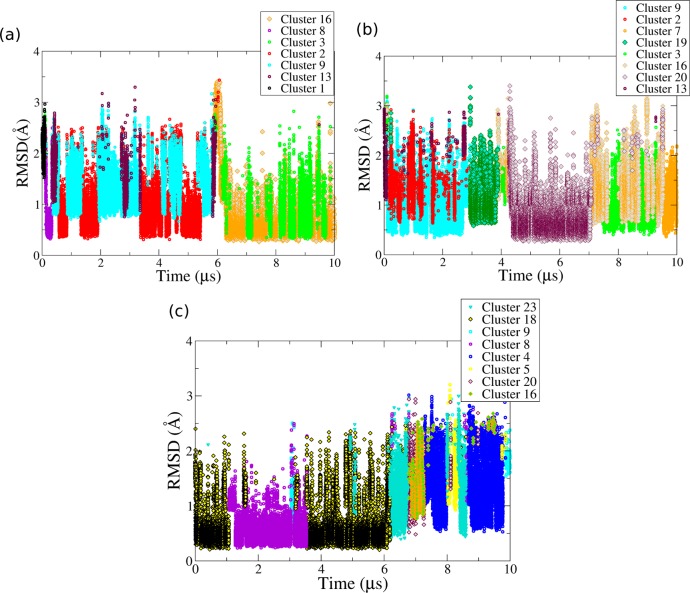
We have carried out a series of extended unbiased molecular dynamics (MD) simulations (up to 10 μs long, ∼162 μs in total) complemented by replica-exchange with the collective variable tempering (RECT) approach for several human telomeric DNA G-quadruplex (GQ) topologies with TTA propeller loops. We used different AMBER DNA force-field variants and also processed simulations by Markov State Model (MSM) analysis. The slow conformational transitions in the propeller loops took place on a scale of a few μs, emphasizing the need for long simulations in studies of GQ dynamics. The propeller loops sampled similar ensembles for all GQ topologies and for all force-field dihedral-potential variants. The outcomes of standard and RECT simulations were consistent and captured similar spectrum of loop conformations. However, the most common crystallographic loop conformation was very unstable with all force-field versions. Although the loss of canonical γ-trans state of the first propeller loop nucleotide could be related to the indispensable bsc0 α/γ dihedral potential, even supporting this particular dihedral by a bias was insufficient to populate the experimentally dominant loop conformation. In conclusion, while our simulations were capable of providing a reasonable albeit not converged sampling of the TTA propeller loop conformational space, the force-field description still remained far from satisfactory.
我们进行了一系列扩展的无偏分子动力学(MD)模拟(长达10微秒,总计约162微秒),并采用集体变量回火的副本交换(RECT)方法,对几种带有TTA螺旋桨环的人类端粒DNA G-四链体(GQ)拓扑结构进行了模拟。我们使用了不同的AMBER DNA力场变体,并通过马尔可夫状态模型(MSM)分析对模拟进行了处理。螺旋桨环中的缓慢构象转变发生在几微秒的时间尺度上,这强调了在GQ动力学研究中进行长时间模拟的必要性。对于所有GQ拓扑结构和所有力场二面角势能变体,螺旋桨环采样了相似的系综。标准模拟和RECT模拟的结果是一致的,并且捕捉到了相似的环构象谱。然而,在所有力场版本中,最常见的晶体学环构象都非常不稳定。尽管第一个螺旋桨环核苷酸的经典γ-反式状态的丧失可能与不可或缺的bsc0 α/γ二面角势能有关,但即使通过偏差来支持这个特定的二面角,也不足以填充实验上占主导的环构象。总之,虽然我们的模拟能够对TTA螺旋桨环构象空间进行合理但未收敛的采样,但力场描述仍远不能令人满意。