Schlit Anne-Françoise, Delaunois Annie, Colomar Aurore, Claudio Branderley, Cariolato Luca, Boev Rossen, Valentin Jean-Pierre, Peters Christopher, Sloan Victor S, Bentz Jürgen W G
UCB Pharma Brussels Belgium.
Present address: Aurore Colomar, Université de Mons Mons Belgium.
Pharmacol Res Perspect. 2017 Apr 21;5(3):e00309. doi: 10.1002/prp2.309. eCollection 2017 Jun.
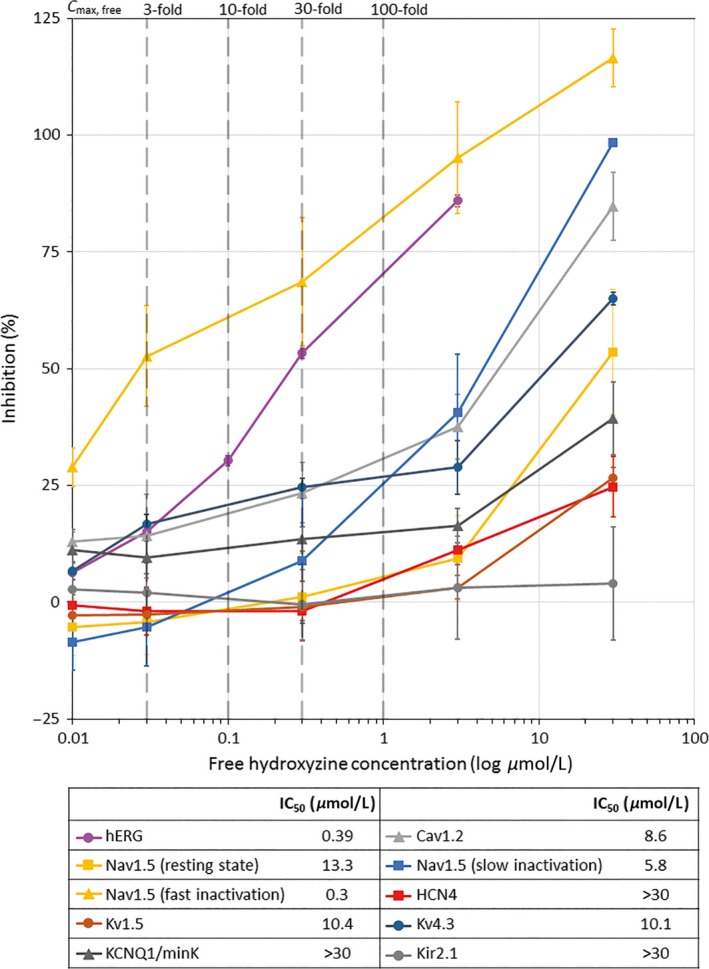
Several noncardiac drugs have been linked to cardiac safety concerns, highlighting the importance of post-marketing surveillance and continued evaluation of the benefit-risk of long-established drugs. Here, we examine the risk of QT prolongation and/or torsade de pointes (TdP) associated with the use of hydroxyzine, a first generation sedating antihistamine. We have used a combined methodological approach to re-evaluate the cardiac safety profile of hydroxyzine, including: (1) a full review of the sponsor pharmacovigilance safety database to examine real-world data on the risk of QT prolongation and/or TdP associated with hydroxyzine use and (2) nonclinical electrophysiological studies to examine concentration-dependent effects of hydroxyzine on a range of human cardiac ion channels. Based on a review of pharmacovigilance data between 14th December 1955 and 1st August 2016, we identified 59 reports of QT prolongation and/or TdP potentially linked to hydroxyzine use. Aside from intentional overdose, all cases involved underlying medical conditions or concomitant medications that constituted at least 1 additional risk factor for such events. The combination of cardiovascular disorders plus concomitant treatment of drugs known to induce arrhythmia was identified as the greatest combined risk factor. Parallel patch-clamp studies demonstrated hydroxyzine concentration-dependent inhibition of several human cardiac ion channels, including the ether-a-go-go-related gene (hERG) potassium ion channels. Results from this analysis support the listing of hydroxyzine as a drug with "conditional risk of TdP" and are in line with recommendations to limit hydroxyzine use in patients with known underlying risk factors for QT prolongation and/or TdP.
几种非心脏药物已引发对心脏安全性的担忧,凸显了上市后监测以及对长期使用药物的获益风险持续评估的重要性。在此,我们研究了第一代镇静抗组胺药羟嗪使用相关的QT间期延长和/或尖端扭转型室性心动过速(TdP)风险。我们采用了综合方法重新评估羟嗪的心脏安全性,包括:(1)全面审查申办方的药物警戒安全数据库,以研究与羟嗪使用相关的QT间期延长和/或TdP风险的真实世界数据;(2)非临床电生理研究,以研究羟嗪对一系列人类心脏离子通道的浓度依赖性影响。基于对1955年12月14日至2016年8月1日期间药物警戒数据的审查,我们确定了59例可能与羟嗪使用相关的QT间期延长和/或TdP报告。除故意过量用药外,所有病例均涉及基础疾病或合并用药,这些至少构成此类事件的另外一个风险因素。心血管疾病与已知可诱发心律失常的药物联合治疗被确定为最大的联合风险因素。平行膜片钳研究表明,羟嗪对包括醚 - 去极化相关基因(hERG)钾离子通道在内的几种人类心脏离子通道具有浓度依赖性抑制作用。该分析结果支持将羟嗪列为具有“TdP条件性风险”的药物,并且与限制在已知有QT间期延长和/或TdP潜在风险因素的患者中使用羟嗪的建议一致。