Department of Surgery, Al Jouf University College of Medicine, Al-Jawf, Saudi Arabia.
Department of Biochemistry, Al Jouf University College of Medicine, Al-Jawf, Saudi Arabia.
Investig Clin Urol. 2017 May;58(3):210-216. doi: 10.4111/icu.2017.58.3.210. Epub 2017 Apr 11.
At present, commercially available antiurolithic drugs have more adverse effects than potential therapeutic or preventive effects with chronic use. With this in mind, the present study was designed to assess the antiurolithic effect of olive oil in a mouse model of ethylene glycol (EG)-induced urolithiasis.
Adult albino mice were divided into 6 groups. Group I was fed the vehicle only. Group II was supplemented with 0.75% EG alone in drinking water during the experimental period to initiate deposition of calcium oxalate in kidneys, which leads to urolithiasis in animals. Groups III (olive oil control group) through V were fed olive oil orally at various doses during the experimental period. Group VI received cystone (750 mg/kg). Groups IV-VI additionally received 0.75% EG in drinking water ad libitum. SPSS ver.17.0 was used for statistical analysis.
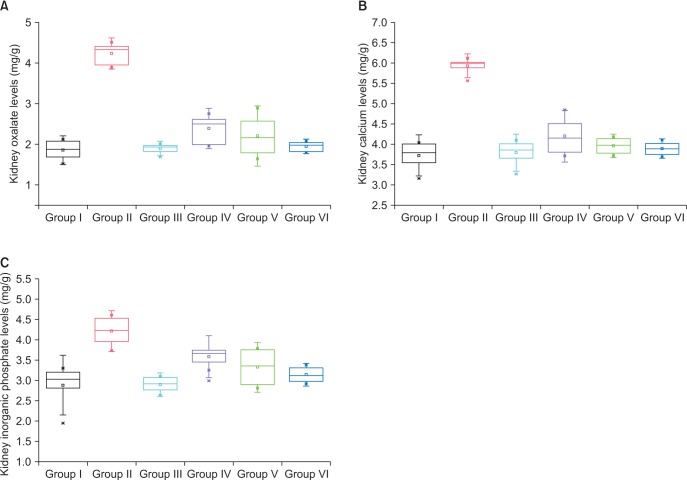
The study results showed significantly higher levels of serum urea, uric acid, and creatinine (p<0.05) in group II than in groups III-VI and I. Administration of olive oil at different doses restored the elevated serum parameters in groups IV and V compared with group II. Urine and kidney calcium, oxalate, and phosphate levels in groups IV-VI were significantly lower (p<0.05) than in animals with EG-induced urolithiasis (group II). Group V mice showed a significant restoration effect on serum as well as urine and kidney parameters compared with group II.
Supplementation with olive oil (1.7 mL/kg body weight) reduced and prevented the growth of urinary stones, possibly by inhibiting renal tubular membrane damage due to peroxidative stress induced by hyperoxaluria.
目前,市售的抗结石药物在长期使用时的不良反应多于潜在的治疗或预防作用。有鉴于此,本研究旨在评估橄榄油在乙二醇(EG)诱导的小鼠尿石症模型中的抗结石作用。
将成年白化小鼠分为 6 组。第 1 组仅给予载体。第 2 组在实验期间通过饮用水补充 0.75%的 EG,以在肾脏中引发草酸钙沉积,导致动物发生尿石症。第 3 组(橄榄油对照组)至第 5 组在实验期间口服给予不同剂量的橄榄油。第 6 组给予胱氨酸(750mg/kg)。第 4 组至第 6 组还通过自由饮水给予 0.75%EG。使用 SPSS ver.17.0 进行统计分析。
研究结果显示,与第 3 组至第 6 组和第 1 组相比,第 2 组的血清尿素、尿酸和肌酐水平显著升高(p<0.05)。第 4 组和第 5 组给予不同剂量的橄榄油后,可使血清参数恢复正常。与 EG 诱导的尿石症(第 2 组)相比,第 4 组至第 6 组的尿和肾钙、草酸和磷酸盐水平显著降低(p<0.05)。与第 2 组相比,第 5 组的血清以及尿和肾参数具有显著的恢复作用。
橄榄油(1.7mL/kg 体重)的补充可减少和预防肾结石的生长,可能是通过抑制由于高草酸尿引起的过氧化应激导致的肾小管膜损伤。