Manchia Mirko, Maina Giuseppe, Carpiniello Bernardo, Pinna Federica, Steardo Luca, D'Ambrosio Virginia, Salvi Virginio, Alda Martin, Tortorella Alfonso, Albert Umberto
Section of Psychiatry, Department of Medical Science and Public Health, University of Cagliari, Via Liguria, 13, 09127, Cagliari, Italy.
Department of Pharmacology, Dalhousie University, Halifax, NS, Canada.
Int J Bipolar Disord. 2017 Dec;5(1):28. doi: 10.1186/s40345-017-0097-1. Epub 2017 Aug 21.
Admixture analysis of age at onset (AAO) has helped delineating the clinical profile of early onset (EO) bipolar disorder (BD). However, there is scarce evidence comparing the distributional properties of AAO as well as the clinical features of EO BD type 1 (BD1) with EO BD type 2 (BD2). To this end, we studied 515 BD patients (224 BD1, 279 BD2, and 12 BD not otherwise specified [NOS]) diagnosed according to DSM-IV-TR criteria.
AAO was defined as the first reliably diagnosed hypo/manic or depressive episode according to diagnostic criteria. We used normal distribution mixture analysis to identify subgroups of patients according to AAO. Models were chosen according to the Schwarz's Bayesian information criteria (BIC). Clinical correlates of EO were analysed using univariate tests and multivariate logistic regression models.
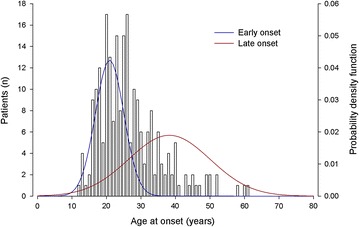
A two normal components model best fitted the observed distribution of AAO in BD1 (BIC = -1599.3), BD2 (BIC = -2158.4), and in the whole sample (BIC = -3854.9). A higher number of EO BD2 patients had a depression-(hypo)mania-free interval (DMI) course, while a higher rate of (hypo)mania-depression-free interval (MDI) course was found in EO BD1. EO BD2 had also a higher rate of comorbidity with alcohol dependence compared to EO BD1. The latter finding was confirmed by multivariate logistic regression analysis.
In conclusion, both BD1 and BD2 had bimodal AAO distributions, but EO subgroups had a diagnostic-specific clinical delineation.
发病年龄(AAO)的混合分析有助于勾勒早发型(EO)双相情感障碍(BD)的临床特征。然而,关于比较AAO的分布特性以及EO双相I型障碍(BD1)和EO双相II型障碍(BD2)临床特征的证据很少。为此,我们研究了515例根据《精神疾病诊断与统计手册》第四版修订版(DSM-IV-TR)标准诊断的BD患者(224例BD1、279例BD2和12例未另行指定的BD [NOS])。
AAO根据诊断标准定义为首次可靠诊断的轻躁狂或抑郁发作。我们使用正态分布混合分析根据AAO识别患者亚组。根据施瓦茨贝叶斯信息准则(BIC)选择模型。使用单变量检验和多变量逻辑回归模型分析EO的临床相关性。
双正态成分模型最适合BD1(BIC = -1599.3)、BD2(BIC = -2158.4)以及整个样本(BIC = -3854.9)中观察到的AAO分布。更多的EO BD2患者有抑郁-(轻躁狂)无发作间期(DMI)病程,而EO BD1中(轻躁狂)-抑郁无发作间期(MDI)病程的发生率更高。与EO BD1相比,EO BD2与酒精依赖的共病率也更高。多变量逻辑回归分析证实了后一发现。
总之,BD1和BD2的AAO分布均为双峰,但EO亚组有诊断特异性的临床特征。