Chae In Ho, Yoon Chang Hwan, Park Jin Joo, Oh Il Young, Suh Jung Won, Cho Young Seok, Youn Tae Jin, Choi Dong Ju
Department of Internal Medicine, Cardiovascular Center, Seoul National University Bundang Hospital, Seongnam, Korea.
J Korean Med Sci. 2017 Jun;32(6):933-941. doi: 10.3346/jkms.2017.32.6.933.
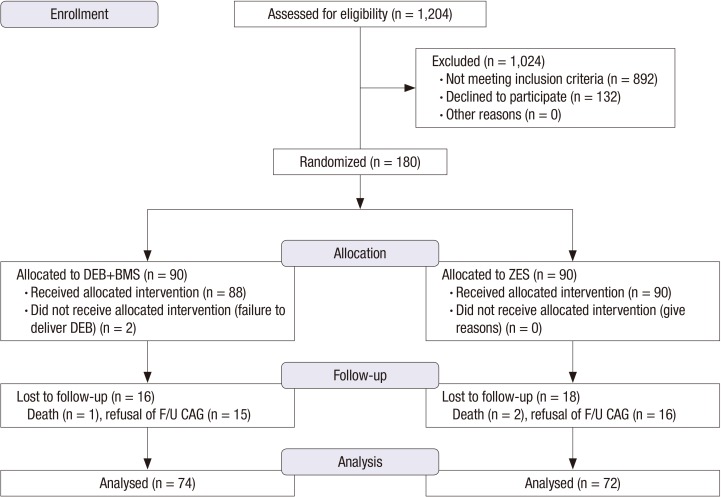
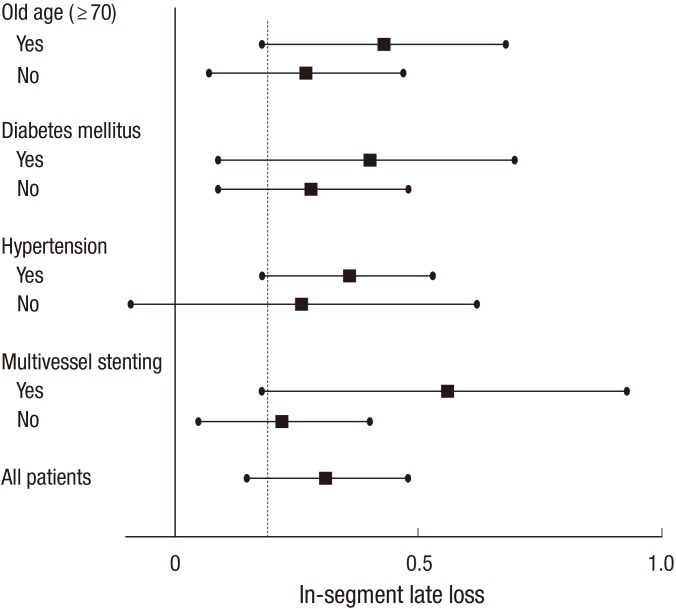
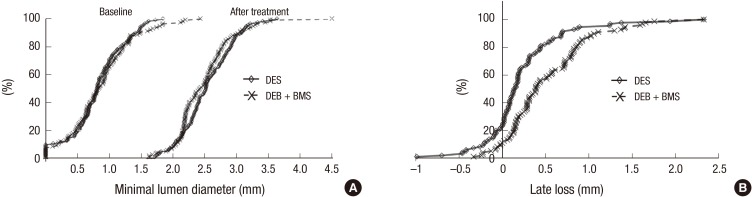
The combined use of a drug-eluting balloon (DEB) and a bare metal stent (BMS) for the treatment of de novo non-small vessel coronary artery diseases (CAD) remains to be evaluated. We investigated the efficacy of a sequential treatment using a DEB together with a BMS implantation in comparison to a zotarolimus-eluting stent (ZES). This study was a prospective, randomized, open-label study. We designed it to demonstrate the non-inferiority of a sequential treatment using a DEB first followed by a BMS (DEB + BMS) compared with the use of a ZES. The primary endpoint was in-segment late loss (LL) at 9 months measured by quantitative coronary angiography (QCA). A total of 180 patients were enrolled in the study. The 9-month follow-up angiography was performed in 72 patients with DEB + BMS and 74 patients with ZES. When comparing the DEB + BMS results with the ZES ones, LL was 0.50 ± 0.46 mm in DEB + BMS patients vs. 0.21 ± 0.44 mm in ZES patients (P < 0.001). The mean difference of the LL was 0.31 mm, which was larger than the prespecified non-inferiority margin of 0.19 mm, and the 2-sided 95% confidence interval was 0.15-0.48. The clinical outcomes were not significantly different. In conclusion, the DEB + BMS strategy is inferior to the ZES one in terms of the LL result at 9 months. The DEB strategy for de novo coronary artery lesions needs to be improved for it to become an alternative treatment option.
药物洗脱球囊(DEB)与裸金属支架(BMS)联合用于治疗初发非小血管冠状动脉疾病(CAD)的效果仍有待评估。我们研究了与佐他莫司洗脱支架(ZES)相比,DEB联合BMS植入的序贯治疗的疗效。本研究为前瞻性、随机、开放标签研究。我们将其设计为证明先使用DEB再植入BMS(DEB + BMS)的序贯治疗与使用ZES相比的非劣效性。主要终点是通过定量冠状动脉造影(QCA)测量的9个月时节段内晚期管腔丢失(LL)。共有180例患者纳入本研究。72例接受DEB + BMS治疗的患者和74例接受ZES治疗的患者进行了9个月的随访血管造影。将DEB + BMS组的结果与ZES组的结果进行比较时,DEB + BMS组患者的LL为0.50±0.46 mm,而ZES组患者为0.21±0.44 mm(P < 0.001)。LL的平均差异为0.31 mm,大于预先设定的非劣效性界值0.19 mm,双侧95%置信区间为0.15 - 0.48。临床结局无显著差异。总之,在9个月时的LL结果方面,DEB + BMS策略劣于ZES策略。对于初发冠状动脉病变的DEB策略需要改进,使其成为一种替代治疗选择。