Etienne-Grimaldi Marie-Christine, Boyer Jean-Christophe, Beroud Christophe, Mbatchi Litaty, van Kuilenburg André, Bobin-Dubigeon Christine, Thomas Fabienne, Chatelut Etienne, Merlin Jean-Louis, Pinguet Frédéric, Ferrand Christophe, Meijer Judith, Evrard Alexandre, Llorca Laurence, Romieu Gilles, Follana Philippe, Bachelot Thomas, Chaigneau Loic, Pivot Xavier, Dieras Véronique, Largillier Rémy, Mousseau Mireille, Goncalves Anthony, Roché Henri, Bonneterre Jacques, Servent Véronique, Dohollou Nadine, Château Yann, Chamorey Emmanuel, Desvignes Jean-Pierre, Salgado David, Ferrero Jean-Marc, Milano Gérard
Centre Antoine Lacassagne, Nice, France.
CHU de Nîmes, Nîmes, France.
PLoS One. 2017 May 8;12(5):e0175998. doi: 10.1371/journal.pone.0175998. eCollection 2017.
Deficiency in dihydropyrimidine dehydrogenase (DPD) enzyme is the main cause of severe and lethal fluoropyrimidine-related toxicity. Various approaches have been developed for DPD-deficiency screening, including DPYD genotyping and phenotyping. The goal of this prospective observational study was to perform exhaustive exome DPYD sequencing and to examine relationships between DPYD variants and toxicity in advanced breast cancer patients receiving capecitabine.
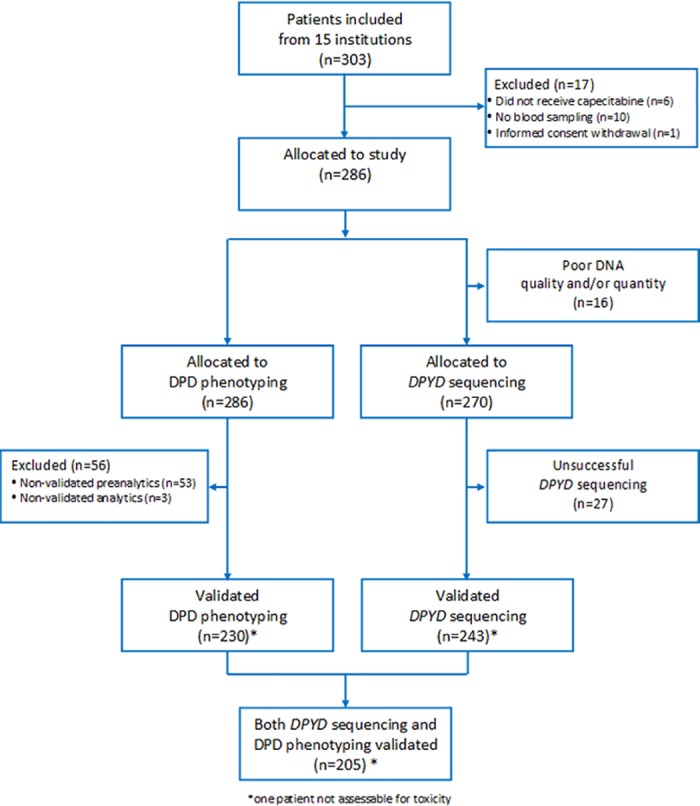
Two-hundred forty-three patients were analysed (88.5% capecitabine monotherapy). Grade 3 and grade 4 capecitabine-related digestive and/or neurologic and/or hemato-toxicities were observed in 10.3% and 2.1% of patients, respectively. DPYD exome, along with flanking intronic regions 3'UTR and 5'UTR, were sequenced on MiSeq Illumina. DPD phenotype was assessed by pre-treatment plasma uracil (U) and dihydrouracil (UH2) measurement.
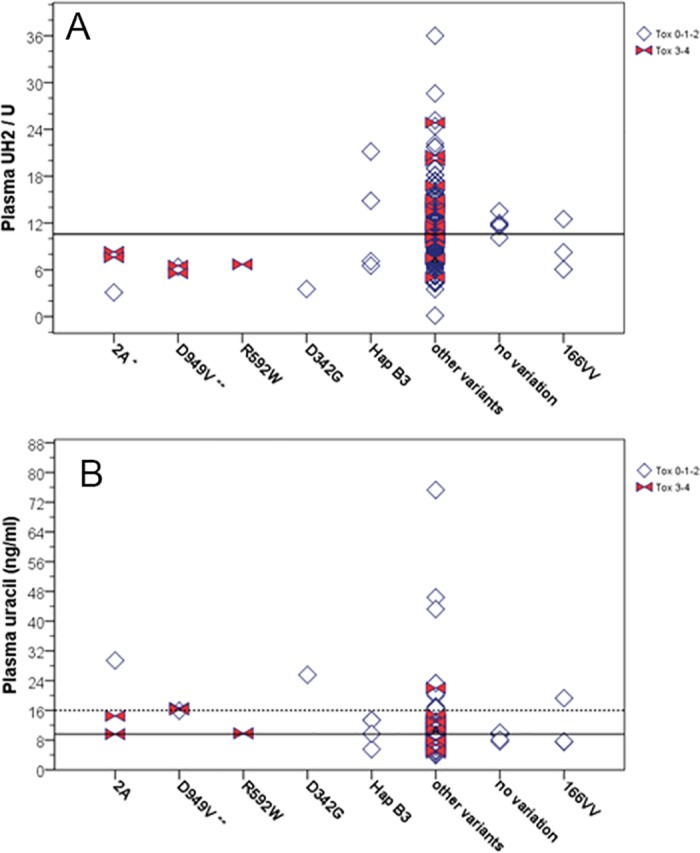
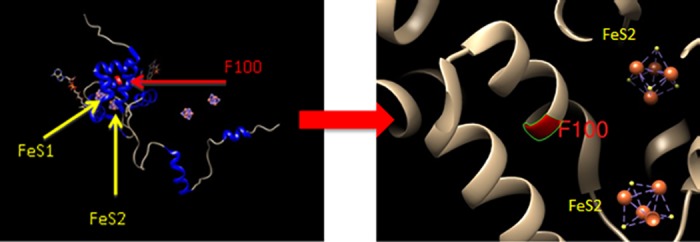
Among the 48 SNPs identified, 19 were located in coding regions, including 3 novel variations, each observed in a single patient (among which, F100L and A26T, both pathogenic in silico). Combined analysis of deleterious variants *2A, I560S (*13) and D949V showed significant association with grade 3-4 toxicity (sensitivity 16.7%, positive predictive value (PPV) 71.4%, relative risk (RR) 6.7, p<0.001) but not with grade 4 toxicity. Considering additional deleterious coding variants D342G, S492L, R592W and F100L increased the sensitivity to 26.7% for grade 3-4 toxicity (PPV 72.7%, RR 7.6, p<0.001), and was significantly associated with grade 4 toxicity (sensitivity 60%, PPV 27.3%, RR 31.4, p = 0.001), suggesting the clinical relevance of extended targeted DPYD genotyping. As compared to extended genotype, combining genotyping (7 variants) and phenotyping (U>16 ng/ml) did not substantially increase the sensitivity, while impairing PPV and RR.
Exploring an extended set of deleterious DPYD variants improves the performance of DPYD genotyping for predicting both grade 3-4 and grade 4 toxicities (digestive and/or neurologic and/or hematotoxicities) related to capecitabine, as compared to conventional genotyping restricted to consensual variants *2A, *13 and D949V.
二氢嘧啶脱氢酶(DPD)缺乏是严重及致死性氟嘧啶相关毒性的主要原因。已开发出多种DPD缺乏筛查方法,包括DPYD基因分型和表型分析。这项前瞻性观察性研究的目的是进行全面的外显子组DPYD测序,并研究接受卡培他滨治疗的晚期乳腺癌患者中DPYD变异与毒性之间的关系。
分析了243例患者(88.5%为卡培他滨单药治疗)。分别有10.3%和2.1%的患者观察到3级和4级卡培他滨相关的消化和/或神经和/或血液毒性。在Illumina MiSeq上对DPYD外显子组以及侧翼内含子区域3'UTR和5'UTR进行测序。通过治疗前血浆尿嘧啶(U)和二氢尿嘧啶(UH2)测量评估DPD表型。
在鉴定出的48个单核苷酸多态性(SNP)中,19个位于编码区,包括3个新变异,每个变异仅在1例患者中观察到(其中,F100L和A26T在计算机模拟中均为致病性变异)。对有害变异*2A、I560S(*13)和D949V的联合分析显示与3 - 4级毒性显著相关(敏感性16.7%,阳性预测值(PPV)71.4%,相对风险(RR)6.7,p<0.001),但与4级毒性无关。考虑额外的有害编码变异D342G、S492L、R592W和F100L,3 - 4级毒性的敏感性提高到26.7%(PPV 72.7%,RR 7.6,p<0.001),并且与4级毒性显著相关(敏感性60%,PPV 27.3%,RR 31.4,p = 0.001),提示扩展靶向DPYD基因分型具有临床相关性。与扩展基因型相比,将基因分型(7个变异)和表型分析(U>16 ng/ml)相结合并没有显著提高敏感性,同时损害了PPV和RR。
与限于共识变异*2A、*13和D949V的传统基因分型相比,探索一组扩展的有害DPYD变异可提高DPYD基因分型预测与卡培他滨相关的3 - 4级和4级毒性(消化和/或神经和/或血液毒性)的性能。