D'Amour Sarah, Harris Laurence R
Department of Psychology, Centre for Vision Research, York University, Toronto, ON, Canada.
PLoS One. 2017 May 8;12(5):e0177349. doi: 10.1371/journal.pone.0177349. eCollection 2017.
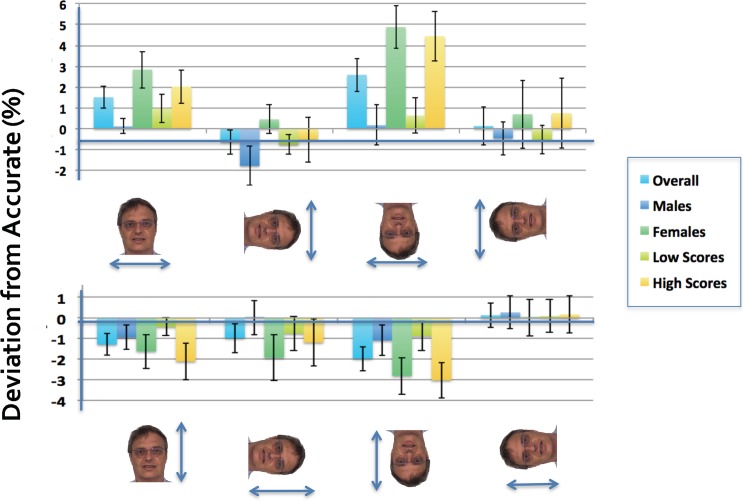
Perceptual body size distortions have traditionally been studied using subjective, qualitative measures that assess only one type of body representation-the conscious body image. Previous research on perceived body size has typically focused on measuring distortions of the entire body and has tended to overlook the face. Here, we present a novel psychophysical method for determining perceived body size that taps into implicit body representation. Using a two-alternative forced choice (2AFC), participants were sequentially shown two life-size images of their own face, viewed upright, upside down, or tilted 90°. In one interval, the width or length dimension was varied, while the other interval contained an undistorted image. Participants reported which image most closely matched their own face. An adaptive staircase adjusted the distorted image to hone in on the image that was equally likely to be judged as matching their perceived face as the accurate image. When viewed upright or upside down, face width was overestimated and length underestimated, whereas perception was accurate for the on-side views. These results provide the first psychophysically robust measurements of how accurately healthy participants perceive the size of their face, revealing distortions of the implicit body representation independent of the conscious body image.
传统上,感知身体大小的扭曲是通过主观的、定性的测量方法来研究的,这些方法只评估一种身体表征类型——有意识的身体形象。以往关于感知身体大小的研究通常集中在测量整个身体的扭曲,并且往往忽略了面部。在这里,我们提出了一种新颖的心理物理学方法来确定感知身体大小,该方法利用了隐性身体表征。使用二选一强制选择(2AFC),向参与者依次展示他们自己面部的两张真人大小的图像,图像为正立、倒立或倾斜90°。在一个时间间隔内,宽度或长度维度会发生变化,而另一个时间间隔包含未扭曲的图像。参与者报告哪张图像与他们自己的面部最匹配。自适应阶梯法调整扭曲图像,以确定与准确图像一样有可能被判断为与他们感知到的面部匹配的图像。当正立或倒立观看时,面部宽度被高估,长度被低估,而侧面视图的感知是准确的。这些结果首次提供了心理物理学上可靠的测量,以了解健康参与者对其面部大小的感知有多准确,揭示了独立于有意识身体形象的隐性身体表征的扭曲。