Emergency Preparedness Program, North Central Health District, Georgia Department of Public Health, Macon.
Department of Pediatrics, Columbia University Medical Center, New York.
J Pediatric Infect Dis Soc. 2018 May 15;7(2):151-158. doi: 10.1093/jpids/pix027.
The epidemiology and clinical features of human coronaviruses (HCoVs) in children are not fully characterized.
A retrospective study of children with HCoV detected by reverse-transcriptase polymerase chain reaction (RT-PCR) was performed for a community cohort and a children's hospital in the same community from January 2013 to December 2014. The RT-PCR assay detected HCoV 229E, HKU1, NL63, and OC43 in nasal swabs from symptomatic children ≤18 years. Factors associated with increased severity of illness in hospitalized children were assessed by multivariable logistic regression.
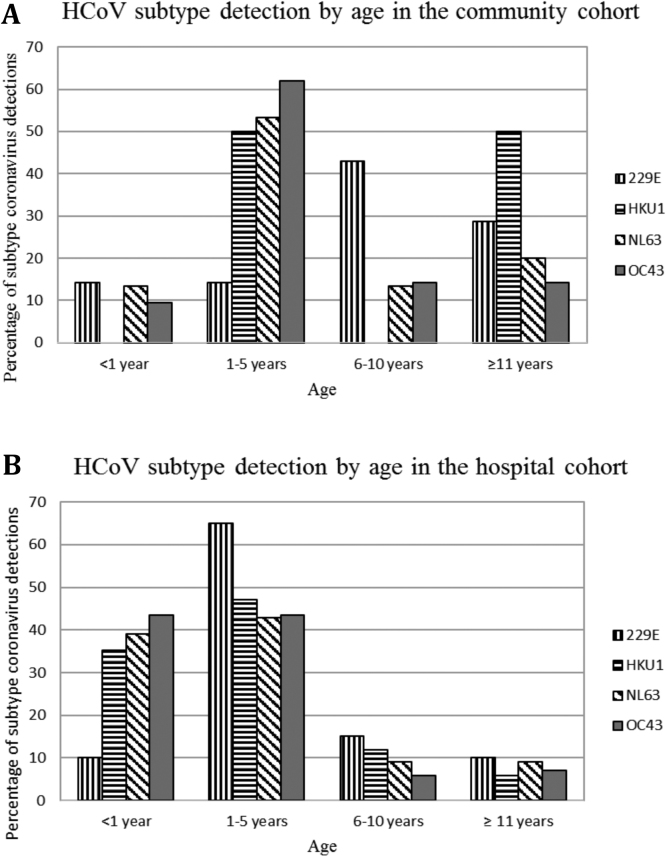
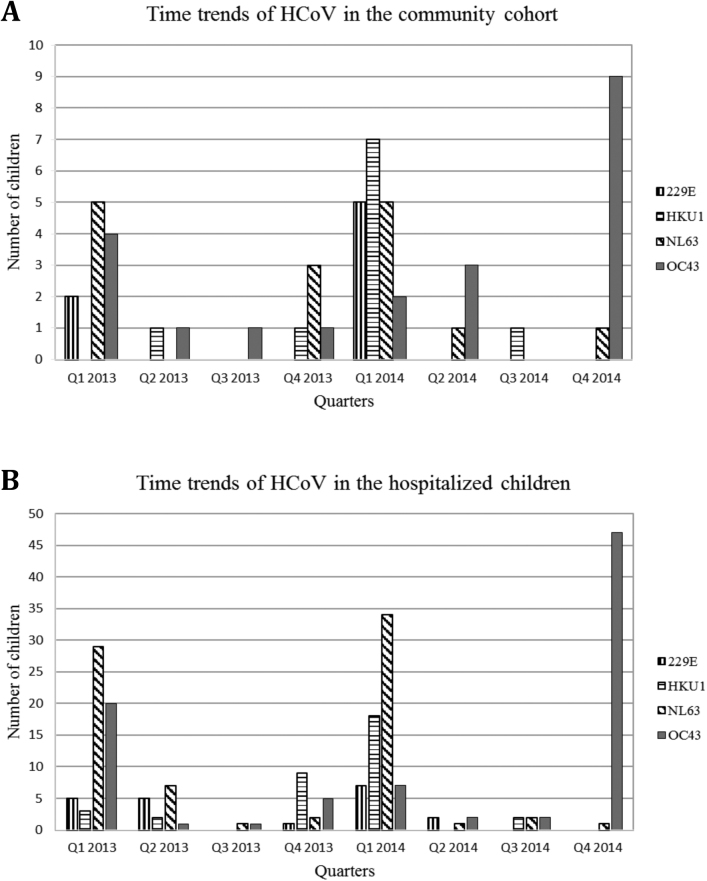
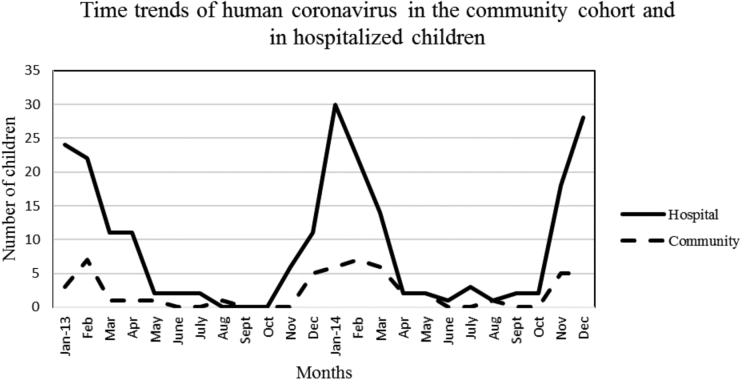
Human coronavirus was detected in 261 children, 49 and 212 from the community and hospital, respectively. The distribution of HCoV types and seasonal trends were similar in the community and hospital. Community cases were older than hospitalized cases (median age, 4.4 versus 1.7 years, respectively; P < .01), and a minority of community cases (26.5%) sought medical attention. Among the hospitalized children with HCoV detected, 39 (18.4%) received respiratory support and 24 (11.3%) were admitted to the pediatric intensive care unit (PICU). Age <2 years (odds ratio [OR] = 5.0; 95% confidence interval [CI], 1.9-13.1) and cardiovascular (OR = 3.9; 95% CI, 1.6-9.5), genetic/congenital (OR = 2.8; 95% CI, 1.1-7.0), and respiratory chronic complex conditions ([CCCs] OR = 4.5; 95% CI, 1.7-12.0) were associated with receiving respiratory support. Genetic/congenital (OR = 2.8; 95% CI, 1.1-7.4) CCCs were associated with PICU admission. Severity of illness was similar among hospitalized children with different HCoV types.
Children in the community with HCoV detected generally had mild illness as demonstrated by few medically attended cases. In hospitalized children, young age and CCCs, but not HCoV type, were associated with increased severity of illness.
人类冠状病毒(HCoV)在儿童中的流行病学和临床特征尚未完全明确。
对 2013 年 1 月至 2014 年 12 月在同一社区的一家社区队列医院和一家儿童医院,通过逆转录酶聚合酶链反应(RT-PCR)检测到 HCoV 的儿童进行了一项回顾性研究。RT-PCR 检测了≤18 岁有症状儿童的鼻拭子中的 HCoV 229E、HKU1、NL63 和 OC43。采用多变量逻辑回归评估与住院儿童疾病严重程度增加相关的因素。
共检测到 261 名 HCoV 儿童,其中社区 49 名,医院 212 名。社区和医院的 HCoV 类型分布和季节性趋势相似。社区病例较医院病例年龄大(中位数年龄分别为 4.4 岁和 1.7 岁;P<0.01),且社区病例中少数(26.5%)寻求医疗帮助。在检测到 HCoV 的住院儿童中,有 39 名(18.4%)接受了呼吸支持,有 24 名(11.3%)住进了儿科重症监护病房(PICU)。年龄<2 岁(比值比[OR] = 5.0;95%置信区间[CI],1.9-13.1)和心血管(OR = 3.9;95% CI,1.6-9.5)、遗传/先天性(OR = 2.8;95% CI,1.1-7.0)和呼吸慢性复杂疾病(CCCs;OR = 4.5;95% CI,1.7-12.0)与接受呼吸支持有关。遗传/先天性(OR = 2.8;95% CI,1.1-7.4)CCCs 与 PICU 入院有关。不同 HCoV 类型的住院儿童的疾病严重程度相似。
社区中检测到 HCoV 的儿童一般表现为轻症,表现为就医的病例较少。在住院儿童中,年龄较小和 CCCs,但不是 HCoV 类型,与疾病严重程度增加相关。