Mater Research Institute-University of Queensland, Woolloongabba QLD 4102, Australia.
Invenra, Incorporated, Madison, Wisconsin 53719, USA.
Genome Res. 2017 Aug;27(8):1395-1405. doi: 10.1101/gr.219022.116. Epub 2017 May 8.
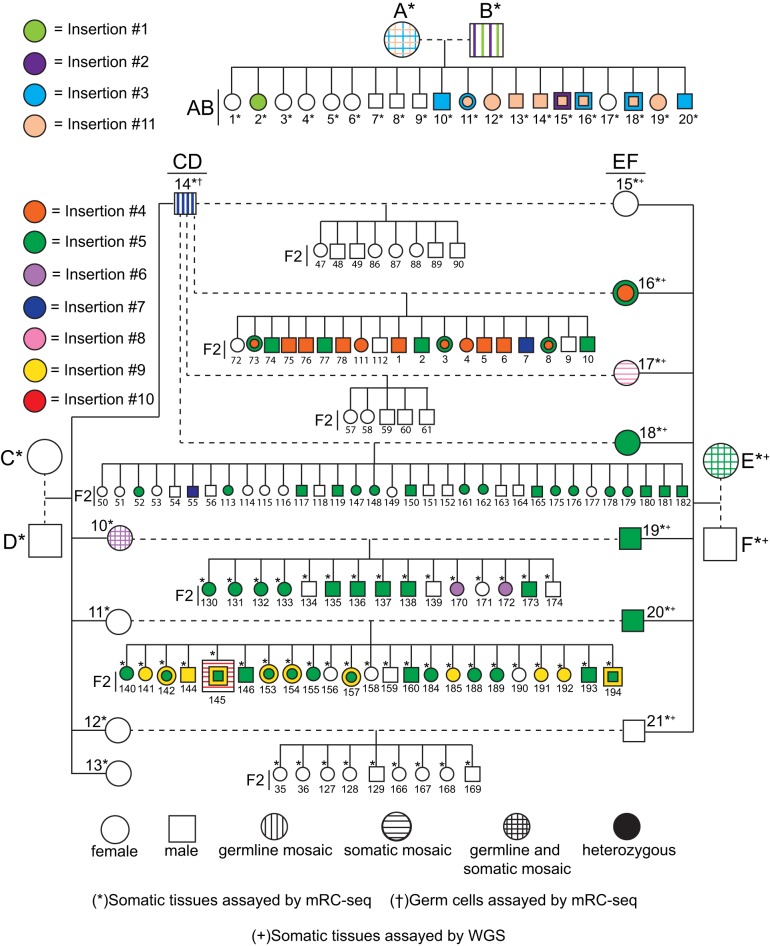
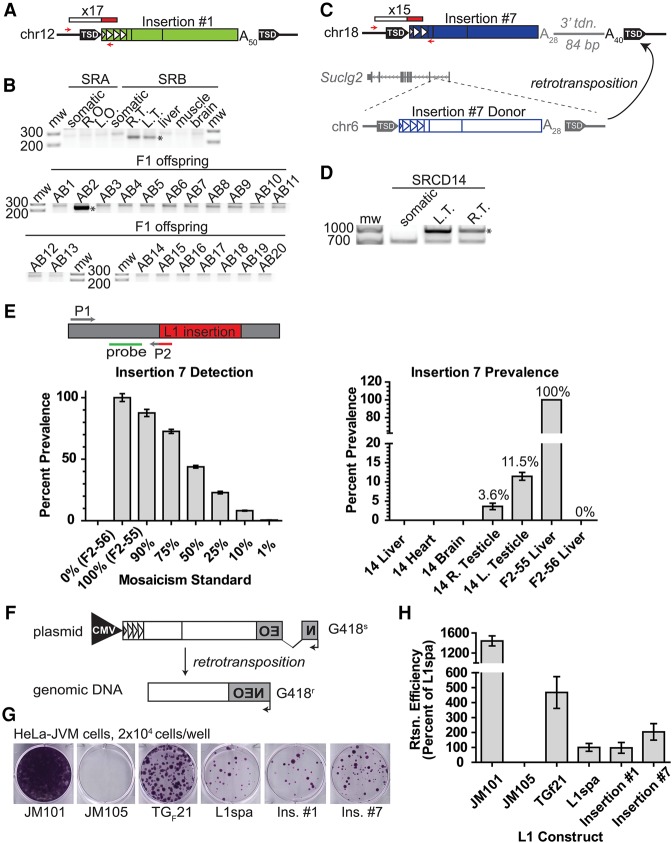
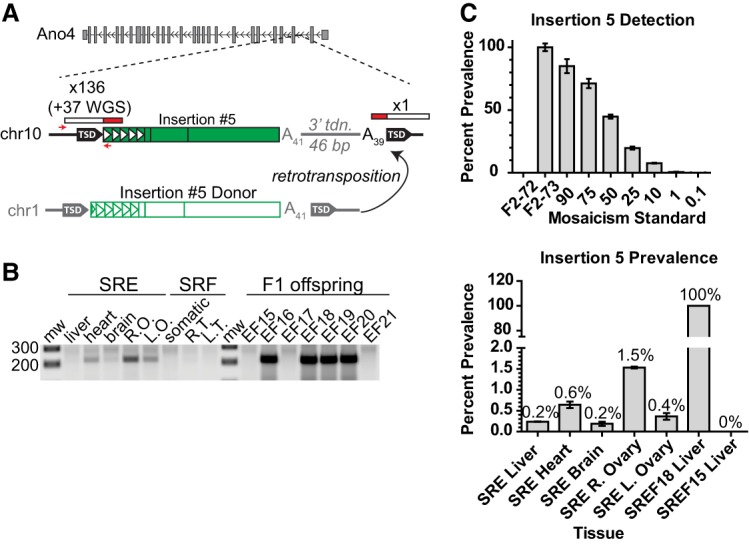
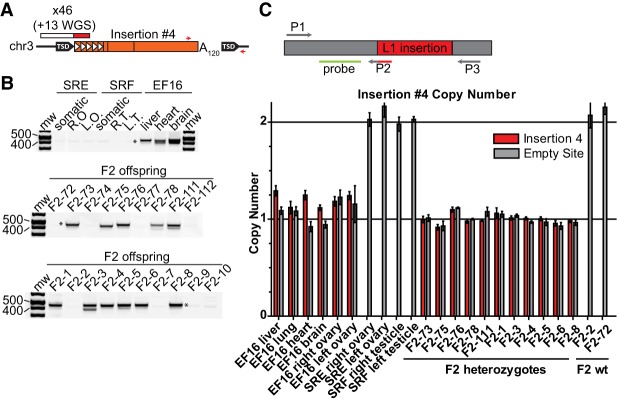
LINE-1 (L1) retrotransposons are a noted source of genetic diversity and disease in mammals. To expand its genomic footprint, L1 must mobilize in cells that will contribute their genetic material to subsequent generations. Heritable L1 insertions may therefore arise in germ cells and in pluripotent embryonic cells, prior to germline specification, yet the frequency and predominant developmental timing of such events remain unclear. Here, we applied mouse retrotransposon capture sequencing (mRC-seq) and whole-genome sequencing (WGS) to pedigrees of C57BL/6J animals, and uncovered an L1 insertion rate of ≥1 event per eight births. We traced heritable L1 insertions to pluripotent embryonic cells and, strikingly, to early primordial germ cells (PGCs). New L1 insertions bore structural hallmarks of target-site primed reverse transcription (TPRT) and mobilized efficiently in a cultured cell retrotransposition assay. Together, our results highlight the rate and evolutionary impact of heritable L1 retrotransposition and reveal retrotransposition-mediated genomic diversification as a fundamental property of pluripotent embryonic cells in vivo.
LINE-1(L1)逆转录转座子是哺乳动物遗传多样性和疾病的重要来源。为了扩大其基因组足迹,L1 必须在将其遗传物质贡献给后代的细胞中移动。因此,可遗传的 L1 插入可能发生在生殖细胞和多能胚胎细胞中,在生殖系特化之前,但此类事件的频率和主要发育时间尚不清楚。在这里,我们应用小鼠逆转录转座子捕获测序(mRC-seq)和全基因组测序(WGS)对 C57BL/6J 动物的家系进行了研究,并发现每 8 次出生就有≥1 次 L1 插入事件。我们追踪了可遗传的 L1 插入到多能胚胎细胞,并且令人惊讶的是,还追踪到了早期原始生殖细胞(PGCs)。新的 L1 插入具有靶位启动的逆转录(TPRT)的结构特征,并在培养细胞逆转座酶测定中有效地移动。总之,我们的研究结果突出了可遗传的 L1 逆转座的速度和进化影响,并揭示了逆转座介导的基因组多样化是体内多能胚胎细胞的基本特性。