Fukutani Atsuki, Misaki Jun, Isaka Tadao
Faculty of Kinesiology, University of CalgaryCalgary, AB, Canada.
Japan Society for the Promotion of Science, Postdoctoral Fellowships for Research AbroadTokyo, Japan.
Front Physiol. 2017 Apr 24;8:234. doi: 10.3389/fphys.2017.00234. eCollection 2017.
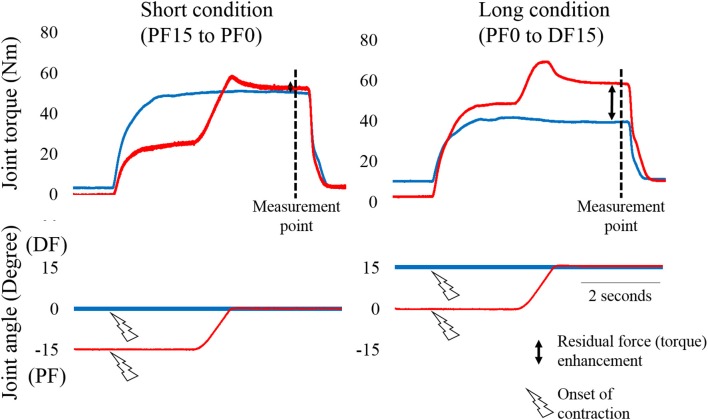
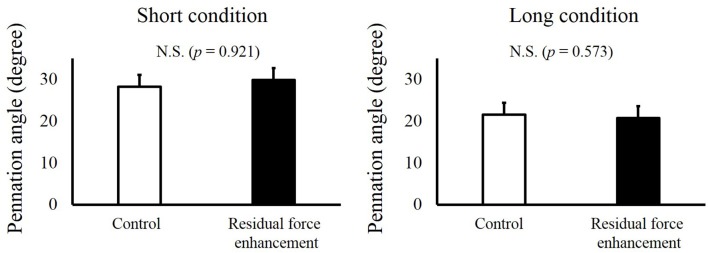
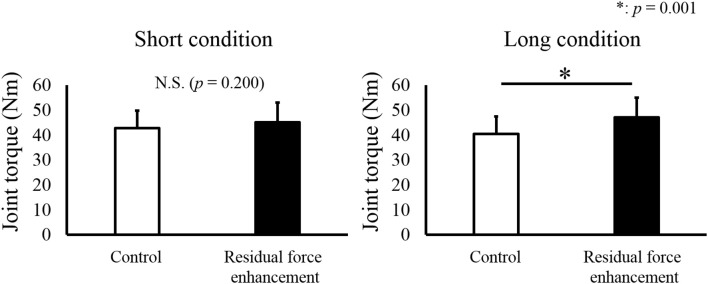
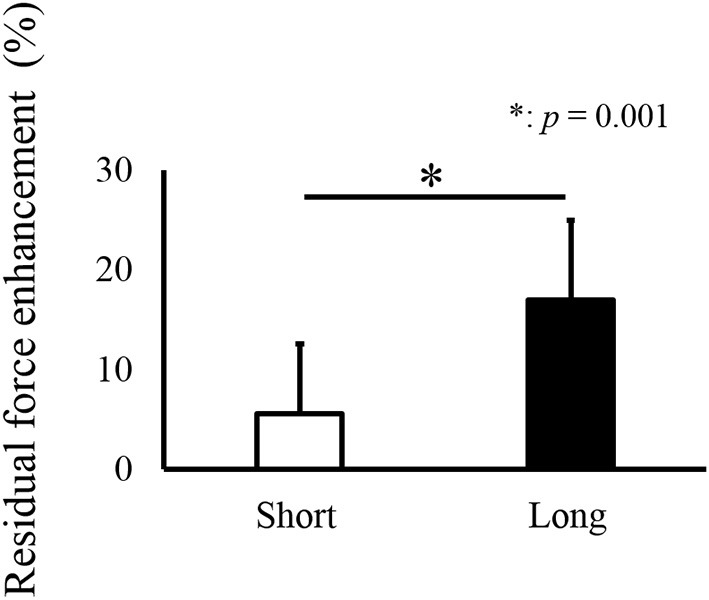
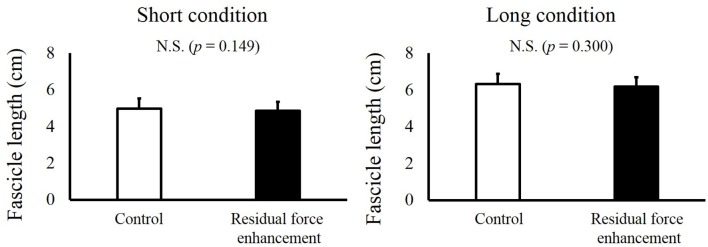
Compared to pure isometric contractions, isometric muscle force at a given length is larger when the eccentric contraction is conducted before the isometric contraction. This phenomenon is widely known as residual force enhancement, and has been confirmed consistently in isolated muscle experiments. The purpose of this study was to confirm whether residual force enhancement also occurs in human plantar flexors and to examine its joint angle dependence. Eleven men participated in this study. Isometric joint torque was measured in a Control trial (pure isometric contraction) and Residual force enhancement (RFE) trial (isometric contraction after eccentric contraction) at plantar flexion 0° (Short condition) and dorsiflexion 15° (Long condition). Fascicle length and pennation angle of the medial gastrocnemius were measured simultaneously to evaluate the influence of architectural parameters on isometric joint torque. Isometric joint torque observed in the Short condition was not significantly different between the Control and RFE trials (Control: 42.9 ± 8.0 Nm, RFE: 45.1 ± 8.4 Nm) ( = 0.200). In contrast, significant differences in isometric joint torque were observed in the Long condition between Control and RFE trials (Control: 40.5 ± 9.3 Nm, RFE: 47.1 ± 10.5 Nm) ( = 0.001). Fascicle length and pennation angle were not different between Control and RFE trials in the Short and Long conditions. Isometric joint torque was larger when eccentric contraction was conducted before isometric contraction while architectural differences were not observed, indicating that residual force enhancement occurs in human plantar flexors. However, the influence of residual force enhancement may be limited in dorsiflexed positions because the magnitude of residual force enhancement is considered to be prominent in the descending limb (long muscle length condition) and small in the ascending limb (short muscle length condition) where human plantar flexors operate in plantar flexed positions.
与单纯的等长收缩相比,当在等长收缩之前进行离心收缩时,在给定长度下的等长肌力更大。这种现象被广泛称为残余力增强,并且在离体肌肉实验中得到了一致证实。本研究的目的是确认残余力增强是否也发生在人类跖屈肌中,并研究其与关节角度的关系。11名男性参与了本研究。在跖屈0°(短肌长度条件)和背屈15°(长肌长度条件)下,于对照试验(单纯等长收缩)和残余力增强(RFE)试验(离心收缩后等长收缩)中测量等长关节扭矩。同时测量腓肠肌内侧的肌束长度和羽状角,以评估结构参数对等长关节扭矩的影响。在短肌长度条件下,对照试验和RFE试验中观察到的等长关节扭矩无显著差异(对照:42.9±8.0 Nm,RFE:45.1±8.4 Nm)(P = 0.200)。相比之下,在长肌长度条件下,对照试验和RFE试验之间观察到等长关节扭矩存在显著差异(对照:40.5±9.3 Nm,RFE:47.1±10.5 Nm)(P = 0.001)。在短肌长度和长肌长度条件下,对照试验和RFE试验之间的肌束长度和羽状角无差异。当在等长收缩之前进行离心收缩时,等长关节扭矩更大,而未观察到结构差异,表明残余力增强发生在人类跖屈肌中。然而,残余力增强的影响在背屈位置可能有限,因为残余力增强的幅度在下降支(长肌长度条件)中被认为较为显著,而在上升支(短肌长度条件)中较小,人类跖屈肌在跖屈位置发挥作用。