Cucchi T, Mohaseb A, Peigné S, Debue K, Orlando L, Mashkour M
CNRS, Muséum national d'Histoire naturelle, Sorbonne Universités, UMR 7209, Archéozoologie, Archéobotanique: Sociétés, Pratiques et Environnements, 75005 Paris, France.
Department of Archaeology, University of Aberdeen, St Mary's, Aberdeen, UK.
R Soc Open Sci. 2017 Apr 5;4(4):160997. doi: 10.1098/rsos.160997. eCollection 2017 Apr.
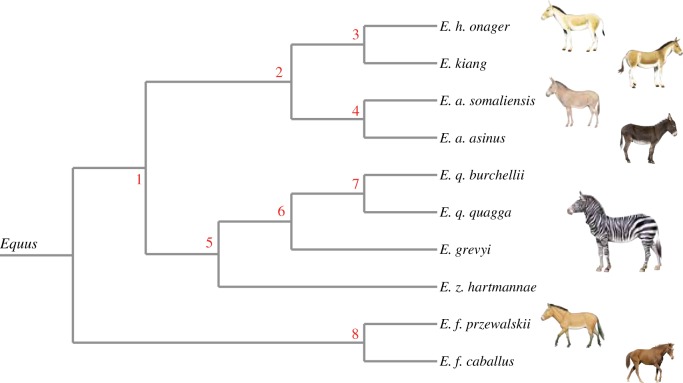
The Plio-Pleistocene evolution of and the subsequent domestication of horses and donkeys remains poorly understood, due to the lack of phenotypic markers capable of tracing this evolutionary process in the palaeontological/archaeological record. Using images from 345 specimens, encompassing 15 extant taxa of equids, we quantified the occlusal enamel folding pattern in four mandibular cheek teeth with a single geometric morphometric protocol. We initially investigated the protocol accuracy by assigning each tooth to its correct anatomical position and taxonomic group. We then contrasted the phylogenetic signal present in each tooth shape with an exome-wide phylogeny from 10 extant equine species. We estimated the strength of the phylogenetic signal using a Brownian motion model of evolution with multivariate statistic, and mapped the dental shape along the molecular phylogeny using an approach based on squared-change parsimony. We found clear evidence for the relevance of dental phenotypes to accurately discriminate all modern members of the genus and capture their phylogenetic relationships. These results are valuable for both palaeontologists and zooarchaeologists exploring the spatial and temporal dynamics of the evolutionary history of the horse family, up to the latest domestication trajectories of horses and donkeys.
由于缺乏能够在古生物学/考古记录中追踪马和驴进化过程的表型标记,上新世-更新世马和驴的进化以及随后的驯化情况仍知之甚少。我们使用来自345个标本的图像,涵盖15个现存马科动物分类单元,通过单一的几何形态测量方案对四颗下颌颊齿的咬合釉质折叠模式进行了量化。我们首先通过将每颗牙齿归到其正确的解剖位置和分类群来研究该方案的准确性。然后,我们将每颗牙齿形状中存在的系统发育信号与10个现存马种的全外显子组系统发育进行对比。我们使用具有多变量统计的布朗运动进化模型估计系统发育信号的强度,并使用基于平方变化简约法的方法沿着分子系统发育图谱绘制牙齿形状。我们发现了明确的证据,证明牙齿表型对于准确区分马属的所有现代成员并捕捉它们的系统发育关系具有相关性。这些结果对于古生物学家和动物考古学家探索马科动物进化历史的时空动态直至马和驴的最新驯化轨迹都具有重要价值。