Park In-Seok, Gil Hyun Woo, Lee Tae Ho, Nam Yoon Kwon, Lim Sang Gu, Kim Dong Soo
Division of Marine Bioscience, College of Ocean Science and Technology, Korea Maritime and Ocean University, Busan 606-791, Korea.
Institute of Marine Living Modified Organisms (iMLMO), Pukyung National University, Busan 608-737, Korea.
Dev Reprod. 2017 Mar;21(1):19-33. doi: 10.12717/DR.2017.21.1.019. Epub 2017 Mar 31.
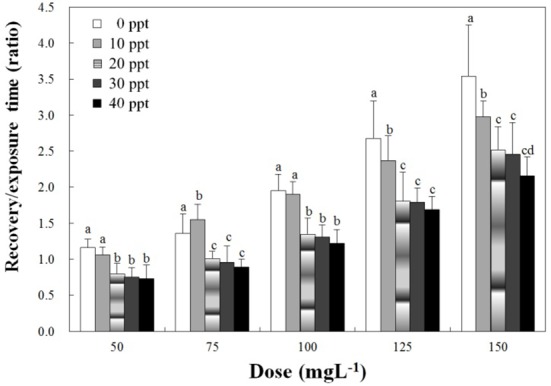
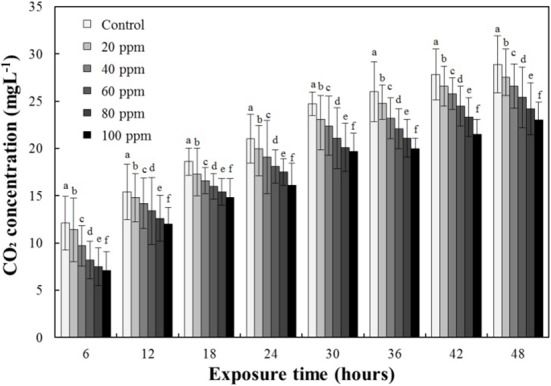
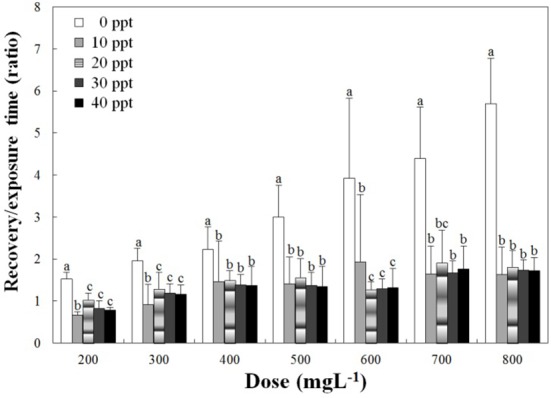
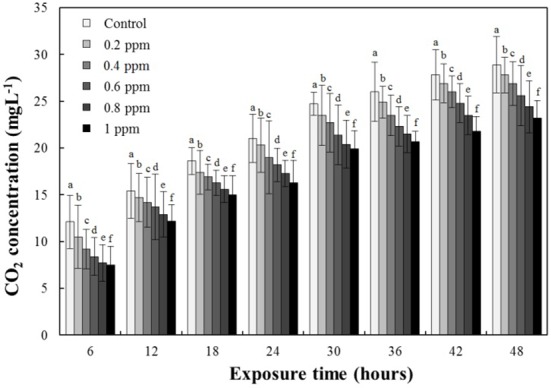
Optimum concentrations of anesthetic clove oil and anesthetic lidocaine-HCl were determined for a species of adult marine medaka, , over a range of salinity conditions, and investigated in a transport simulation experiment by analyzing various water and physiological parameters. Research indicated that the higher the concentration of anesthetic at each salinity, the shorter the anesthesia time at each salinity. At each concentration, fish were anesthetized slower at water salinities over 10 ppt (<0.05). Anesthesia time at 10 ppt was faster than any other salinity. In 10 ppt salinity, the dissolved oxygen (DO) concentrations and respiratory frequencies of the clove-oil-administered groups decreased until 48 hours (0.05), whereas the NH and CO concentrations increased until 48 hours (0.05). In same period, the DO, NH, and CO concentrations and respiratory frequencies all decreased as the clove oil concentration increased (0.05). The trends in the DO, NH, and CO concentrations and respiratory frequencies in the lidocaine-HCl-administered groups were similar to those in the clove-oil-administered groups. In conclusion, clove oil and lidocaine-HCl are effective anesthetics, improving the transportation of the marine medaka. The results from this study will contribute to safe laboratory handling of the marine medaka, which are commonly required by many research studies and experiments.
在一系列盐度条件下,确定了成年海洋青鳉鱼的麻醉丁香油和麻醉盐酸利多卡因的最佳浓度,并通过分析各种水和生理参数,在运输模拟实验中进行了研究。研究表明,在每个盐度下,麻醉剂浓度越高,在每个盐度下的麻醉时间越短。在每个浓度下,盐度超过10 ppt(<0.05)时鱼的麻醉速度较慢。10 ppt时的麻醉时间比任何其他盐度都快。在10 ppt盐度下,丁香油处理组的溶解氧(DO)浓度和呼吸频率在48小时内下降(0.05),而NH和CO浓度在48小时内上升(0.05)。在同一时期,随着丁香油浓度的增加,DO、NH和CO浓度以及呼吸频率均下降(0.05)。盐酸利多卡因处理组的DO、NH和CO浓度以及呼吸频率的变化趋势与丁香油处理组相似。总之,丁香油和盐酸利多卡因是有效的麻醉剂,可改善海洋青鳉鱼的运输。本研究结果将有助于安全地在实验室处理海洋青鳉鱼,这是许多研究和实验普遍需要的。