Leighton Emma, Sainsbury Christopher Ar, Jones Gregory C
Diabetes Department, Gartnavel General Hospital, Glasgow, UK.
Diabetes Ther. 2017 Jun;8(3):475-487. doi: 10.1007/s13300-017-0265-4. Epub 2017 May 8.
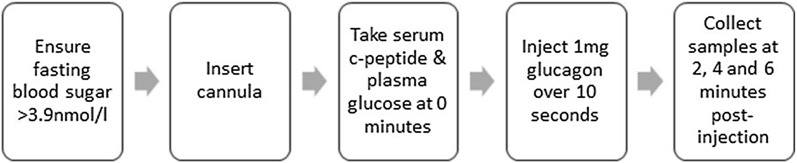
C-peptide is a widely used measure of pancreatic beta cell function. It is produced in equimolar amounts to endogenous insulin but is excreted at a more constant rate over a longer time. Methods of estimation include urinary and unstimulated and stimulated serum sampling. Modern assays detect levels of c-peptide which can be used to guide diabetes diagnosis and management. We explore the evidence behind the various tests available. We recommend the glucagon stimulation c-peptide testing owing to its balance of sensitivity and practicality. C-peptide levels are associated with diabetes type and duration of disease. Specifically a c-peptide level of less than 0.2 nmol/l is associated with a diagnosis of type 1 diabetes mellitus (T1DM). C-peptide level may correlate with microvascular and macrovascular complications and future use of insulin therapy, as well as likely response to other individual therapies. We explore the potential uses of c-peptide measurement in clinical practice.
C肽是一种广泛用于衡量胰腺β细胞功能的指标。它与内源性胰岛素以等摩尔量产生,但在更长时间内以更恒定的速率排泄。评估方法包括尿液检测以及非刺激和刺激状态下的血清采样。现代检测方法可检测C肽水平,这些水平可用于指导糖尿病的诊断和管理。我们探讨了现有各种检测方法背后的证据。由于其敏感性和实用性的平衡,我们推荐胰高血糖素刺激C肽检测。C肽水平与糖尿病类型和病程有关。具体而言,C肽水平低于0.2 nmol/l与1型糖尿病(T1DM)的诊断相关。C肽水平可能与微血管和大血管并发症、胰岛素治疗的未来使用以及对其他个体治疗的可能反应相关。我们探讨了C肽检测在临床实践中的潜在用途。