Poupard Nicolas, Badarou Pamela, Fasani Fabienne, Groult Hugo, Bridiau Nicolas, Sannier Frédéric, Bordenave-Juchereau Stéphanie, Kieda Claudine, Piot Jean-Marie, Grillon Catherine, Fruitier-Arnaudin Ingrid, Maugard Thierry
Université de la Rochelle, UMR CNRS 7266, LIENSs, Equipe Approches Moléculaires, Environnement-Santé, Avenue Michel Crépeau, 17000 La Rochelle, France.
Centre de Biophysique Moléculaire, UPR CNRS 4301, 45071 Orléans, France.
Mar Drugs. 2017 May 9;15(5):134. doi: 10.3390/md15050134.
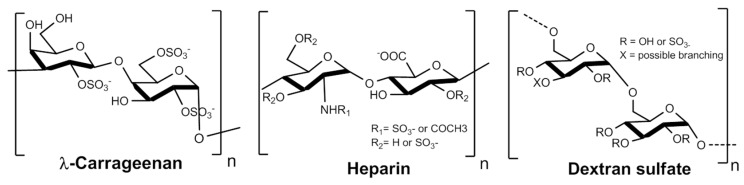
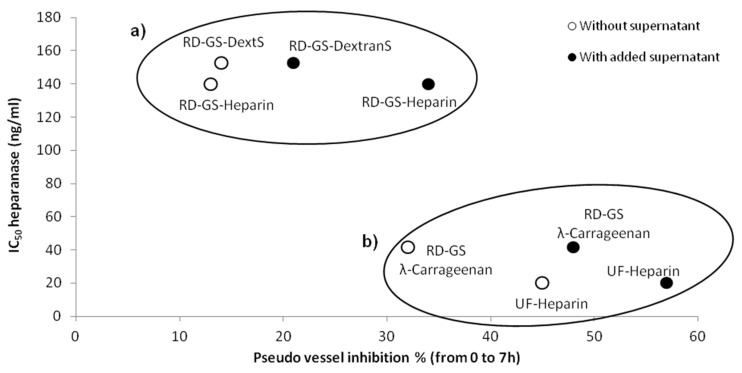
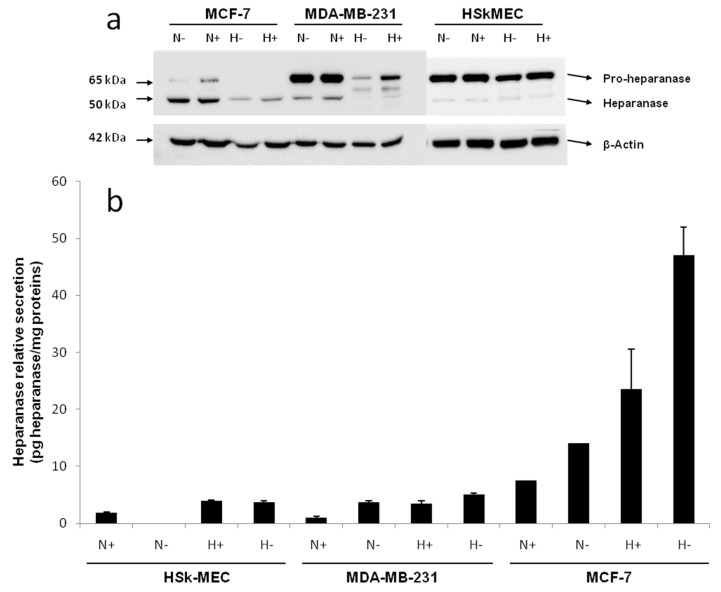
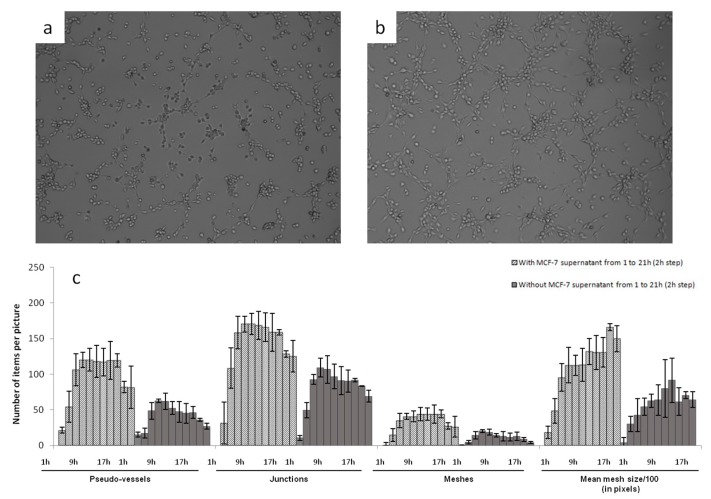
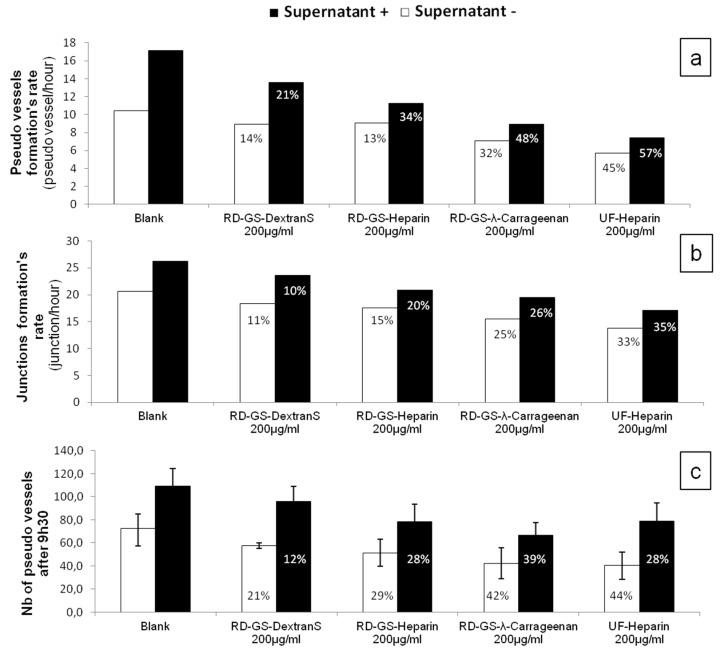
Heparanase is overexpressed by tumor cells and degrades the extracellular matrix proteoglycans through cleavage of heparan sulfates (HS), allowing pro-angiogenic factor release and thus playing a key role in tumor angiogenesis and metastasis. Here we propose new HS analogs as potent heparanase inhibitors: Heparin as a positive control, Dextran Sulfate, λ-Carrageenan, and modified forms of them obtained by depolymerization associated to glycol splitting (RD-GS). After heparanase activity assessment, 11 kDa RD-GS-λ-Carrageenan emerged as the most effective heparanase inhibitor with an IC of 7.32 ng/mL compared to 10.7 ng/mL for the 16 kDa unfractionated heparin. The fractionated polysaccharides were then tested in a heparanase-rich medium-based in vitro model, mimicking tumor microenvironment, to determine their effect on microvascular endothelial cells (HSkMEC) angiogenesis. As a preliminary study, we identified that under hypoxic and nutrient poor conditions, MCF-7 cancer cells released much more mature heparanase in their supernatant than in normal conditions. Then a Matrigel assay using HSkMEC cultured under hypoxic conditions in the presence (or not) of this heparanase-rich supernatant was realized. Adding heparanase-rich media strongly enhanced angiogenic network formation with a production of twice more pseudo-vessels than with the control. When sulfated polysaccharides were tested in this angiogenesis assay, RD-GS-λ-Carrageenan was identified as a promising anti-angiogenic agent.
乙酰肝素酶在肿瘤细胞中过表达,并通过切割硫酸乙酰肝素(HS)来降解细胞外基质蛋白聚糖,从而使促血管生成因子释放,因此在肿瘤血管生成和转移中起关键作用。在此,我们提出新型HS类似物作为有效的乙酰肝素酶抑制剂:肝素作为阳性对照、硫酸葡聚糖、λ-角叉菜胶,以及通过与二醇裂解相关的解聚获得的它们的修饰形式(RD-GS)。在评估乙酰肝素酶活性后,11 kDa的RD-GS-λ-角叉菜胶成为最有效的乙酰肝素酶抑制剂,其IC50为7.32 ng/mL,相比之下,16 kDa的未分级肝素的IC50为10.7 ng/mL。然后,在基于富含乙酰肝素酶的培养基的体外模型中测试分级多糖,该模型模拟肿瘤微环境,以确定它们对微血管内皮细胞(HSkMEC)血管生成的影响。作为一项初步研究,我们发现,在缺氧和营养缺乏的条件下,MCF-7癌细胞在上清液中释放的成熟乙酰肝素酶比在正常条件下多得多。然后,使用在缺氧条件下培养的HSkMEC进行基质胶试验,该试验中存在(或不存在)这种富含乙酰肝素酶的上清液。添加富含乙酰肝素酶的培养基可显著增强血管生成网络的形成,产生的伪血管数量是对照组的两倍。当在该血管生成试验中测试硫酸化多糖时,RD-GS-λ-角叉菜胶被确定为一种有前景的抗血管生成剂。