Fenner Jennifer, Seltzer Jennifer, Peyton Scott, Sullivan Heather, Tolson Peter, Walsh Ryan P, Hill JoVonn, Counterman Brian A
Department of Biological Sciences, Mississippi State University, Starkville, MS 39762, USA.
Department of Biochemistry, Molecular Biology, Entomology and Plant Pathology, Mississippi State University, Starkville, MS 39762, USA.
Insects. 2017 May 9;8(2):50. doi: 10.3390/insects8020050.
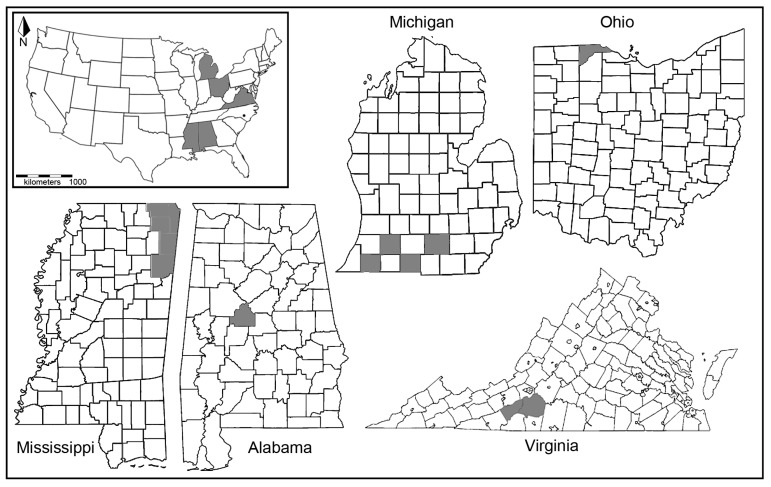
The Mitchell's satyr, , is an endangered species that is limited to highly isolated habitats in the northern and southern United States. Conservation strategies for isolated endangered species often implement captive breeding and translocation programs for repopulation. However, these programs risk increasing the spread of harmful pathogens, such as the bacterial endosymbiont . can manipulate the host's reproduction leading to incompatibilities between infected and uninfected hosts. This study uses molecular methods to screen for presence across the distribution of the Mitchell's satyr and its subspecies, St. Francis satyr, which are both federally listed as endangered and are considered two of the rarest butterflies in North America. The screens confirmed the presence of in the northern and newly discovered southern populations of the Mitchell's satyr, but not in the St. Francis satyr population. These results combined with previous reports of in highlight that infection varies both geographically and temporally in satyr populations. The temporal variance shows the importance of continued monitoring of infection during conservation programs. To reduce the risk of reproductive incompatibilities, it is advised that all individuals collected for conservation purposes be screened for and recommended to avoid the use of infected individuals for captive breeding and translocation programs.
米切尔眼蝶(Mitchell's satyr)是一种濒危物种,仅分布于美国北部和南部高度隔离的栖息地。针对隔离的濒危物种的保护策略通常实施圈养繁殖和重新引入计划以进行种群复壮。然而,这些计划有增加有害病原体传播的风险,例如细菌内共生体(bacterial endosymbiont)。(该细菌内共生体)可以操纵宿主的繁殖,导致受感染和未受感染的宿主之间出现不相容性。本研究使用分子方法在米切尔眼蝶及其亚种圣弗朗西斯眼蝶(St. Francis satyr)的分布范围内筛选(该细菌内共生体的)存在情况,这两种蝴蝶均被联邦列为濒危物种,并且被认为是北美最稀有的两种蝴蝶。筛选结果证实米切尔眼蝶的北部种群和新发现的南部种群中存在(该细菌内共生体),但在圣弗朗西斯眼蝶种群中未发现。这些结果与之前关于(该细菌内共生体在)(米切尔眼蝶中的)报道相结合,突出表明(该细菌内共生体的)感染在眼蝶种群中存在地理和时间上的差异。时间差异表明在保护计划期间持续监测(该细菌内共生体的)感染情况的重要性。为降低生殖不相容性的风险,建议对所有为保护目的而采集的个体进行(该细菌内共生体的)筛选,并建议避免在圈养繁殖和重新引入计划中使用受感染的个体。