Wang Fujiang, He Qiansong, Wang Jinxin, Yuan Qing, Guo Hong, Chai Lijuan, Wang Shaoxia, Hu Limin, Zhang Yue
Tianjin State Key Laboratory of Modern Chinese Medicine, Tianjin University of Traditional Chinese Medicine, 312 Anshanxi Road, Nankai District, Tianjin, 300193, China.
Key Laboratory of Formula of Traditional Chinese Medicine (Tianjin University of Traditional Chinese Medicine), Ministry of Education, Tianjin, 300193, China.
BMC Complement Altern Med. 2017 May 10;17(1):258. doi: 10.1186/s12906-017-1738-8.
Salvianolate lyophilized injection (SLI) has been clinically used in China for the treatment of acutely cerebral infarction. Clinical and experimental studies have shown that Diabetes mellitus (DM) not only increases the risk of ischemic stroke recurrence but also leads to poor outcomes and increases fatality rates after stroke. Our previous study has proved that SLI can reduce the infarct volume after stroke in type 1 diabetic rats. The aim of the study is to explore the mechanism of SLI on stroke outcome in type 1 diabetic (T1DM) rats.
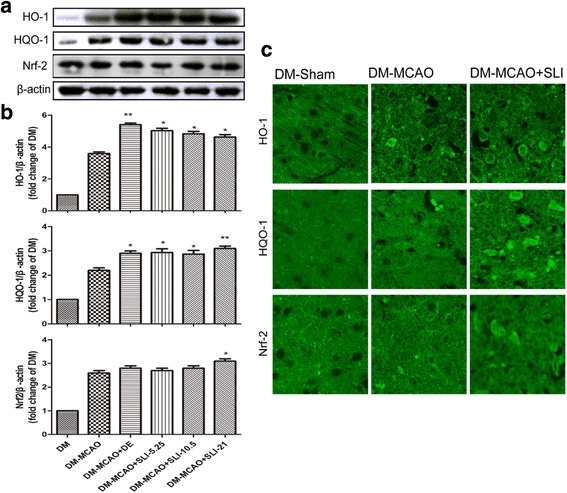
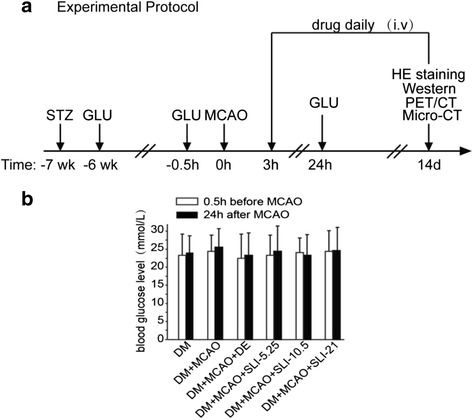
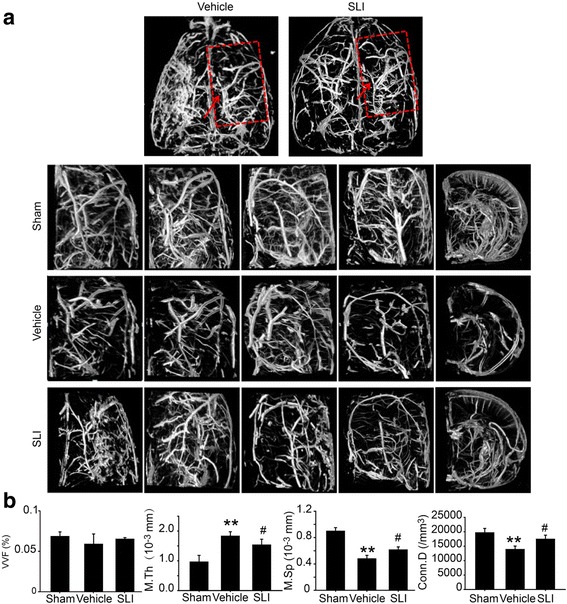
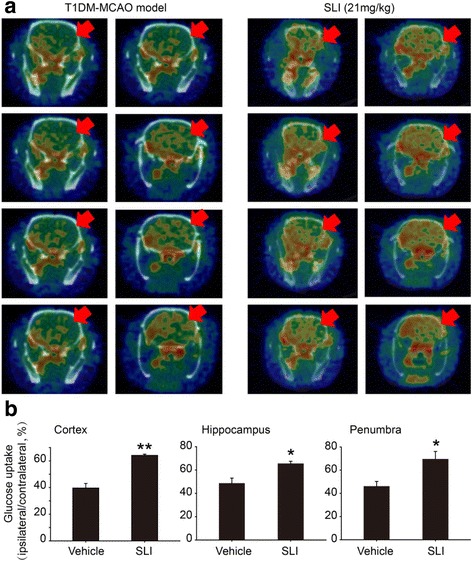
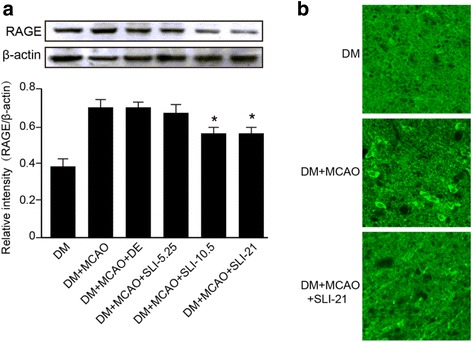
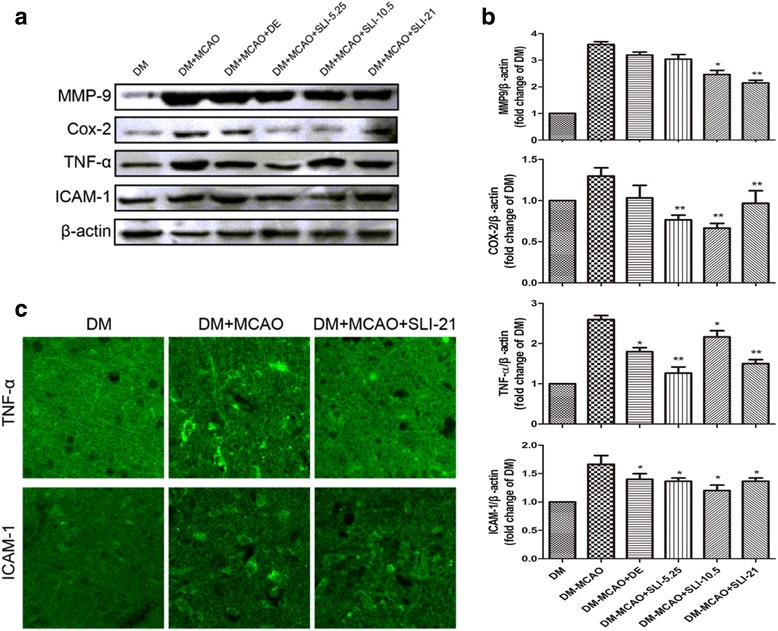
Type 1 diabetes rats model (T1DM) was induced in male Wistar rats by intraperitoneal (i.p) injection of streptozotocin (60 mg/kg) and T1DM rats were subjected to intraluminal middle cerebral artery occlusion (MCAO). The T1DM + MCAO rats were randomly divided into six groups: sham-operated, model-vehicle, positive control group (Edaravone-treating, DE 6 mg/kg) and SLI-treating group (10.5 mg/kg, 21 mg/kg and 42 mg/kg). SLI and DE were administered by tail vein injection at 3 h after MCAO, then daily for 14 days. Micro-CT scans of the brain tissue revealed vessel characteristics and distribution in the ischemia zone. Glucose uptake was analyzed by PET/CT. RAGE, MMP9 and inflammatory factors (COX-2, TNF-α and ICAM-1), HQ-1, HQO-1 and Nrf-2 expression levels in the ischemic brain tissue were analyzed by Immunofluorescence staining and Western blot at 14 days after MCAO.
In this study, we have demonstrated that SLI treatment significantly increased the number of brain microvasculature in ipsilateral and glucose uptake in cortex, hippocampus and penumbra in the T1DM + MCAO rats. SLI also significantly decreased the expression of RAGE, MMP9 and inflammatory factors expression, and increased the expression of HQ-1, HQO-1 and Nrf-2 in T1DM + MCAO rats.
The study showed that SLI could protect against cerebral ischemia injury in T1DM + MCAO rats and the mechanism is related to decrease inflammatory factors and activate of the Nrf2/HO-1 signaling pathway.
丹参多酚酸盐冻干注射剂(SLI)在中国已被临床用于治疗急性脑梗死。临床和实验研究表明,糖尿病(DM)不仅会增加缺血性中风复发的风险,还会导致预后不良并增加中风后的死亡率。我们之前的研究证明,SLI可以减少1型糖尿病大鼠中风后的梗死体积。本研究的目的是探讨SLI对1型糖尿病(T1DM)大鼠中风结局的作用机制。
通过腹腔注射链脲佐菌素(60mg/kg)诱导雄性Wistar大鼠建立1型糖尿病大鼠模型(T1DM),然后对T1DM大鼠进行大脑中动脉线栓法闭塞(MCAO)。将T1DM + MCAO大鼠随机分为六组:假手术组、模型-溶剂组、阳性对照组(依达拉奉治疗组,DE 6mg/kg)和SLI治疗组(10.5mg/kg、21mg/kg和42mg/kg)。在MCAO后3小时通过尾静脉注射给予SLI和DE,然后每天给药14天。对脑组织进行微型CT扫描以揭示缺血区的血管特征和分布。通过PET/CT分析葡萄糖摄取情况。在MCAO后14天,通过免疫荧光染色和蛋白质印迹法分析缺血脑组织中RAGE、MMP9和炎性因子(COX-2、TNF-α和ICAM-1)、HQ-1、HQO-1和Nrf-2的表达水平。
在本研究中,我们证明SLI治疗可显著增加T1DM + MCAO大鼠同侧脑微血管数量以及皮质、海马和半暗带的葡萄糖摄取。SLI还可显著降低T1DM + MCAO大鼠中RAGE、MMP9的表达以及炎性因子的表达,并增加HQ-1、HQO-1和Nrf-2的表达。
该研究表明,SLI可保护T1DM + MCAO大鼠免受脑缺血损伤,其机制与减少炎性因子和激活Nrf2/HO-1信号通路有关。