Institute of Applied Physics, Nizhny Novgorod, Russia.
Division of Atmospheric Sciences, University of Helsinki, Helsinki, Finland.
Sci Rep. 2017 May 9;7(1):1614. doi: 10.1038/s41598-017-01673-9.
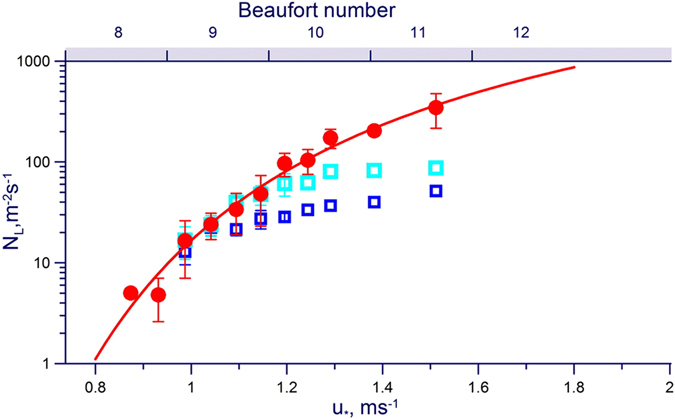
Showing the record strengths and growth-rates, recent hurricanes have highlighted needs for improving forecasts of tropical cyclone intensities most sensitive to models of the air-sea interaction. Especially challenging is the nature of sea-spray supposed to strongly affecting the momentum- and energy- air-sea fluxes at strong winds. Even the spray-generation mechanisms in extreme winds remained undetermined. Basing on high-speed video here we identify it as the bag-breakup mode of fragmentation of liquid in gaseous flows known in a different context. This regime is characterized by inflating and consequent bursting of the short-lived objects, bags, comprising sail-like water films surrounded by massive liquid rims then fragmented to giant droplets with sizes exceeding 500 micrometers. From first principles of statistical physics we develop statistical description of these phenomena and show that at extreme winds the bag-breakup is the dominant spray-production mechanism. These findings provide a new basis for understanding and modeling of the air-sea exchange processes at extreme winds.
展示记录的强度和增长率,最近的飓风凸显了改进对热带气旋强度预测的需求,这些预测对海气相互作用模型最为敏感。特别具有挑战性的是海雾的性质,据推测它会强烈影响强风下的动量和能量海气通量。即使在极端风中的喷雾生成机制仍然不确定。基于高速视频,我们在这里将其识别为众所周知的不同背景下的气体流中液体碎裂的袋式破裂模式。这种状态的特征是短暂物体的膨胀和随后的爆裂,这些物体由帆船状的水膜组成,周围是大量的液体边缘,然后碎裂成尺寸超过 500 微米的巨大液滴。从统计物理学的基本原理出发,我们对这些现象进行了统计描述,并表明在极端风中,袋式破裂是主要的喷雾生成机制。这些发现为理解和模拟极端风中的海气交换过程提供了新的基础。