Kim Ha Neui, Pak Malk Eun, Shin Myung Jun, Kim Soo Yeon, Shin Yong Beom, Yun Young Ju, Shin Hwa Kyoung, Choi Byung Tae
Department of Korean Medical Science, School of Korean Medicine, Pusan National University, Yangsan, Gyeongsangnam‑do 50612, Republic of Korea.
Department of Rehabilitation Medicine, School of Medicine, Pusan National University, Busan 49241, Republic of Korea.
Int J Mol Med. 2017 Jun;39(6):1393-1402. doi: 10.3892/ijmm.2017.2970. Epub 2017 Apr 27.
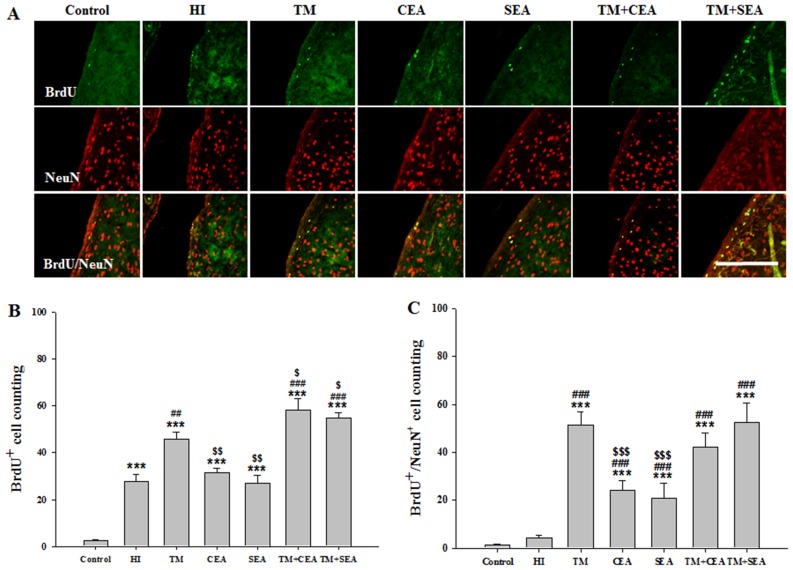
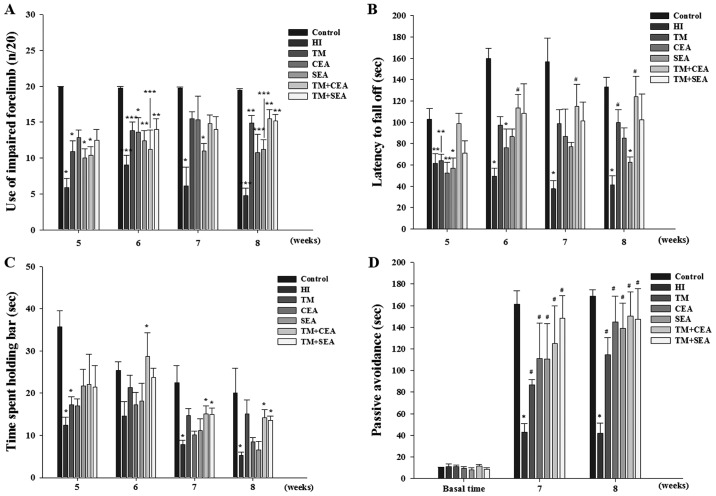
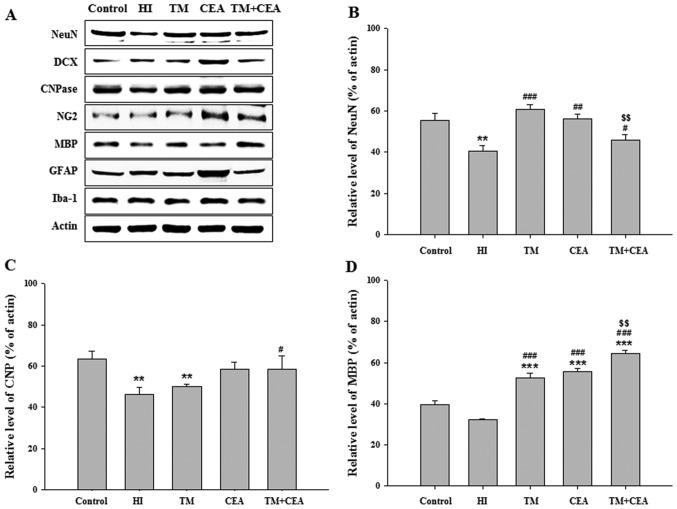
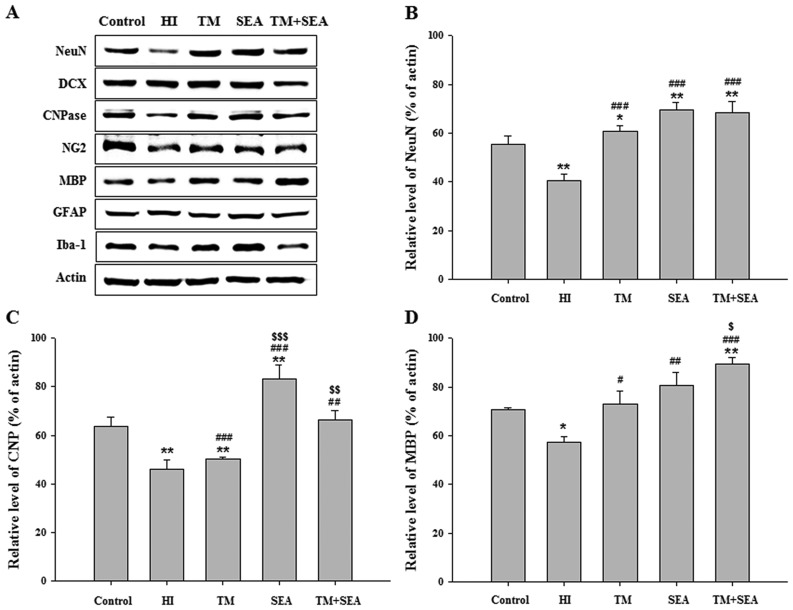
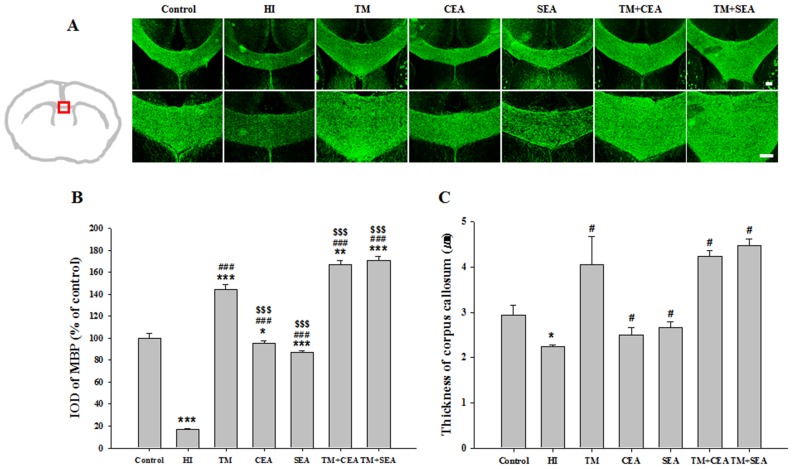
In the present study, we investigated whether treadmill training and electroacupuncture (EA) have autonomous or synergistic beneficial effects on deficits caused by neonatal hypoxia‑ischemia in Sprague-Dawley rats. For this purpose, rats subjected to hypoxia-ischemia underwent treadmill training and EA stimulation from 4 to 8 weeks of age. Conventional EA (CEA) and scalp EA (SEA) were delivered by electrical stimulation (2 Hz, 1 mA) at traditional acupoints and at the scalp to the primary motor area, respectively. In the behavioral examination, markedly improved performances in the rotarod test were observed in the rats that underwent treadmill exercise, and in the rats that underwent treadmill exercise and CEA compared to the untreated rats subjected to hypoxia-ischemia. An improvement was also observed in the passive avoidance test in the rats that underwent treadmill training and EA. As shown by western blot analysis, the expression levels of neuronal nuclei (NeuN), 2',3'-cyclic-nucleotide 3'-phosphodiesterase and myelin basic protein (MBP) exhibited a significant decrease in the contralateral subventricular zone (SVZ) of the rats subjected to hypoxia‑ischemia compared to the controls; however, these expression levels increased following treadmill exercise and EA stimulation. As shown by immunohistochemical analyses, the thickness of the corpus callosum and the integrated optical density (IOD) of MBP were significantly increased in the rats subjected to treadmill exercise and EA compared to the untreated rats subjected to hypoxiaa-ischemia. The synergistic effects of treadmill training and EA were also observed in the protein levels and IOD of MBP. A marked increase in the number of bromodeoxyuridine (BrdU)- and BrdU/NeuN-positive cells in the contralateral SVZ was also observed in the rats that underwent treadmill training and EA; the number of BrdU-positive cells was synergistically affected by treadmill training and EA. These results suggest that treadmill training and EA stimulation contribute to the enhancement of behavioral recovery following hypoxia-ischemia via the upregulation of myelin components and neurogenesis. Thus, treatment with EA stimulation, as well as treadmill training offers another treatment option to promote functional recovery in cerebral palsy.
在本研究中,我们调查了跑步机训练和电针(EA)对新生期缺氧缺血所致的Sprague-Dawley大鼠功能缺陷是否具有自主或协同的有益作用。为此,对经历缺氧缺血的大鼠在4至8周龄时进行跑步机训练和EA刺激。传统电针(CEA)和头皮电针(SEA)分别通过在传统穴位和头皮上的初级运动区进行电刺激(2Hz,1mA)来实施。在行为学检查中,与未接受治疗的缺氧缺血大鼠相比,进行跑步机运动的大鼠以及进行跑步机运动和CEA的大鼠在转棒试验中的表现显著改善。在进行跑步机训练和EA的大鼠的被动回避试验中也观察到了改善。蛋白质免疫印迹分析显示,与对照组相比,缺氧缺血大鼠对侧脑室下区(SVZ)中神经元细胞核(NeuN)、2',3'-环核苷酸3'-磷酸二酯酶和髓鞘碱性蛋白(MBP)的表达水平显著降低;然而,在跑步机运动和EA刺激后,这些表达水平有所增加。免疫组织化学分析显示,与未接受治疗的缺氧缺血大鼠相比,进行跑步机运动和EA的大鼠胼胝体厚度和MBP的积分光密度(IOD)显著增加。在MBP的蛋白质水平和IOD方面也观察到了跑步机训练和EA的协同作用。在进行跑步机训练和EA的大鼠的对侧SVZ中,还观察到溴脱氧尿苷(BrdU)和BrdU/NeuN阳性细胞数量显著增加;BrdU阳性细胞数量受到跑步机训练和EA的协同影响。这些结果表明,跑步机训练和EA刺激通过上调髓鞘成分和神经发生,有助于增强缺氧缺血后的行为恢复。因此,EA刺激治疗以及跑步机训练为促进脑瘫功能恢复提供了另一种治疗选择。