Sun Lei, Chen Chen, Zhu Aijing, Huang Ying, Zhu Hong, Yi Cheng
Department of Medical Oncology, Cancer Center, West China Hospital, Sichuan University, Chengdu, Sichuan 610041, P.R. China.
Department of Pathophysiology, West China School of Preclinical and Forensic Medicine, Sichuan University, Chengdu, Sichuan 610041, P.R. China.
Int J Mol Med. 2017 Jun;39(6):1468-1476. doi: 10.3892/ijmm.2017.2968. Epub 2017 Apr 26.
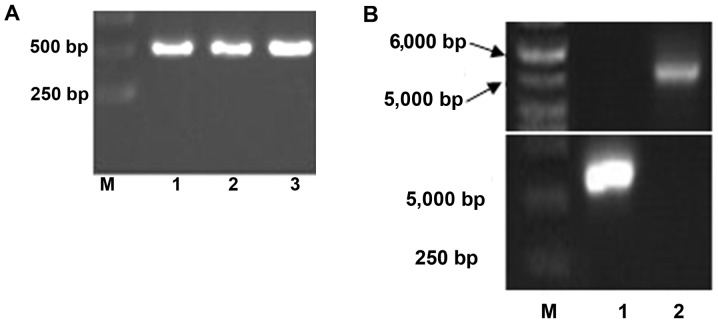
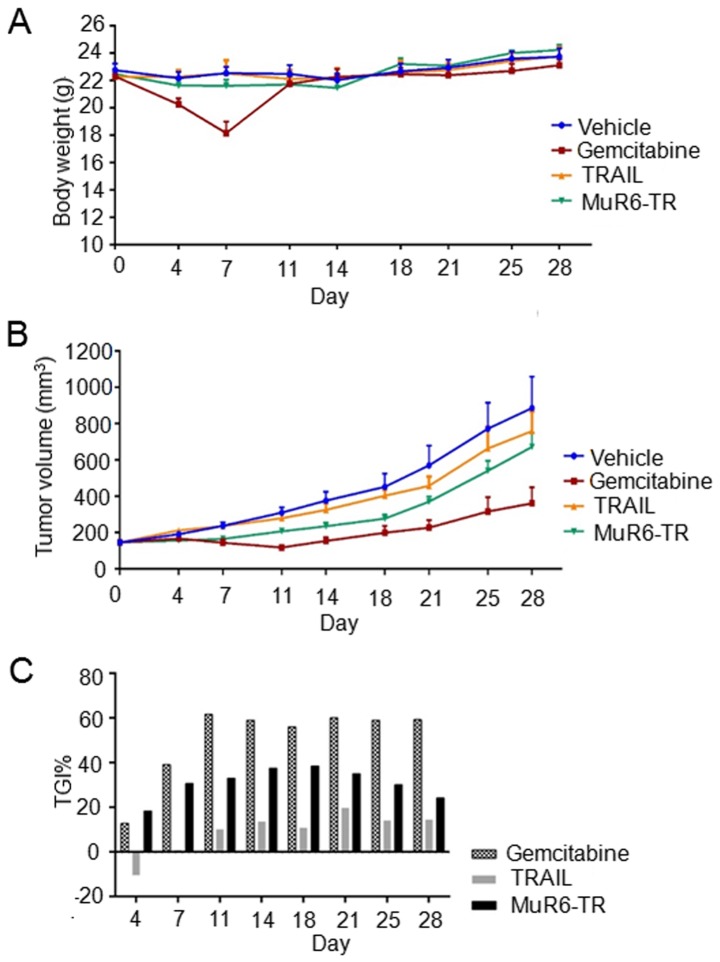
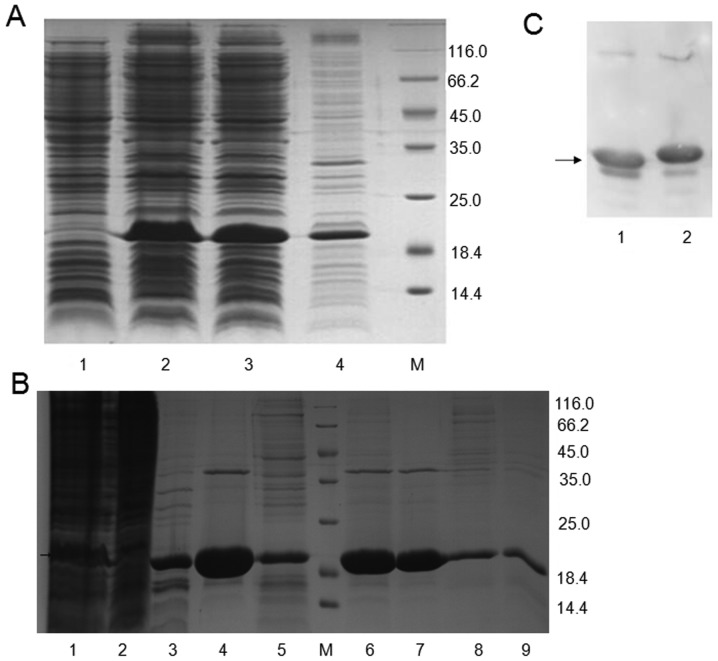
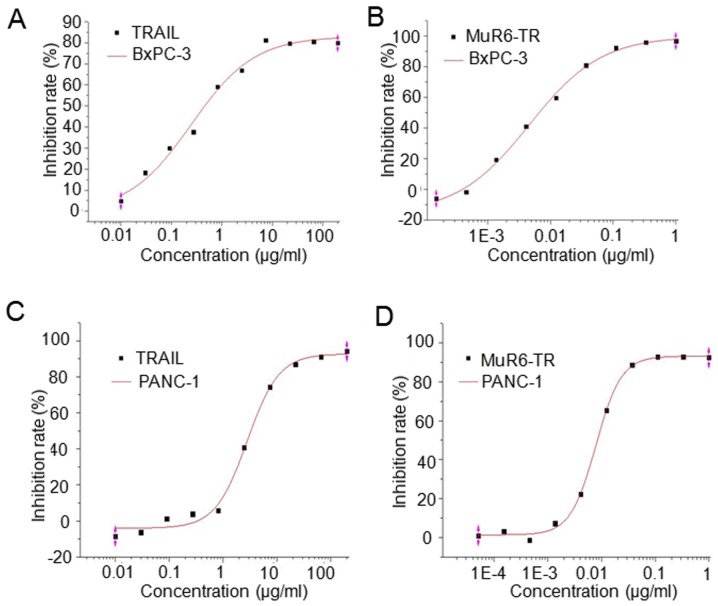
To remedy the drug resistance of natural tumor necrosis factor-related apoptosis-inducing ligand (TRAIL) and enhance its antitumor effects, we prepared a type of TRAIL mutant membrane penetrating peptide alike (TMPPA)‑TRAIL mutant R6 (MuR6-TR) by mutating the N‑terminal of the soluble TRAIL gene sequence. The expressed MuR6‑TR protein was purified to treat pancreatic carcinoma cell lines BxPC‑3 and PANC‑1. The inhibitory effects on the proliferation of BxPC‑3 and PANC‑1 cells was assessed with CCK‑8 assay and compared with natural TRAIL. The antitumor effect of MuR6‑TR was assessed on implant tumors derived from PANC‑1 cells in nude mice and compared with gemcitabine. Finally, the soluble MuR6‑TR gene was successfully mutated with 4 amino acids in the N‑terminal of TRAIL and had a molecular size of 513 bp. The mutant MuR6‑TR was connected to pET32a and verified by enzymatic digestion and sequencing. The recombinant MuR6‑TR was transformed and expressed in Escherichia coli. The CCK‑8 assay results indicated that MuR6‑TR inhibited the growth of BxPC‑3 and PANC‑1 cells in a dose‑dependent manner, with IC50 values of 4.63 and 7.84 ng/ml, respectively, which were much lower than that of natural TRAIL. MuR6‑TR demonstrated a higher inhibitory effect on tumor growth (24.2%) than natural TRAIL (14.4%) and an effect similar to that of gemcitabine at an early period. Thus, the mutant MuR6‑TR exhibited a stronger antitumor effect than that of natural TRAIL both in vivo and in vitro and may have potential therapeutic value for pancreatic carcinoma, which requires further validation.
为了弥补天然肿瘤坏死因子相关凋亡诱导配体(TRAIL)的耐药性并增强其抗肿瘤作用,我们通过对可溶性TRAIL基因序列的N端进行突变,制备了一种TRAIL突变体膜穿透肽类似物(TMPPA)-TRAIL突变体R6(MuR6-TR)。对表达的MuR6-TR蛋白进行纯化,用于处理胰腺癌细胞系BxPC-3和PANC-1。采用CCK-8法评估其对BxPC-3和PANC-1细胞增殖的抑制作用,并与天然TRAIL进行比较。在裸鼠体内评估MuR6-TR对源自PANC-1细胞的移植瘤的抗肿瘤作用,并与吉西他滨进行比较。最终,可溶性MuR6-TR基因在TRAIL的N端成功突变了4个氨基酸,分子大小为513 bp。将突变体MuR6-TR连接到pET32a上,并通过酶切和测序进行验证。重组MuR6-TR在大肠杆菌中进行转化和表达。CCK-8法检测结果表明,MuR6-TR以剂量依赖性方式抑制BxPC-3和PANC-1细胞的生长,IC50值分别为4.63和7.84 ng/ml,远低于天然TRAIL。MuR6-TR对肿瘤生长的抑制作用(24.2%)高于天然TRAIL(14.4%),且在早期与吉西他滨的作用相似。因此,突变体MuR6-TR在体内和体外均表现出比天然TRAIL更强的抗肿瘤作用,对胰腺癌可能具有潜在的治疗价值,这需要进一步验证。