Lafraia Fernanda M, Herbella Fernando A M, Kalluf Julia R, Patti Marco G
Department of Surgery, Escola Paulista de Medicina, Federal University of São Paulo, São Paulo, SP, Brazil.
Department of Surgery, University of North Carolina at Chapel Hill, Chapel Hill, USA.
Arq Bras Cir Dig. 2017 Jan-Mar;30(1):69-71. doi: 10.1590/0102-6720201700010019.
: High resolution manometry is the current technology used to the study of esophageal motility and is replacing conventional manometry in important centers for esophageal motility with parameters used on esophageal motility, following the Chicago Classification. This classification unifies high resolution manometry interpretation and classifies esophageal disorders.
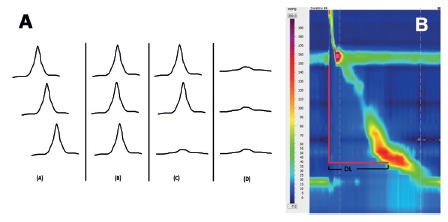
: This review shows, in a pictorial presentation, the new parameters established by the Chicago Classification, version 3.0, aimed to allow an easy comprehension and interpretation of high resolution manometry.
: Esophageal manometries performed by the authors were reviewed to select illustrative tracings representing Chicago Classification parameters.
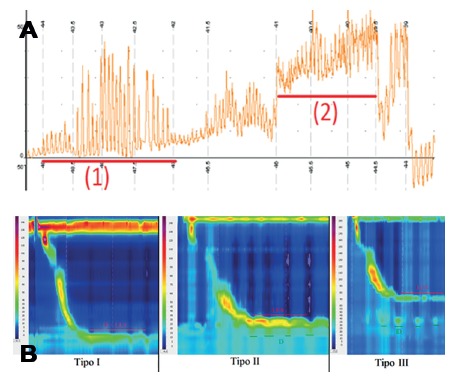
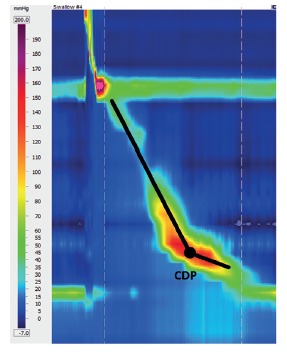
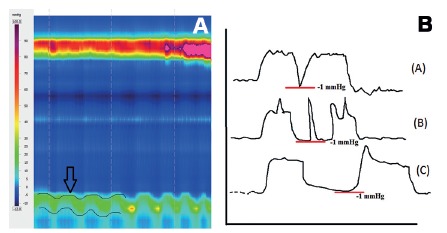
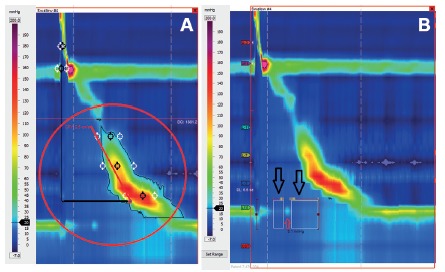
: The parameters are: Esophagogastric Morphology, that classifies this junction according to its physiology and anatomy; Integrated Relaxation Pressure, that measures the lower esophageal sphincter relaxation; Distal Contractile Integral, that evaluates the contraction vigor of each wave; and, Distal Latency, that measures the peristalsis velocity from the beginning of the swallow to the epiphrenic ampulla.
: Clinical applications of these new concepts is still under evaluation.
: Mostrar, de forma pictórica, os novos parâmetros compilados na versão 3.0 da Classificação de Chicago, buscando facilitar a compreensão e interpretação da manometria de alta resolução.
MÉTODOS:: Foram revistas as manometrias da casuística dos autores e selecionados os traçados representativos dos parâmetros da Classificação de Chicago.
: Entre os parâmetros apresentados foram considerados a Morfologia da Transição Gastroesofágica, que classifica o segmento de acordo com sua fisiologia e anatomia; a Integral da Pressão de Relaxamento, que mede o relaxamento do esfíncter esofagiano inferior; a Integral Contrátil Distal, que avalia o vigor contrátil da onda peristáltica; e, a Latência Distal, que mede o tempo da peristalse, desde o início da deglutição até a ampola epifrênica.
CONCLUSÃO:: A aplicabilidade clínica desses novos conceitos ainda está sendo estudada.
高分辨率测压法是目前用于研究食管动力的技术,在重要的食管动力研究中心,它正取代传统测压法,并采用芝加哥分类法中关于食管动力的参数。该分类法统一了高分辨率测压法的解释,并对食管疾病进行分类。
本综述以图示形式展示了芝加哥分类法3.0版确立的新参数,旨在便于理解和解释高分辨率测压法。
回顾作者进行的食管测压,以选择代表芝加哥分类法参数的典型描记图。
这些参数包括:食管胃形态,根据其生理和解剖结构对该连接处进行分类;综合松弛压,测量食管下括约肌的松弛情况;远端收缩积分,评估每一波的收缩强度;以及远端潜伏期,测量从吞咽开始到膈上壶腹的蠕动速度。
这些新概念的临床应用仍在评估中。
以图示形式展示芝加哥分类法3.0版编纂的新参数,以促进对高分辨率测压法的理解和解释。
回顾作者病例中的测压情况,并选择代表芝加哥分类法参数的描记图。
所呈现的参数包括胃食管移行部形态,根据其生理和解剖结构对该节段进行分类;松弛压力积分,测量食管下括约肌的松弛情况;远端收缩积分,评估蠕动波的收缩强度;以及远端潜伏期,测量从吞咽开始到膈上壶腹的蠕动时间。
这些新概念的临床适用性仍在研究中。